
Healthcare and pharma sit on the most sensitive data an enterprise holds, spread across CRM, ERP, clinical, and commercial systems. The obligation is not only to protect it but to prove the protection held: who was entitled to what, and that nothing else was ever read. A model that reasons over the data and then redacts the answer fails that test by construction.
Data AI agents for healthcare, where PHI is never read without authorization.
On patient and clinical data, masking the output is not enough, because the protected data was already read to produce it. Colrows enforces access at compile time, so an agent never touches data a user is not entitled to see.
01 · The pressure
Minimum necessary is a rule, not a setting.
HIPAA
Minimum necessary & PHI
Protected health information may be accessed only to the minimum necessary. That is an access decision, which has to happen before the data is read.
Auditability
Prove who saw what
Regulators and internal compliance need a verifiable record of every access, not a log to reconstruct by hand after an incident.
Data residency
Runs where the data lives
Clinical and commercial data often cannot leave a jurisdiction or a tenant. The query has to run in place, not ship the data out.
Consistency
One definition, every team
Field, marketing, and operations must not each carry their own version of a metric. Definitions live once in the graph.
02 · The architecture
Access decided before the data is read.
Colrows sits above your systems as a semantic execution layer. Every question, from a person or an agent, compiles into governed SQL with RBAC, ABAC, and row and column predicates injected before the plan runs. PHI a user is not entitled to is never part of the query, so there is nothing to mask on the way out.
Because it queries in place with a federated engine, data does not move to a third party. And because meaning is defined once in the graph, a prescriber, a brand, or a region resolves to the same entity across the CRM, ERP, and clinical sources, with every resolution written to an auditable trail.
The result is a system a commercial team can query in natural language while a compliance team can defend line by line: PHI governed before the query runs.
Mask output vs. compile-time
| PHI read, then redacted | PHI never read without authorization |
| Minimum-necessary as a filter | Minimum-necessary as structure |
| Data centralized to query | Federated, queried in place |
| Access logged after the fact | Every resolution auditable by design |
03 · Proof
Cipla, 8× data adoption across a fragmented estate.
Cipla ran 22,500+ field reps against data siloed across the Cirrius CRM, Oracle, and the ERP, where every new question became an IT ticket. Colrows deployed a semantic execution layer with a federated query engine and built analytics and reporting agents that reason across all three systems, governed and explainable, without moving the data.
8×
Increase in data adoption among business teams
>90%
Reduction in decision latency (days → minutes)
1000×
Faster campaign diagnosis
More on governed AI for healthcare.
HIPAA-Compliant AI Analytics: Governing PHI Before the Query Runs
On healthcare data, masking output is not enough. Compile-time governance means PHI is never read without authorization.
Read more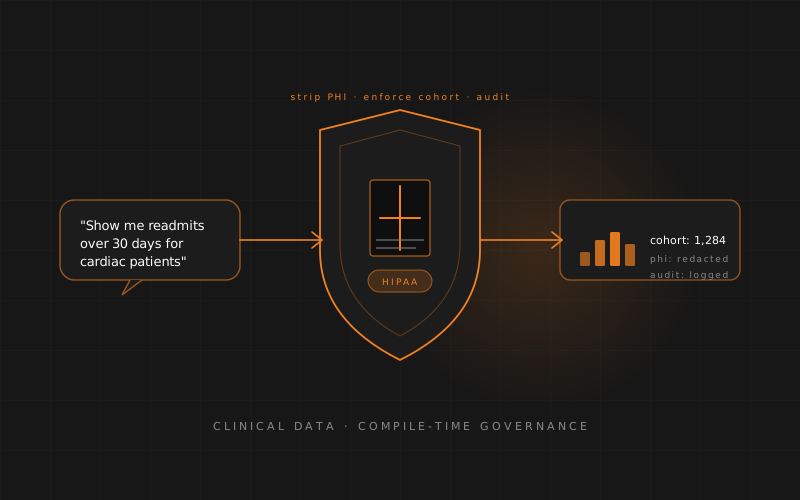
Conversational Analytics for Clinical Data: HIPAA-Compliant Architecture
Safely leveraging AI for data insights in a regulated, audit-heavy environment.
Read more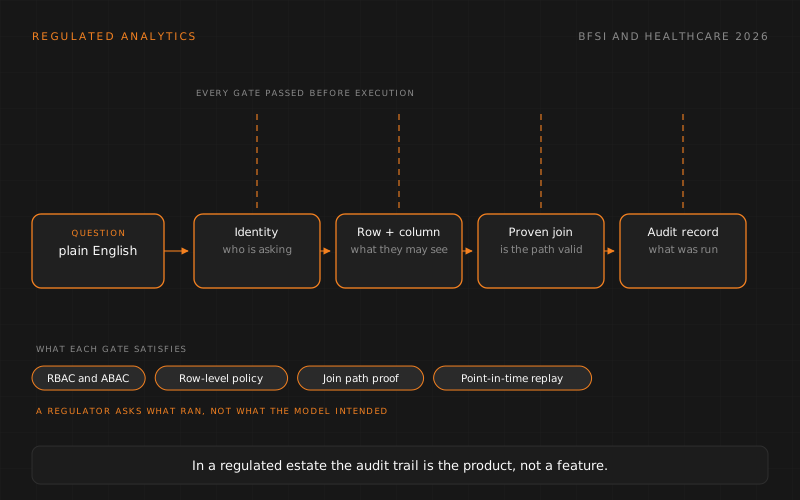
AI Analytics for Regulated Industries in 2026
There is no HIPAA certification for software, and the EU AI Act high-risk deadline moved. What that means.
Read moreQuestions from data leaders in healthcare.
Is masking PHI on the output enough for HIPAA?
No. Masking output means the protected data was still read to produce the answer. Colrows enforces access at compile time, so PHI is never read without authorization in the first place. The minimum-necessary principle is structural, not a filter applied after the fact.
Can a field team use natural language without exposing patient data?
Yes. A question in natural language compiles into governed SQL scoped to that user's entitlements. A commercial analyst sees aggregate prescriber trends; a clinical role with the right authorization sees more. The same graph enforces both, and every resolution is auditable.
Does Colrows move our clinical or commercial data?
No. Colrows runs in your own cloud and queries in place with a federated engine, so data does not move to a third party. At Cipla it federated across the CRM, Oracle, and the ERP without centralizing them into another store.
Governed agents on your most sensitive data.
Scope a fixed-scope deployment in your own cloud, with access decided before the query runs.