
A retailer's data problem is rarely storage. It is that thousands of stores, dozens of teams, and a stack of BI tools each carry their own version of a metric, and reconciling them consumes the very people who should be acting on them. Add a custom in-house system or two, and data management becomes a standing cost rather than an advantage.
Data AI agents for retail, so every store sees one number.
Retail runs on fast decisions across thousands of locations, and the fastest way to lose trust is two dashboards that disagree. Colrows gives every team governed, deterministic self-serve from one shared definition of the business.
01 · The pressure
Scale multiplies the cost of an inconsistent number.
Consistency
One number, every store
Sales, margin, and stock have to mean the same thing in every location and every report, or decisions stall in reconciliation.
Speed
Front-line, self-serve
Store and field staff need answers in the flow of work, in natural language or Slack, not a ticket to a central team.
Overhead
Retire the custom stack
Bespoke internal tools carry a maintenance tax. A governed platform can replace them, not sit beside them.
Federation
No migration tax
Consistency should not require consolidating every system into one warehouse first. Query the estate in place.
02 · The architecture
Define the metric once. Serve it everywhere.
Colrows sits above your databases and warehouses as a semantic execution layer. A metric is defined once in the graph, and every question, whether typed by a category manager or asked in Slack by a store lead, compiles against that one definition into governed SQL. Two teams cannot drift to two numbers, because there is only one definition to compile against.
Because it federates across the estate, you get that consistency without a migration project first. And because every question is governed and deterministic, self-serve scales to the front line without scaling risk: access is scoped per user, and the same question returns the same answer every time.
That is what lets a retailer push analytics out to thousands of locations instead of funneling every question through a central team: governed, deterministic self-serve across every store.
Dashboard sprawl vs. one graph
| Metric re-implemented per tool | Defined once in the graph |
| Stores see different numbers | One number, everywhere |
| Central team is the bottleneck | Front-line self-serve, governed |
| Consolidate before you query | Federated, queried in place |
03 · Proof
SSP Group, one platform in place of many.
SSP Group ran fragmented database tooling alongside a custom in-house front-line system the team had to maintain. Colrows replaced it with a single governed platform combining SQL, notebooks, conversational analytics, and Slack, retiring the custom system entirely rather than adding another tool beside it.
40%
Reduction in data management overhead
3×
Faster issue resolution for front-line staff
80%
Improvement in cross-team collaboration
More on governed AI for retail.
AI Analytics for Retail: Governed, Deterministic Self-Serve Across Every Store
Retail runs on fast decisions across thousands of locations. Proof from a 3,000-venue travel-retail deployment.
Read more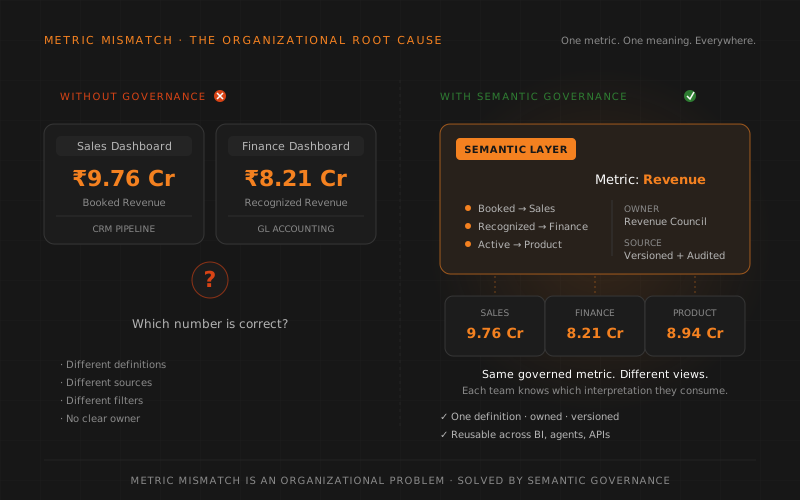
Why BI Metrics Don't Match Across Dashboards
The same metric, three numbers. Why it happens, and how a single semantic definition fixes it.
Read more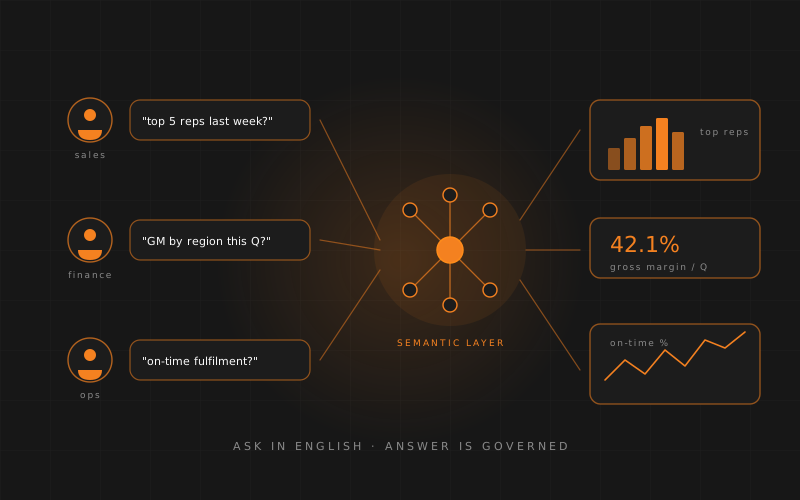
Self-Serve Analytics: Empowering Business Teams
Governed self-serve that scales to the front line without scaling risk.
Read moreQuestions from data leaders in retail.
Why do our dashboards show different numbers for the same metric?
Because each dashboard re-implements the metric in its own SQL. Colrows defines a metric once in the semantic graph, and every question compiles against that definition, so a store, a region, and head office all resolve the same number from the same logic.
Can front-line staff query without building dashboards?
Yes. Staff ask in natural language, or in Slack, and the question compiles into governed SQL scoped to their access. At SSP Group this replaced a custom in-house front-line system and cut issue-resolution time threefold.
Do we have to consolidate everything into one warehouse first?
No. Colrows queries across your existing databases and warehouses with a federated engine, so you get one consistent semantic layer without a migration project as the price of entry.
One number, every store, governed.
Scope a fixed-scope deployment against your own estate, no migration required first.