Prefer to read offline or share it internally? Download this analysis as a PDF.
Download the PDFTwo eras, two sets of requirements
The semantic layer is not a new idea. It was invented for business intelligence, and for that job it was designed well. A few hundred analysts asked a fairly stable set of questions. Dashboards changed slowly. Business definitions were revisited quarterly, not weekly. In that world, a team of engineers could author the semantic model by hand and keep it current, because the rate of change was human-scale.
- Hundreds of analysts
- Dashboards change slowly
- Definitions change rarely
- Manual curation is affordable
- Thousands of agents
- Agents generate dynamic, contextual questions beyond predefined paths
- Definitions change constantly
- Manual curation cannot keep up
AI changed the arithmetic. A semantic layer no longer serves hundreds of analysts clicking through curated dashboards. It serves thousands of AI agents that generate queries continuously, reason over enterprise knowledge, plan multi-step workflows, and act on what they conclude. Agents do not ask the same question twice, and they do not stay inside the paths someone modeled in advance.
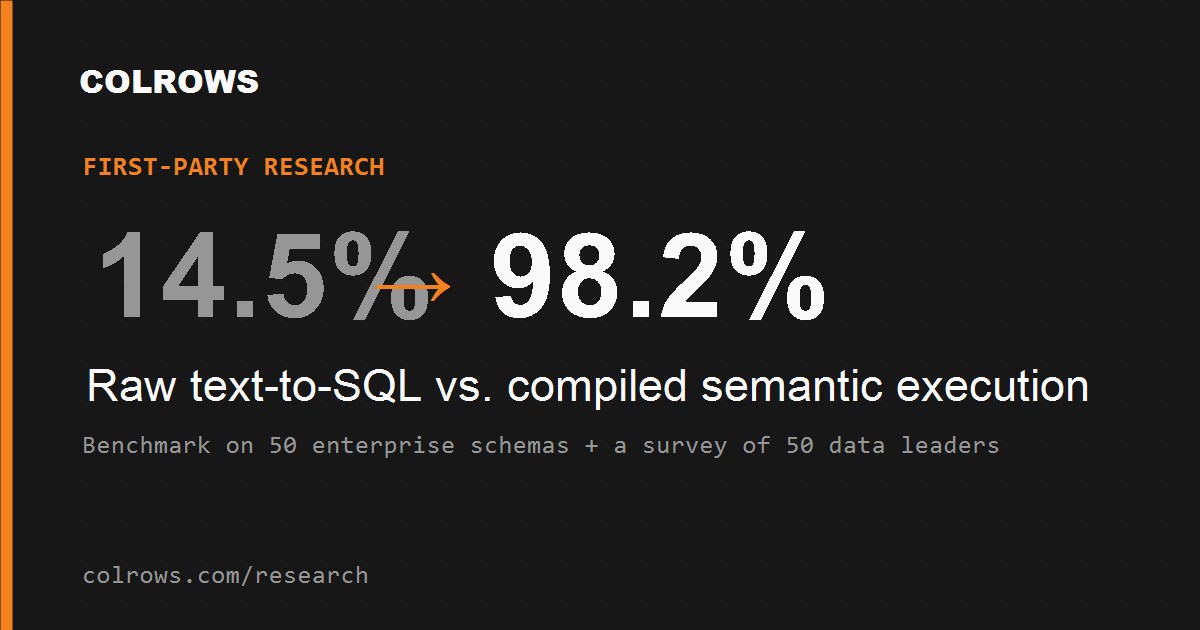
The evidence for why this matters is now independent of any vendor. On Spider 2.0, a benchmark built from realistic enterprise databases, frontier models answered as few as 6 to 17 percent of questions correctly when pointed straight at the warehouse. Working through a well-modeled semantic layer, the same class of models reached 98 to 100 percent (dbt Labs, April 2026). Gartner reached the same conclusion in May 2026: without semantic context, AI agents are far more likely to hallucinate and produce unreliable results. Our own first-party benchmark measured the same gap: 14.5% execution accuracy for raw text-to-SQL against 98.2% for compiled semantic execution, on identical queries.
The real problem is not building the model
Most discussions of semantic layers focus on the build: how expressive the modeling language is, how elegantly metrics are defined. Building a semantic model is a substantial engineering effort. Keeping it continuously aligned with reality is the larger and more enduring operational challenge.
An enterprise changes constantly, and every change is a small tax on the semantic layer: schemas evolve, tables appear, columns are renamed, business definitions shift, acquisitions bring entire estates with their own vocabulary, new applications land, dashboards multiply, dbt projects are refactored, user behaviour moves, and governance policies tighten. Each one is minor on its own. Together, in a company of any size, they arrive faster than any team can absorb them.
This is why semantic maintenance grows harder as organizations grow, not easier. The model that was accurate at launch decays quietly, and the larger the enterprise, the faster it decays.
Why every earlier semantic layer becomes static
This is not a criticism of any product. It is the lifecycle their architecture assumes:
In the BI era, this loop was perfectly acceptable. A dashboard was wrong for a week, someone raised a ticket, an engineer re-mapped the model, and the business moved on. Applied to enterprise AI, the same loop becomes operationally unsustainable: agents run continuously, the window between a change and its correction is a window of confident wrong answers at machine speed, and the queue of changes grows faster than the team clearing it. The architecture is not failing. It is doing exactly what it was designed to do, under conditions it was never designed for.
A different architecture: semantics that emerge from how the business works
Colrows starts from a different premise. Enterprise semantics should not be a document that people write and then maintain. They should emerge continuously from how the organization actually uses its data, and they should be governed and provable at the moment of execution.
- Databases (storage layer)
- Analytics dashboards
- Documents
- Data catalogs
- Confluence pages
- dbt models
- Lineage
- User feedback
adapts · enriches
governs
- Governed, reproducible answers
Colrows continuously acquires semantic knowledge from the sources an enterprise already has: databases provide the structural foundation of enterprise data; analytics dashboards show which definitions and metrics the business relies on; documents and Confluence pages carry the meaning written for humans; data catalogs supply governed metadata; dbt models and lineage encode the transformations the data team has already agreed on; and user feedback settles ambiguity. Manually authored metadata is one input among many, not the only source of truth.
What this creates over time is the real asset: an enterprise semantic memory. Not metadata, and not a model someone wrote, but a durable record of how the business actually thinks: how it measures, joins, filters, and governs information, with every definition carrying the evidence it was learned from. A fragment of that memory looks like this:
The result is not a static artifact. The Colrows semantic graph is a living system that learns from new signals, validates definitions against real usage, adapts as schemas and meanings move, enriches itself with relationships and join paths as it observes them, and governs every answer it produces. This is what an Autonomous Semantic Layer means in practice, and it is why schema drift is a non-event rather than a project: drift is detected from the signals themselves and the graph repairs itself, consulting a human only where a genuine business decision is required.
The same property makes Colrows unusually comfortable with legacy schemas. Because meaning is learned from usage, lineage, and documentation rather than from tidy naming, decades-old systems with cryptic column names can stay exactly as they are. No renaming programme is needed before AI becomes useful.
Requirements that only exist in the AI agent era
Colrows was designed around requirements that did not exist when earlier semantic layers were architected. In the BI era, none of these were requirements. Agents made all six unavoidable.
From a layer to an operating system
This shift also changes what the category is. During the BI era, semantic layers sat between dashboards and databases: useful, but peripheral. During the AI era, semantic intelligence becomes the operating system through which every AI agent understands enterprise knowledge. Every agent that queries, reasons, plans, or acts does so through it. That is no longer a reporting convenience. It is core enterprise architecture.
Four architectural generations
The clearest way to compare the market is not feature by feature, but by the architectural philosophy each product represents. Each is well built for the assumptions it was designed around. (For feature-level head-to-heads, see the platform comparison hub and the Semantic Layer Buyer's Guide.)
| Architecture | Representative product | What it assumes |
|---|---|---|
| AI-generated query assistant | Databricks Genie | No lasting semantic model. An LLM writes SQL at query time from catalog metadata and curated hints. Fast to start; Databricks documents that the same question can return different answers. |
| Human-curated semantic model | ThoughtSpot | A governed model defined and verified by people. Accurate and well governed where the data is well modeled and the model is kept current by a team. |
| Ontology-driven semantic layer | Timbr.ai | A SQL knowledge graph with inheritance and inference across sources. Rich modelling; the ontology and its mappings are authored and maintained by people. |
| Continuous semantic intelligence | Colrows | A semantic graph that acquires meaning from operational signals, adapts as the business changes, and compiles every answer deterministically under compile-time governance. |
Databricks Genie is the strongest choice for an estate standardized entirely on Databricks: nothing to install, governance inherited from Unity Catalog, no separate licence. It sees only Databricks, its SQL is generated probabilistically at query time, and it stays accurate through continuous human curation of instructions and examples. Read the full head-to-head: Colrows vs Databricks Genie.
ThoughtSpot brings a mature, human-verified semantic model and a strong security layer, and was named a Leader in the 2026 Gartner Magic Quadrant for Analytics and BI. Its architecture reflects the assumptions of the business intelligence era, where semantic models were primarily authored and maintained manually: third-party analyses typically budget half to one full-time person for model upkeep, and its own documentation has historically measured accuracy near 80 percent on small, clean models and near 60 percent on complex ones. Read the full head-to-head: Colrows vs ThoughtSpot.
Timbr.ai is a thoughtful ontology product with genuine depth: inheritance, inference, and graph traversal in standard SQL, across sources, without moving data. Founded in 2018, its architecture also reflects the assumptions of the BI era, where semantic models were authored and maintained by hand. Its mapping assistance is semi-automatic, and its published documentation describes no mechanism for detecting schema drift or semantic decay on its own. That is an architectural optimization for a different set of operating conditions, not a defect.
Enterprise AI will not be limited by model intelligence.
It will be limited by semantic intelligence.
The organizations that succeed will not simply have semantic layers. They will have semantic systems that continuously learn, adapt, and govern enterprise knowledge as the business evolves. Colrows was designed from the ground up for that future.
As foundation models converge in capability, continuous semantic intelligence becomes the enduring competitive advantage of the enterprise.
Every Colrows capability described here can be demonstrated live against your own schemas, including your oldest ones. To arrange a working session, write to engage@colrows.com.
Frequently asked questions
Why do AI agents need a different semantic layer than BI analysts?
BI-era semantic layers served a few hundred analysts asking a fairly stable set of questions, so a team could author the model by hand and keep it current. AI agents changed the arithmetic: thousands of agents generate queries continuously, ask dynamic contextual questions beyond predefined paths, and never stay inside the paths someone modeled in advance. Definitions change constantly, and manual curation cannot keep up.
What are the four architectural generations of semantic layers?
AI-generated query assistants (Databricks Genie), where an LLM writes SQL at query time from catalog metadata; human-curated semantic models (ThoughtSpot), governed models defined and verified by people; ontology-driven semantic layers (Timbr.ai), SQL knowledge graphs whose ontologies and mappings are authored and maintained by people; and continuous semantic intelligence (Colrows), a semantic graph that acquires meaning from operational signals, adapts as the business changes, and compiles every answer deterministically under compile-time governance.
What is continuous semantic intelligence?
Semantics that emerge continuously from how the organization actually uses its data, rather than a document people write and maintain. Colrows acquires semantic knowledge from databases, dashboards, documents, data catalogs, Confluence pages, dbt models, lineage, and user feedback, then learns, validates, adapts, enriches, and governs its semantic graph as the business changes.
How does Colrows handle schema drift?
Drift is detected from the operational signals themselves and the semantic graph repairs itself, consulting a human only where a genuine business decision is required. Schema drift becomes a non-event rather than a project.
Does Colrows require renaming or restructuring legacy schemas?
No. Because meaning is learned from usage, lineage, and documentation rather than from tidy naming, decades-old systems with cryptic column names can stay exactly as they are. No renaming programme is needed before AI becomes useful.
Selected sources
- Spider 2.0 enterprise benchmark: Lei et al., ICLR 2025, arXiv:2411.07763. Accessed July 15, 2026.
- dbt Labs, Semantic Layer vs. Text-to-SQL: 2026 Benchmark Update, dbt Developer Blog, April 7, 2026.
- data.world knowledge graph study, arXiv:2311.07509; BEAVER enterprise benchmark, arXiv:2409.02038; Cube paired benchmark, arXiv:2604.25149.
- Gartner press release, May 11, 2026: Lack of Semantics Causes Inaccurate AI Agents and Wasted Spending.
- Databricks Genie documentation (overview, best practices, talk-to-genie, troubleshooting), docs.databricks.com and learn.microsoft.com. Accessed July 15, 2026.
- ThoughtSpot documentation (semantic-layer, search-sage, security, consumption-pricing), docs.thoughtspot.com; 2026 Gartner Magic Quadrant announcement, GlobeNewswire, July 1, 2026. Accessed July 15, 2026.
- Timbr.ai documentation (platform, intro-timbr, data-mapper), docs.timbr.ai and timbr.ai; founding year per PitchBook company profile. Accessed July 15, 2026.
Statements about ThoughtSpot, Timbr.ai, and Databricks Genie reflect vendor documentation and public sources as of July 15, 2026 and may change as those products evolve. Product names and trademarks belong to their respective owners.