Finding knowledge vs governing the answer
| Dimension | Retrieval-based knowledge management | Governed knowledge execution |
|---|---|---|
| Finds the document | Yes | Yes |
| Governs who may see it | Applied after retrieval, if at all | Applied before the answer is built |
| Answer quality | A model summarises what it fetched | Compiled from a typed knowledge graph |
| Auditability | Partial, the sources but not the reasoning | Point-in-time reproducible |
The left column describes almost every tool ranked for this term. The right column is what an AI agent needs before it acts unattended. Our company brain hub covers the architecture the right column depends on.
What AI knowledge management means in 2026
AI knowledge management is the use of AI to capture, organise, find, and act on what an organisation collectively knows. The definition is not the interesting part. The interesting part is the shift in how teams build it.
The 2026 consensus is to stop migrating everything into one store. Leave documents where they live, connect them, and place an intelligence layer on top. Modern systems also capture knowledge passively, from resolved tickets and agent conversations, so sharing becomes a byproduct of work rather than a separate chore. Both moves are sound, and both address the same first problem: the raw material is a mess.
The numbers say why. Between 80 and 90 percent of enterprise knowledge is unstructured, trapped in documents, email, chat, and recordings. Gartner reports that 57 percent of organisations estimate their data is not AI-ready. IBM finds 82 percent of enterprises hit workflow disruptions from siloed data.
An orchestration layer connects that mess, and connecting is the easy part. It does not, on its own, make the knowledge safe to act on. Exposing a silo to an agent is not the same as deciding whether the agent should reach it. That decision is the governance most tools defer. We covered the capture half in capturing tacit knowledge at scale.
The five approaches, scored
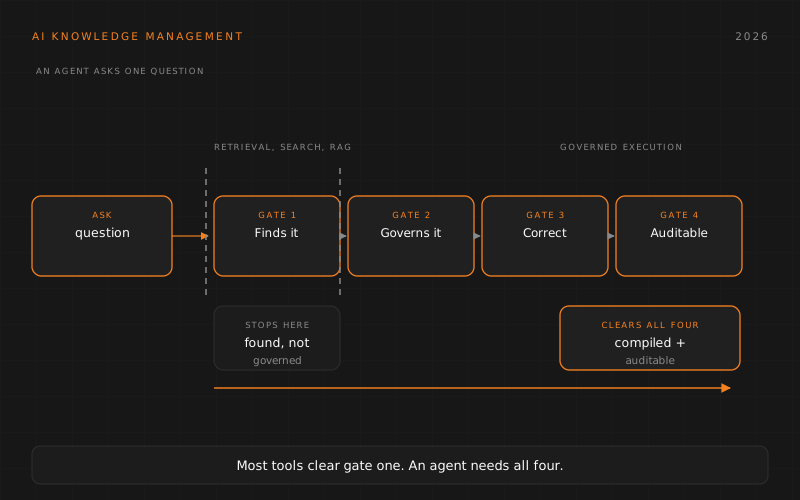
Scored on four questions. Does it find the knowledge, govern the answer, produce a correct-by-construction result, and leave an auditable trail. Directional, not lab numbers.
| Approach | Finds knowledge | Governs the answer | Correct by construction | Auditable |
|---|---|---|---|---|
| Governed semantic execution | Yes | Before execution | Yes | Point-in-time |
| Knowledge orchestration layer | Yes | At query time | No | Partial |
| Knowledge graph | Yes | Depends on the query engine | No | Partial |
| RAG and document retrieval | Yes | At query time, if configured | No | Sources only |
| Enterprise search | Yes | No | No | No |
Fix the Context, Not the Model. A well-governed semantic layer that understands business context creates more reliable AI-driven analytics than fine-tuning the model itself. Knowledge management is the same problem wearing a different name. The reliability comes from governing the context an agent can reach, not from a smarter summariser on top of the same messy documents.
Where retrieval stops short
Finding is not using. Enterprise search and RAG both answer the question "where is the relevant text?" A person then reads it and decides. An AI agent has no reading step. It acts on whatever the retriever returned, which turns a good-enough search result into a wrong action.
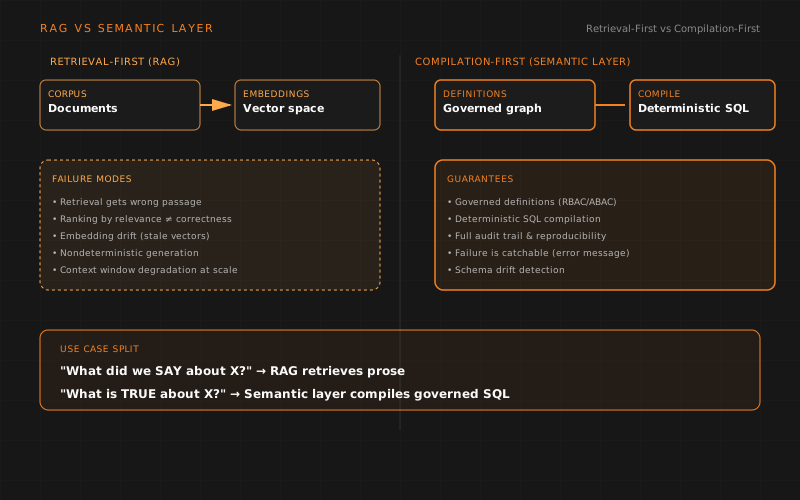
Summarising is not computing. A model handed three documents produces a fluent summary. Ask it for a number that spans those documents, and the model estimates rather than computes. For a knowledge base of policies or definitions, an estimated answer is a wrong answer delivered confidently. We set out that failure in RAG vs the semantic layer.
Retrieval has no memory of what it is entitled to. Most retrieval stacks filter permissions after fetching, or trust the caller. A governed layer resolves identity first and never builds an answer the caller was not allowed to receive. Data catalogues cannot execute AI agents covers why the catalogue that documents knowledge is not the thing that governs its use.
Why the gap suddenly matters
Enterprise knowledge management has been imperfect for decades, and the business survived. The retrieved document was usually close enough, because a person read it and caught the gaps. Findable was enough because a human did the governing, the sense-checking, and the arithmetic in their head.
Agents removed that human. An AI agent does not read the retrieved passage and pause. It acts on the passage, at machine speed, across more of the knowledge base than any person would open in a day. The tolerance that made loose knowledge management acceptable disappears the moment the reader is software. A wrong document that a person would have caught becomes a wrong action nobody reviewed.
The same architecture debate playing out in analytics is now playing out in knowledge management. A governed layer resolves intent and proves the answer before returning it. That is the difference between an agent that helps and one that confidently acts on the wrong thing. We set out the mechanics in governing AI agents that query enterprise data. The definitional foundation sits in what a semantic layer is.
From knowledge management to a company brain
The approach that clears all four gates is the one that treats knowledge as something to compile rather than retrieve. A company brain holds definitions, relationships, and policies in a typed, governed graph. A company brain is the modelled version of what your organisation knows, rather than a pile of documents about it. When a person or agent asks a question, the brain resolves the intent against that graph. It applies access rules before an answer exists, and returns a result that reproduces on demand.
A company brain offers a different guarantee from a better search box. Search makes knowledge findable. A company brain makes knowledge usable by software that acts without supervision, which is the real requirement once agents enter the workflow. The recall side lives in the enterprise memory graph. The shift from passive stores to active knowledge runs through from metric stores to knowledge machines.
What to require of an AI knowledge management system
- Ask when governance runs. Before the answer exists, or after retrieval. Only the first is safe for unattended agents.
- Ask whether the system computes the answer or summarises it. A summary of documents is not a governed number.
- Ask whether the same question reproduces. If the answer drifts between runs, no audit can rely on it.
- Ask what the audit record contains. The sources it retrieved, or the exact answer and the steps that produced it.
- Ask who the agent is. An agent inheriting a broad human role can reach knowledge the person never opened.
Most tools ranked for this term answer the first question with "after retrieval." They answer the rest with "no." That is fine for helping an employee find a document. An agent acting on your behalf needs more. The right question at a demo is not how much it can find. It is how much of what it finds you can trust it to act on unread.
A note on the claims
The data-readiness and unstructured-data figures come from Gartner and IBM as reported in 2026 industry coverage, and are directional rather than audited. The scoring reflects how each approach works by design, not a rating of any single vendor. Colrows sells a governed semantic execution layer, and we wrote the sections above with that disclosed. We review this page quarterly.
The two retrieval approaches in that row are pulled apart in RAG vs semantic search.
Frequently asked questions
What is AI knowledge management?
AI knowledge management uses AI to capture, organise, find, and act on what an organisation collectively knows. People and AI systems then get accurate answers without hunting through scattered systems. The 2026 shift leaves documents where they are, connects them, and puts an intelligence layer on top instead of migrating everything into one store. The harder half, which most tools skip, is governing what that intelligence may answer.
Why do AI knowledge management projects fail?
Usually because the knowledge foundation was never AI-ready. Gartner reports 57 percent of organisations estimate their data is not ready for AI. IBM finds 82 percent hit workflow disruptions from siloed data, and 80 to 90 percent of enterprise knowledge is unstructured. Retrieval on that foundation surfaces plausible text. It cannot guarantee the answer is correct, or that the caller had the right to see it.
Is AI knowledge management the same as RAG?
No. RAG, or retrieval-augmented generation, is one technique inside AI knowledge management. It fetches relevant documents and lets a model summarise them, which makes knowledge findable. RAG does not govern access before the query runs, prove that a computed answer is correct, or leave a reproducible audit trail. RAG is a retrieval method; governed knowledge management is an execution guarantee.
What does AI knowledge management need to be safe for AI agents?
Four things a human reader used to supply alone. Identity resolution, so the agent sees only what its caller may see. Governance that runs before the answer exists, not after. A correct-by-construction result rather than a summarised guess. And an audit record that reproduces the exact answer later. A governed semantic layer supplies all four, which is why a company brain is the safe substrate for agentic work.