The short answer, in one table
| Dimension | Semantic search | RAG | Semantic execution layer |
|---|---|---|---|
| What it returns | Ranked passages | Generated prose | A computed result |
| What it reads | Unstructured text | Unstructured text | Governed structured data |
| Correct by construction | No, ranked by similarity | No, summarised by a model | Yes, join path proven |
| Access enforced | At index or filter time | Around retrieval | Before the query runs |
| Best for | Find the source | Explain the sources | Answer with a number |
Read the last row first. It is the one that decides your architecture, and it is the row the other comparisons leave out. More of this reasoning sits in our comparisons hub.
What semantic search actually does
Semantic search retrieves by meaning instead of by keyword. It converts documents into vectors, converts your question into a vector, and returns the chunks that sit closest in that space.
The gain is real. Ask for "time off policy" and you get the document titled "Leave and Absence Guidelines", which keyword search would miss. Synonyms, paraphrases, and clumsy phrasing stop mattering.
What it returns, though, is a ranked list. Semantic search does not write an answer. It does not reconcile two documents that disagree. It ranks by similarity, and similarity is not correctness: the passage closest in vector space can still be the outdated version of the policy. The reader supplies the judgement.
What RAG adds, and what it does not
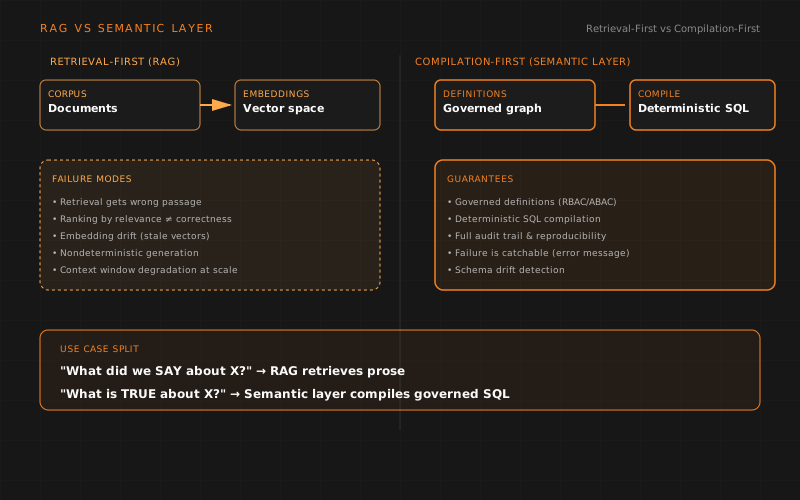
RAG, retrieval-augmented generation, bolts a language model onto the end of that pipeline. It retrieves the relevant chunks, feeds them to the model as context, and the model writes an answer.
This is why the two get compared at all. In most stacks semantic search is the retrieval step inside RAG, so they are not really rivals. RAG is a system; semantic search is a component of it.
What RAG adds is synthesis. It reads across five documents and gives you a paragraph instead of five links. What it does not add is any guarantee that the paragraph is right. The model writes fluent prose whether or not the retrieved chunks support it. A confident wrong answer is more dangerous than an empty result. We covered the failure modes in RAG vs semantic layer, which takes the architecture question further than this page does.
Vector search, semantic search, hybrid search
Three terms get used interchangeably, and the sloppiness causes real architecture mistakes.
Vector search is the mechanism. You embed text as numbers and find nearest neighbours in that space. Semantic search is the outcome you want: retrieval by meaning. Vector search is the usual way to get there, so people say both words for the same thing.
Hybrid search blends vector similarity with old-fashioned keyword matching. It exists because pure vector search is weak at exact tokens. Product codes, error numbers, and surnames are precisely the things a similarity score smooths over. Most serious production systems run hybrid rather than pure vector.
None of the three changes the ceiling. Vector, keyword, or hybrid, you are still ranking text that already exists. The retrieval quality improves. The class of answerable question does not. That ceiling is what the next section is about, and it is the same ceiling we mapped in the enterprise memory graph.
The question neither one can answer
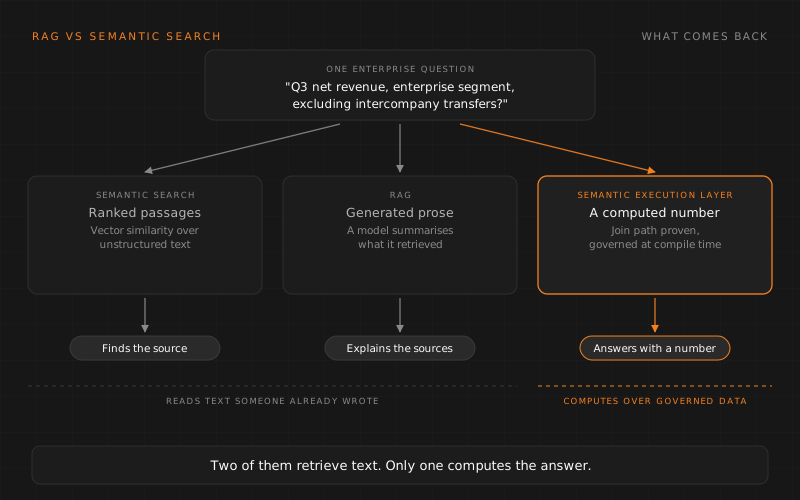
Ask either system: "What was net revenue for the enterprise segment in Q3, excluding intercompany transfers?"
Semantic search returns the quarterly report. RAG returns a paragraph about the quarterly report. Neither returns the number, because neither computes anything. Both read text that someone already wrote.
That question needs a join across tables, a filter on segment and period, an exclusion rule, and an aggregation. It is arithmetic over governed structured data. Retrieval is the wrong instrument, and no amount of prompt engineering converts one into the other.
The accuracy gap is measurable. Our first-party benchmark put raw text-to-SQL generation at 14.5 percent execution accuracy. A governed semantic compiler reached 98.2 percent on the same questions. Join-path hallucination in the raw case ran at 80 percent.
Governance splits the same way. Both retrieval approaches filter the index or post-filter the chunks, so access control happens around retrieval. A governed layer applies role, row, and column rules at compile time, so an answer the caller may not see is never built. That distinction is the subject of governing AI agents that query enterprise data.
Fix the Context, Not the Model. A well-governed semantic layer that understands business context creates more reliable AI-driven analytics than fine-tuning the model itself. Swapping in a larger model does not teach it your join paths.
Three questions, three architectures
Route by what the answer has to be, not by which technology is fashionable.
| If the user needs | Use | Why |
|---|---|---|
| To find and read the source | Semantic search | The document is the answer. Summarising it adds risk. |
| An explanation across documents | RAG | Synthesis is the value, and prose is acceptable. |
| A number they will act on | Semantic execution layer | The answer must be computed, governed, and reproducible. |
Most enterprises need all three, which is why the useful question is routing, not replacement. We draw a related distinction, graphs against layers, in semantic layer vs knowledge graph.
How the three stack
They compose cleanly when each keeps its own job.
Semantic search indexes the unstructured corpus: policies, contracts, tickets, transcripts. RAG sits on that index for questions whose answer is genuinely prose. A semantic execution layer sits over the warehouse and answers anything numeric, compiling intent into dialect-perfect SQL with the join path proven before execution.
A router in front decides which path a question takes. Get that routing wrong and you get the classic failure. A language model estimates a revenue figure from a PDF, because nobody wired up the numeric path. We take the compile step apart in what is a semantic compiler. The definitional groundwork sits in what a semantic layer is.
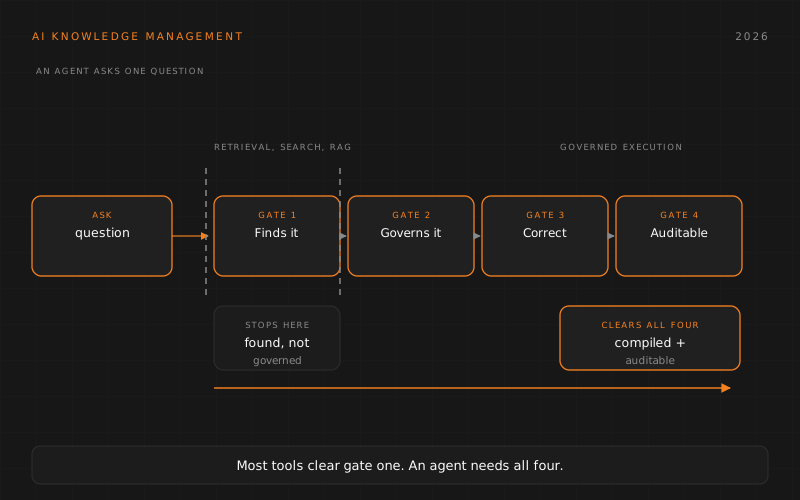
Where the retrieved and the computed meet is the wider category question, which we scored across five approaches in AI knowledge management.
Why "just use a bigger model" fails here
Teams usually try the model first. It is the cheapest thing to change.
The benchmarks do not support it. On Spider 1.0, a clean academic schema, GPT-4o reached 86.6 percent. On Spider 2.0, which uses real enterprise schemas with hundreds of columns and genuine business logic, the same model reached 10.1 percent. The model did not get worse. The schema got real.
That collapse is a context problem, not a reasoning problem. The model has no way to know which of your four revenue columns is the one finance signs off on. Only a curated semantic layer carries that. We took the mechanism apart in why text-to-SQL accuracy drops on real schemas and compared the two philosophies in deterministic vs probabilistic text-to-SQL.
Where Colrows fits, and where it does not
Colrows is a semantic execution layer. It is the third column, not a replacement for the first two.
It does not index your contracts, and it will not summarise a policy document. If your users need to find and read a source, use semantic search. If they want prose assembled from several documents, use RAG.
Colrows takes the questions the other two answer badly: the numeric, governed, auditable ones. It resolves intent against a versioned semantic graph, proves the join path, applies role and row-level rules at compile time, and emits dialect-perfect SQL. The answer reproduces point-in-time, which is what makes it defensible in an audit rather than merely plausible.
Frequently asked questions
What is the difference between RAG and semantic search?
Semantic search is a retrieval method. It converts your question and your documents into vectors, then returns the passages whose meaning sits closest to the question. RAG adds a second step: it takes those retrieved passages and passes them to a language model, which writes an answer in prose. Semantic search hands you the sources. RAG hands you a summary of the sources. RAG almost always contains semantic search inside it.
Is semantic search part of RAG?
Usually yes. The R in RAG is retrieval, and semantic search is the most common way to do that retrieval. A RAG pipeline embeds your documents, runs a vector similarity search to find the relevant chunks, then generates an answer from them. You can build RAG on keyword search instead, and many production systems blend both. But in most 2026 stacks, semantic search is the retrieval engine that RAG sits on top of.
Which is better, RAG or semantic search?
Neither is better in general; they answer different questions. Use semantic search when the user needs to find and read the source, such as a policy, a contract clause, or a past ticket. Use RAG when the user wants a direct written answer assembled from several documents. Use neither when the answer is a number that has to be correct, because both read unstructured text and neither computes.
Can RAG answer questions about structured data?
Not reliably. RAG retrieves text and lets a model summarise it. Suppose the answer needs a join across tables, a date filter, and an aggregated measure. The model then estimates from whatever fragments it fetched. It does not compute the result. Our first-party benchmark measured raw text-to-SQL generation at 14.5 percent execution accuracy against a governed semantic compiler at 98.2 percent. For numeric questions, use a semantic layer that compiles the query.
Do RAG and semantic search enforce permissions?
Only if you build that yourself, and usually at the wrong moment. Both typically filter the index, or post-filter the retrieved chunks. They apply access around retrieval, not before the answer exists. A governed semantic layer applies role and row-level rules at compile time. It never builds an unauthorised result in the first place, and every answer leaves a reproducible audit record.