OLAP semantic layer vs semantic execution layer
AtScale intercepts BI queries and resolves them against multidimensional cubes with aggregate awareness. A semantic execution layer resolves meaning, proves the join path, and enforces policy at compile time, then emits governed SQL for an agent.
| Dimension | AtScale (OLAP semantic layer) | Colrows (semantic execution layer) |
|---|---|---|
| Core model | Multidimensional (OLAP) cubes, aggregate-aware | Typed semantic graph, continuously maintained |
| Primary consumer | Human analysts via Excel, Power BI, Tableau (MDX/DAX) | AI agents and autonomous workflows |
| Logic resolution | Query interception against cubes | Compile-time SQL generation with join path proof |
| Governance | Role-based, applied at query time | Compile-time RBAC + ABAC + row/column predicates |
| Maintenance | High: heavy semantic modeling and aggregate design | Low: schema-driven, self-healing graph |
What AtScale does well
- Aggregate awareness. AtScale's defining strength is performance: it maintains and routes to aggregates so BI queries over billions of rows stay fast.
- BI-tool integration. Live MDX and DAX connectivity means Excel pivot tables, Power BI, and Tableau all query the same governed model.
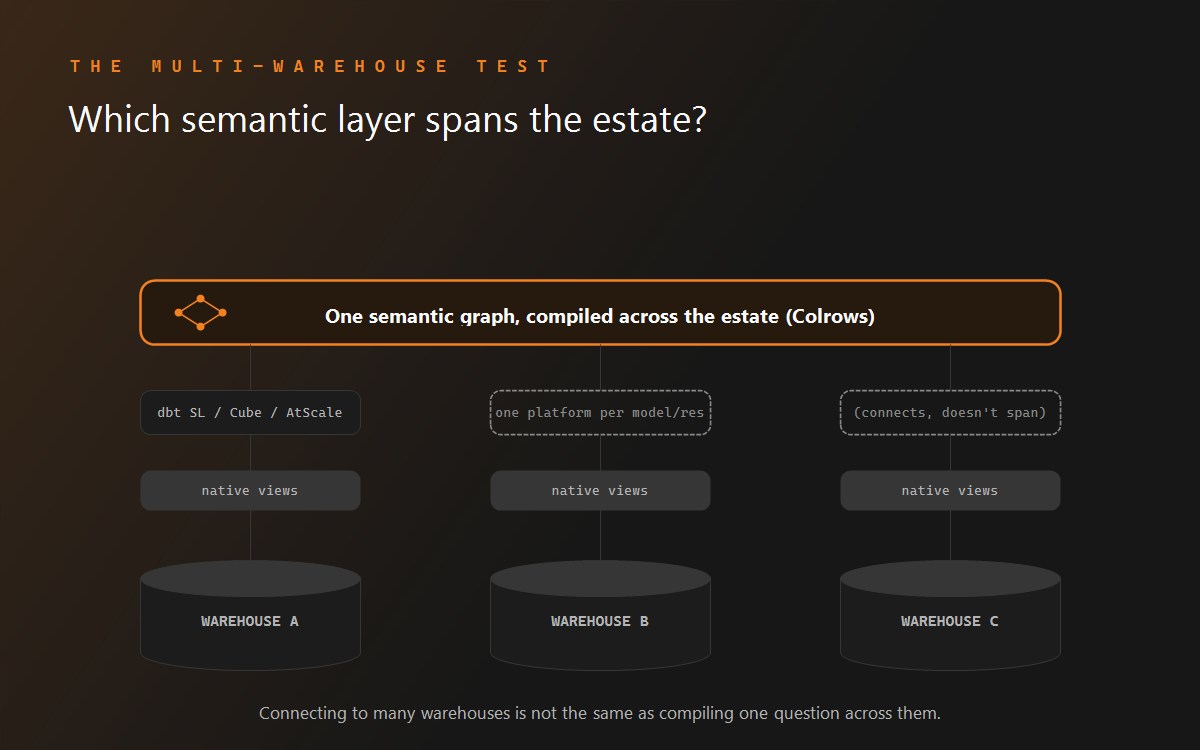
- Universal semantic layer. One model spans multiple back-ends and presents consistent dimensions and measures to every BI consumer.
- Enterprise track record. AtScale is a mature product with deployments in large, aggregate-heavy BI environments.
If your consumers are BI tools that need fast, live aggregates over huge data, AtScale is purpose-built. The question is what happens when the consumer becomes an AI agent.
Where AtScale gets stretched for AI agents
- Cube-first, human-first. AtScale's intelligence lives in OLAP cube definitions built for dashboards. Agents need entities, relationships, and policies in a typed graph, not cube traversal.
- Heavy modeling and maintenance. Multidimensional modeling and aggregate design are ongoing, specialist work. That is a cost and a drift risk on a fast-changing estate.
- AI is retrofitted via API. Natural-language and AI features sit on top of the cube model, not a compile-then-execute pipeline that proves the query before it runs.
- Limited multi-hop reasoning. Cube traversal is bounded by the modeled dimensions. Graph traversal across arbitrary entities is not the native shape.
AtScale is not wrong. It is an OLAP BI layer, not an agent execution layer. For the deeper contrast, see Colrows vs AtScale and semantic layer vs knowledge graph.
Fix the Context, Not the Model. An agent bolted onto an OLAP cube inherits the cube's boundaries. Reliability comes from a governed semantic layer that resolves meaning and proves the query, not from a larger model on top.
The AtScale alternatives, by job to be done
1. Colrows - for governed, multi-warehouse AI agents
Colrows is a compile-time semantic execution layer built agent-first. It compiles intent through a typed semantic graph into deterministic, dialect-perfect SQL across 16+ engines, proves join paths, and enforces RBAC, ABAC, and row/column policy before any query touches the warehouse. Where AtScale routes BI queries to aggregates, Colrows governs and compiles agent intent. Best fit for autonomous agents that need reproducibility and compile-time governance.
2. Cube - for headless, open-source metric APIs
Cube exposes governed metrics over SQL, REST, GraphQL, and MDX, with an open-source core. It is lighter than AtScale to run and strongest for embedded analytics and high-volume metric serving. It is still human-first, with hand-authored models.
3. dbt Semantic Layer (MetricFlow) - for code-first metrics
The dbt Semantic Layer defines metrics in version-controlled code and generates SQL for Snowflake, BigQuery, Databricks, and Redshift. Ideal for dbt-native teams. Requires dbt Cloud. See the dbt pricing teardown.
4. Looker (LookML) - for BI-native governed modeling
Looker's LookML is a governed modeling layer inside Google Cloud, strong for human BI and embedded analytics. See Looker alternatives.
5. Snowflake Cortex Analyst - for Snowflake-only self-serve
Cortex Analyst is fast warehouse-native text-to-SQL, but Snowflake-only and governs after generation.
6. Databricks Genie - for Databricks-only conversational BI
Databricks Genie inherits Unity Catalog governance, capped at 30 tables per space and bounded to Databricks.
Cost snapshot (2026, USD)
Point-in-time figures. AtScale does not publish list pricing. Verify against vendors before committing.
| Platform | Entry | Model |
|---|---|---|
| AtScale | Custom (no public list price) | Annual enterprise contract, quoted per deployment |
| Cube Cloud | Free dev tier; Starter $40/dev/mo; Premium $80/dev/mo | Per-seat + consumption (Cube Compute Units) |
| dbt Cloud / Semantic Layer | Developer free; Starter $100/user/mo | Seats + usage; SL requires dbt Cloud |
| Colrows | Free POC | Custom annual (priced on questions asked) |
Which alternative fits you
- Your consumers are Excel, Power BI, Tableau over huge live aggregates: AtScale is hard to beat. Stay unless agents become your main consumer.
- You want a lighter, open-source metric API: Cube.
- You are dbt-native: dbt Semantic Layer.
- Your primary consumer is an AI agent needing deterministic, multi-warehouse SQL with governance before execution: evaluate Colrows.
Frequently asked questions
What is AtScale best at?
Aggregate-aware performance and live MDX/DAX integration into Excel, Power BI, and Tableau over very large datasets.
How much does AtScale cost?
AtScale does not publish list pricing. It is an annual enterprise contract quoted per deployment; mid-market deals commonly run into the tens of thousands per year, larger ones into six figures.
Is AtScale built for AI agents?
No. It is human-first, serving BI tools querying OLAP cubes. Its AI features are retrofitted onto the cube model rather than a compile-time execution layer.