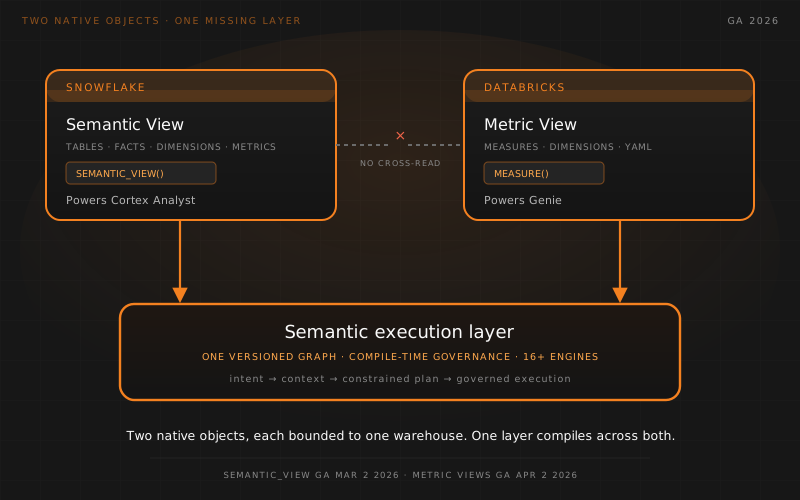
A data leader needs one answer first. Can either native object turn a business question into governed SQL across the whole estate? Each does its own platform well. Neither crosses the platform boundary. The table below sets the scope before the detail.
Snowflake Semantic Views vs Databricks Metric Views vs a semantic execution layer
| Dimension | Snowflake Semantic Views | Databricks Metric Views | Semantic execution layer (Colrows) |
|---|---|---|---|
| Object type | Schema-level object | Unity Catalog object | Compile-then-execute engine |
| What you define | TABLES, RELATIONSHIPS, FACTS, DIMENSIONS, METRICS | Measures and dimensions in YAML | A versioned, typed semantic graph |
| Query path | SEMANTIC_VIEW() in SQL | MEASURE() in SQL | Compiled, dialect-perfect SQL |
| Powers | Cortex Analyst, Snowflake Intelligence (now Snowflake CoWork) | Genie, dashboards, external BI | Any AI agent over MCP |
| Reach | Snowflake only | Databricks only | 16+ engines, one graph |
| GA | SQL query GA 2 Mar 2026 | GA 2 Apr 2026, open-sourced | Available now |
Read the table this way. Both native objects are governed definitions inside one warehouse. A semantic execution layer is a compiler that proves and governs the query across many warehouses. They solve related but different problems. For the wider multi-engine picture, see the semantic layer buyer's guide 2026.
What a Snowflake Semantic View is
A Snowflake Semantic View is a schema-level object. It stores tables, relationships, facts, dimensions, and metrics in one place. You query it with the SEMANTIC_VIEW() function in standard SQL. The object gives Cortex Analyst a governed model of your business, so text-to-SQL resolves against defined meaning rather than raw columns.
The object carries practical limits. Snowflake recommends fewer than 10 tables per view and around 50 columns for good performance. For Cortex Analyst use, the definition must fit inside a 1 MB, roughly 32,000-token cap. Snowflake now recommends the Semantic View over the older Semantic Model, because the view is a schema object that BI tools can also read. For the applied setup, see the semantic layer for Snowflake deep-dive, or the full object walkthrough in Snowflake Semantic Views explained.
What a Databricks Metric View is
A Databricks Metric View is a Unity Catalog object. You define measures and dimensions once, in YAML, and govern them centrally. You query a measure with the MEASURE() function. The view resolves the correct aggregation at the dimension level you choose, so one number stays consistent across every consumer.
Metric Views have their own rules. You cannot nest a measure call inside another aggregate, so a pattern like SUM(MEASURE(...)) does not compile. The object is Databricks-only and requires Unity Catalog. It arrived in DBR 16.4, so older runtimes cannot read it. Unity Catalog Business Semantics reached general availability on 2 April 2026, and Databricks open-sourced the core the same year. For the applied setup, see the semantic layer for Databricks deep-dive, or the object walkthrough in Databricks Metric Views explained.
Side by side
The two objects rhyme. Each centralizes metric meaning inside its own catalog. Each feeds a native AI assistant. Snowflake Semantic Views feed Cortex Analyst. Databricks Metric Views feed Genie. Each also feeds BI and dashboards, so a governed measure means the same thing across tools on that platform.
The syntax differs, but the intent matches. Snowflake authors an object with SEMANTIC_VIEW() as the query path. Databricks authors YAML with MEASURE() as the query path. Both let you define revenue once and read it everywhere on that platform. The design goal is the same. The reach is not. For the assistant-level comparison, see Cortex Analyst vs Genie.
Where each one stops
Both objects share one hard boundary. Each lives inside its own platform. A Snowflake Semantic View cannot read Databricks. A Databricks Metric View cannot read Snowflake. Neither object queries the other. The moment your data sits in more than one place, a single-vendor object leaves a gap.
The timing makes the point sharp. Snowflake made standard SQL querying of Semantic Views generally available on 2 March 2026. Databricks made Business Semantics generally available on 2 April 2026. The two native semantic layers shipped about a month apart. The native semantic layer war is live and citable. It also means most large enterprises now run two governed objects that cannot see each other.
The multi-warehouse reality
Few large enterprises live on one warehouse. Many run Snowflake for one domain and Databricks for another. In that estate, you end up maintaining two definitions of revenue. One lives in a Snowflake Semantic View. One lives in a Databricks Metric View. Both claim to be the source of truth for the same metric.
That is the gap. Two dialects of revenue drift apart over time. A filter changes in one and not the other. A finance report and a lakehouse dashboard quote different numbers for the same quarter. The native objects govern well inside their own walls, and they cannot reconcile across them. For the head-to-head on this exact estate, see the Snowflake and Databricks semantic layer question.
Fix the Context, Not the Model. A well-governed semantic layer that understands business context creates more reliable AI-driven analytics than fine-tuning the model itself. The native objects apply that principle inside one warehouse. A semantic execution layer applies it across every warehouse.
Can one layer span both?
There are two paths to spanning both. The first is an open standard. Open Semantic Interchange released its v1.0 spec on 27 January 2026, a vendor-neutral YAML format under Apache 2.0. It entered the Apache Incubator as Apache Ossie in June 2026, with 50 plus organizations and several converters merged. That is a real portability signal. It is not a finished one. Participation is not the same as shipped native support, so do not treat cross-warehouse portability as solved today. For the standard itself, see Open Semantic Interchange explained.
The second path works now. A semantic execution layer compiles one governed semantic graph across both platforms. It does not ask Snowflake to read Databricks or the reverse. It holds the definition above both and compiles it down. The theory behind that model is in what is a semantic compiler.
A note on accuracy claims
You will see a 90 percent accuracy figure attached to both Cortex Analyst and Genie. Do not read those as comparable. Snowflake reports about 90 percent on its own 150-question internal benchmark. Databricks reports similar figures on a separate internal set. The questions differ, the baselines differ, and neither result is independently verified. Treat each number as a within-vendor claim, not a head-to-head score.
Both, plus a layer above both
The honest recommendation for a multi-warehouse estate is not to pick one native object. Keep the Snowflake Semantic View for Snowflake. Keep the Databricks Metric View for Databricks. Then add a layer that holds one definition above both. Colrows is that layer. It compiles intent through a typed semantic graph into deterministic, dialect-perfect SQL. It runs that SQL across Snowflake, Databricks, and 16+ other engines from one graph. It proves join paths before execution. It enforces governance at compile time, so filtered rows are never read. The runtime is one line: intent → context resolution → constrained planning → governed execution.
The two native objects and the execution layer are complementary, not rivals. The objects govern meaning inside each warehouse. The layer governs and executes that meaning across all of them. To weigh the options for your estate, compare Colrows with the native tools.
Frequently asked questions
What is the difference between Snowflake Semantic Views and Databricks Metric Views?
Both are native catalog objects that centralize metric definitions inside one platform. A Snowflake Semantic View is a schema-level object storing tables, relationships, facts, dimensions, and metrics, queried with SEMANTIC_VIEW(). A Databricks Metric View is a Unity Catalog object storing measures and dimensions in YAML, queried with MEASURE(). Snowflake Semantic Views power Cortex Analyst. Databricks Metric Views power Genie.
Can Snowflake Semantic Views and Databricks Metric Views interoperate?
No. A Snowflake Semantic View lives in Snowflake and cannot read Databricks. A Databricks Metric View lives in Unity Catalog and cannot read Snowflake. Neither object queries the other platform. Spanning both from one definition is the job of a layer above them, not either native object.
Which is more accurate, Cortex Analyst or Genie?
The numbers are not comparable. Snowflake reports about 90 percent on its own 150-question internal benchmark. Databricks reports similar figures on a separate internal set. Different questions, different baselines, and neither is independently verified. Treat each number as a within-vendor claim, not a head-to-head result.
Can one semantic layer span both Snowflake and Databricks?
A semantic execution layer can. It compiles one governed semantic graph into the SQL dialect of each engine, so the same definition of revenue runs on both. The Open Semantic Interchange standard points toward native portability, but native support is still partial in 2026. Portability is not solved today.
Are Snowflake Semantic Views and Databricks Metric Views generally available?
Yes, both shipped in 2026. Snowflake made standard SQL querying of Semantic Views generally available on 2 March 2026. Databricks made Unity Catalog Business Semantics, including Metric Views, generally available on 2 April 2026 and open-sourced the core the same year. The two arrived about a month apart.