Metric-insight feed vs semantic execution layer
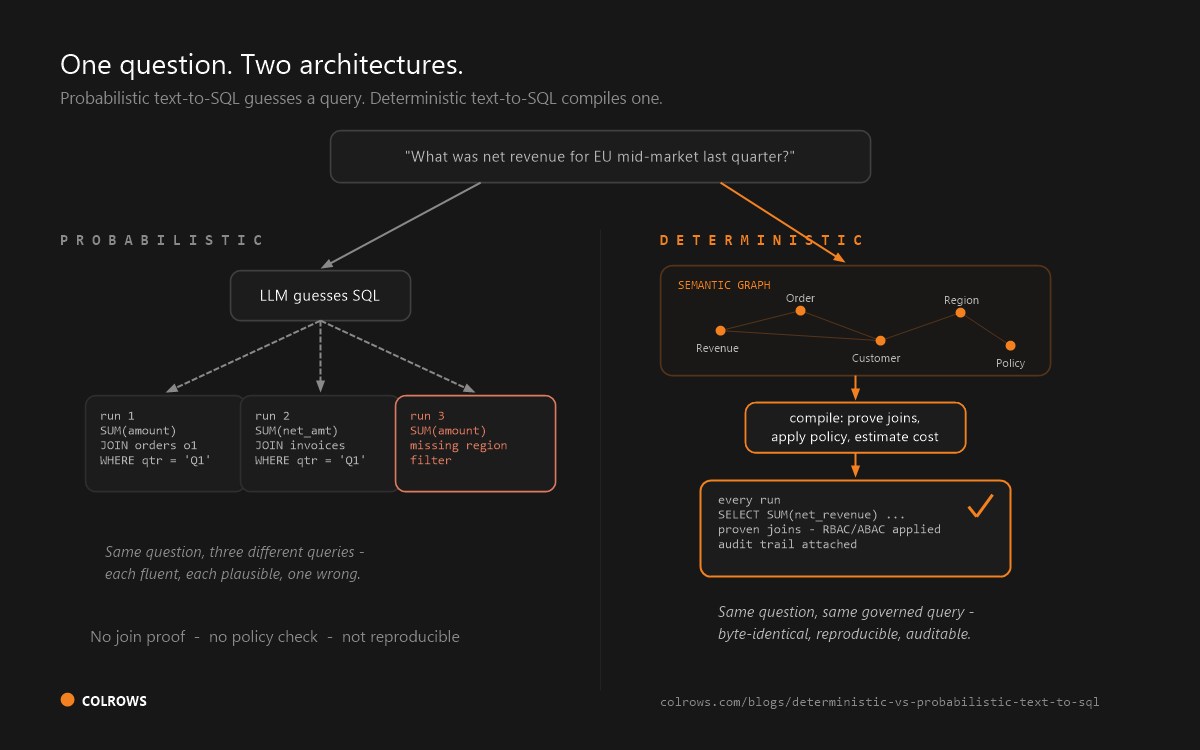
Tableau Pulse watches defined metrics and narrates changes. A semantic execution layer resolves arbitrary intent, proves the join path, and enforces policy at compile time, then emits governed SQL for an agent.
| Dimension | Tableau Pulse (metric-insight feed) | Colrows (semantic execution layer) |
|---|---|---|
| Scope | Defined metrics; one published data source per metric | Any governed question across the estate |
| Interaction | Metric-scoped natural-language Q&A and insight feed | Open agent intent compiled to deterministic SQL |
| Reach | Tableau Cloud only; full AI gated behind Tableau+ | 16+ warehouses; deployment-agnostic |
| Governance | Tableau permissions, applied at query time | Compile-time RBAC + ABAC + row/column predicates |
| Primary consumer | Business users watching a feed | AI agents and autonomous workflows |
What Tableau Pulse does well
- Zero-effort metric monitoring. Pulse turns a published metric into a followed feed with automatic anomaly and trend callouts. For business users already in Tableau, adoption is easy.
- Natural-language on metrics. Users ask plain-language questions scoped to a metric and get a governed answer, backed by Salesforce Einstein.
- Native to the Tableau estate. If your organization runs Tableau Cloud, Pulse rides on the governance and content you already have.
Pulse is a good fit for its job: keep humans informed about the metrics they own. The question is what happens when you want an agent to answer arbitrary questions across many systems.
Where Tableau Pulse gets stretched
- Single published source per metric. A Pulse metric binds to one Tableau published data source. Cross-source questions are out of scope by design.
- Metric-only Q&A. Questions are scoped to the defined metric, not open exploration across the warehouse.
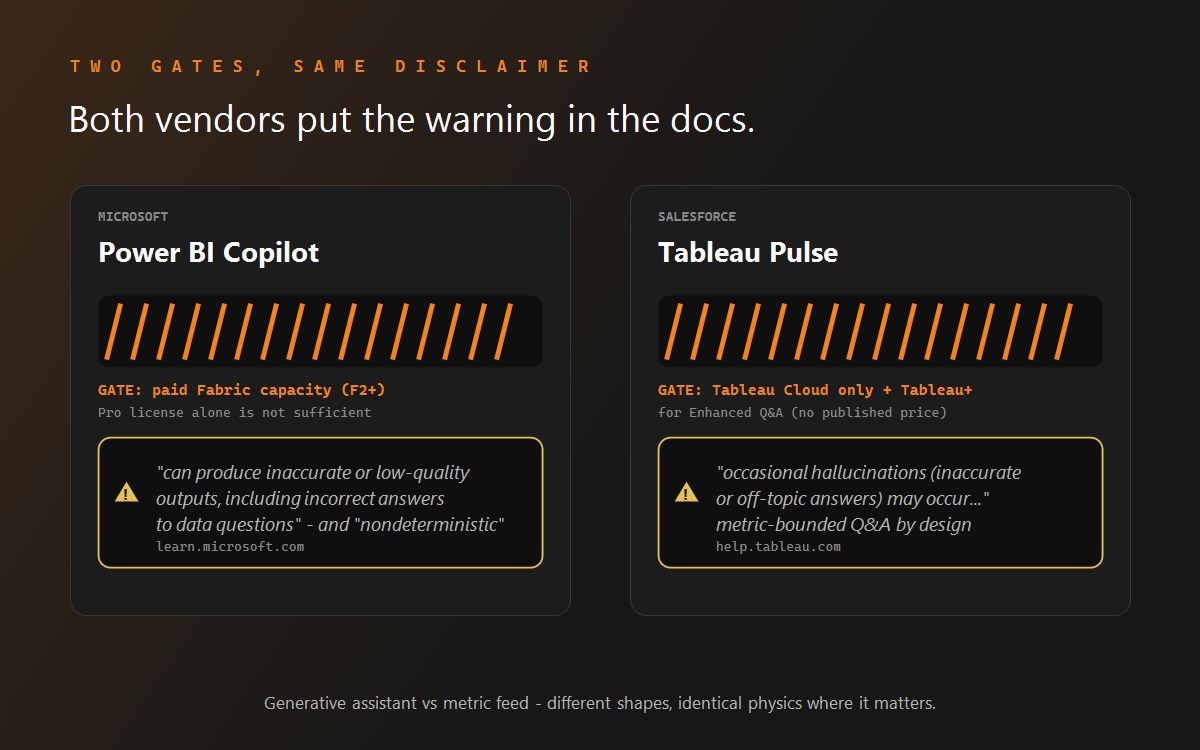
- Cloud-only, and Tableau+ gating. Pulse is Tableau Cloud only, and the fuller AI capabilities live inside the Tableau+ premium edition, an uplift.
- Human-first, not agent execution. Pulse narrates metrics to people. It does not compile arbitrary agent intent into governed SQL across warehouses.
Pulse is not wrong. It is a metric feed, not an execution layer. For the deeper contrast, see Colrows vs Tableau Pulse and Power BI Copilot vs Tableau Pulse.
Fix the Context, Not the Model. A metric feed with a bigger model still only narrates the metrics you defined. Arbitrary, governed answers come from a semantic layer that resolves meaning and proves the query before it runs.
The Tableau Pulse alternatives, by job to be done
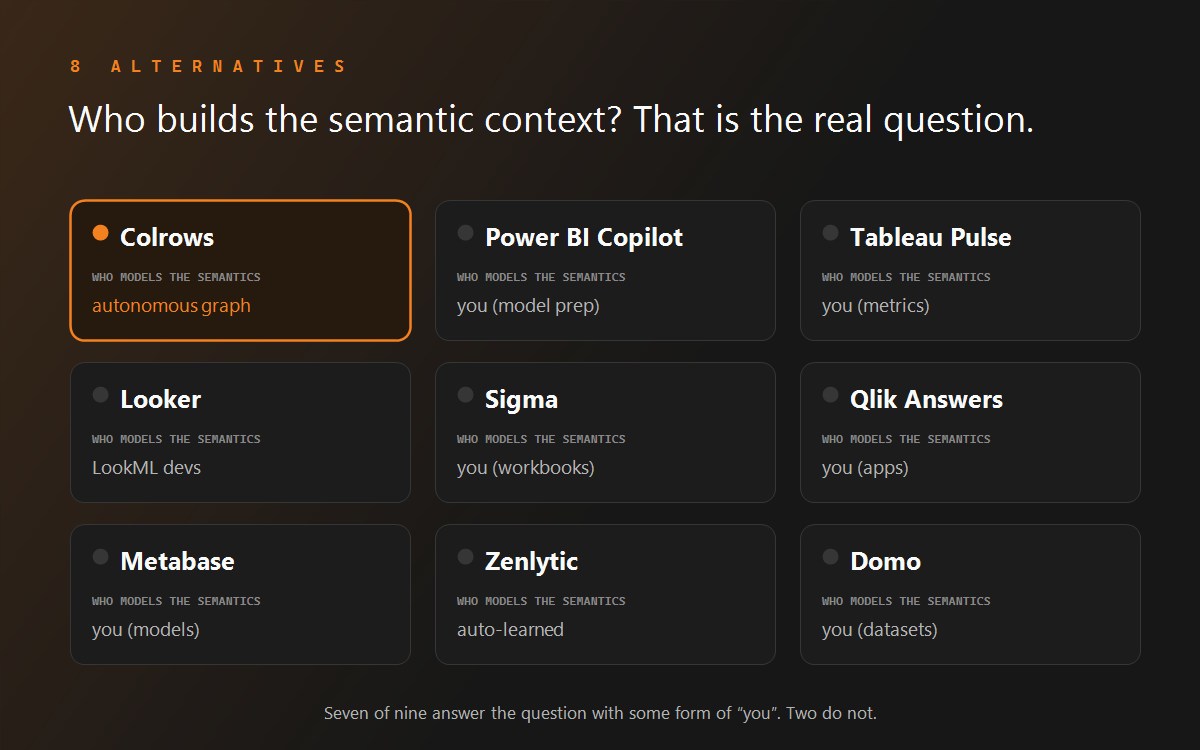
1. Colrows - for governed, multi-warehouse AI agents
Colrows is a compile-time semantic execution layer built agent-first. It compiles intent through a typed semantic graph into deterministic, dialect-perfect SQL across 16+ engines, proves join paths, and enforces RBAC, ABAC, and row/column policy before any query runs. Where Pulse narrates metrics to humans, Colrows compiles and governs agent intent across the whole estate.
2. Power BI Copilot - for Microsoft-first shops
If your stack is Microsoft, Power BI Copilot is the natural peer to Pulse: conversational analytics inside the Power BI ecosystem. It shares Pulse's nondeterminism concerns; see why Copilot gives wrong answers.
3. ThoughtSpot Spotter - for search-driven self-service
ThoughtSpot Spotter uses a search-token architecture plus an agentic semantic layer, multi-cloud and LLM-flexible. Best when thousands of business users want to search their data directly.
4. Cube - for headless metric APIs
Cube serves governed metrics over SQL, REST, GraphQL, and MDX with an open-source core. Best for embedded analytics and many front-ends.
5. Snowflake Cortex Analyst - for Snowflake-only self-serve
Cortex Analyst is fast warehouse-native text-to-SQL, but Snowflake-only and governs after generation.
6. Databricks Genie - for Databricks-only conversational BI
Databricks Genie inherits Unity Catalog governance, capped at 30 tables per space and bounded to Databricks.
Cost snapshot (2026, USD)
Point-in-time figures. Pulse ships inside Tableau Cloud licensing. Verify against vendors before committing.
| Platform | Entry | Model |
|---|---|---|
| Tableau Pulse | Included with Tableau Cloud (Viewer ~$15/user/mo; Explorer/Creator higher) | Per-role seats; advanced AI gated behind Tableau+ premium edition |
| Power BI Copilot | Power BI Pro $14/user/mo; Premium capacity for full Copilot | Seats + capacity |
| ThoughtSpot | Essentials $25/user/mo | Per-user + consumption |
| Colrows | Free POC | Custom annual (priced on questions asked) |
Which alternative fits you
- You want low-effort metric monitoring for Tableau users: stay with Pulse.
- You are a Microsoft shop: Power BI Copilot.
- You want thousands of users searching data directly: ThoughtSpot Spotter.
- Your primary consumer is an AI agent needing deterministic, multi-warehouse SQL with governance before execution: evaluate Colrows.
Tableau Next ships task agents rather than investigation agents. Agentic BI tools explains where that lands on the autonomy ladder.
Frequently asked questions
What is Tableau Pulse?
A metric-insight feed inside Tableau Cloud that tracks defined metrics, surfaces automated insights, and answers metric-scoped natural-language questions, built on Salesforce Einstein.
What are its main limits?
One published source per metric, metric-scoped Q&A, Tableau Cloud only, and full AI gated behind the Tableau+ premium edition.
How much does Tableau Pulse cost?
There is no standalone Pulse price. It ships with Tableau Cloud (per-role seats), and advanced AI features live in the Tableau+ premium edition.