First, the renames
Four renames in one year make older comparisons unreliable. Here is the current map.
| Now called | Previously | Renamed | What it is |
|---|---|---|---|
| Genie One | Databricks One | Apr and Jun 2026 | Business-user interface |
| Genie Agents | Genie Spaces | Jul 2026 | Natural language to SQL |
| Genie Code | Databricks Assistant | Mar 2026 | Developer agent |
| Agent mode | Research Agent | Feb 2026 | Multi-step reasoning in Genie |
| AI Search | Vector Search | Jun 2026 | Retrieval |
The Mosaic AI brand also disappeared from product names during 2026. Snowflake AI tools compared maps the equivalent warehouse stack. Our comparisons hub holds the cross-vendor versions of this analysis.
The stack, layer by layer
Status, dates, and caps come from Databricks release notes and documentation. Directional, not lab numbers.
| Product | Answers | Status | Cap to know | Billing |
|---|---|---|---|---|
| Unity Catalog Metric Views | What the metric means | GA Apr 2026 | Databricks only | No extra licence |
| Genie Agents | What is the number | GA | 30 tables, 5 recommended | Free to 31 Jan 2027 |
| Genie Agents, agent mode | Why did it move | GA Jul 2026 | Same table cap | Free to 31 Jan 2027 |
| Genie One | Where do I ask | GA Jun 2026 | 20,000 char instructions | Free to 31 Jan 2027 |
| Genie Code | Write the pipeline | GA | None published | Billed, 150 free DBUs |
| Genie Ontology | Builds context automatically | Public Preview | Default on | Included |
| AI/BI Dashboards | Show the trend | GA | 100 datasets per dashboard | Warehouse compute |
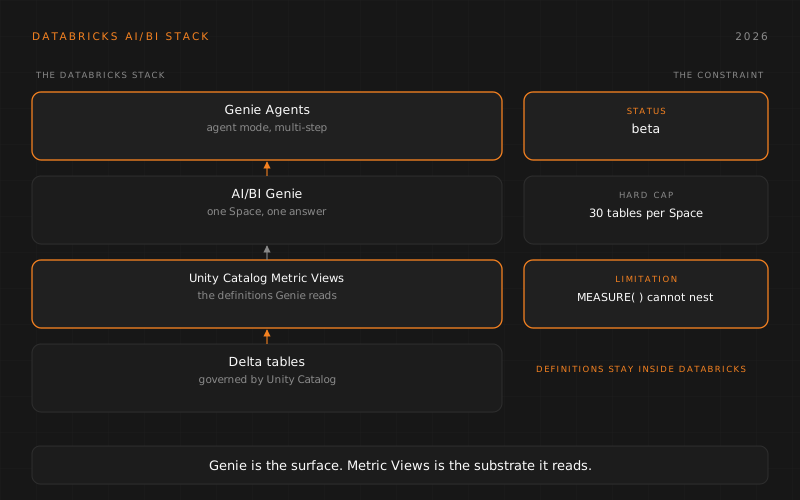
Fix the Context, Not the Model. A well-governed semantic layer that understands business context creates more reliable AI-driven analytics than fine-tuning the model itself. Databricks documentation agrees. It recommends Metric Views for Genie Agents precisely because pre-defined metrics and aggregations stop the agent inventing its own.
The layers that matter
1. Unity Catalog Metric Views - the substrate
Metric Views reached general availability in April 2026 and were open-sourced into Apache Spark. They separate measures from dimensions, and you query them through the MEASURE() function. Two documented constraints shape design. A metric view cannot join directly to another table at query time, so you wrap it in a common table expression. MEASURE() also cannot act as a window function.
2. Genie Agents - the text-to-SQL layer
Genie Agents answers natural-language questions over Unity Catalog data and requires a pro or serverless SQL warehouse. The table cap is 30, and the best-practice documentation recommends five or fewer for quality. That gap between the ceiling and the recommendation is the real planning constraint, because a large estate becomes many agents to build and keep current.
3. Agent mode - the multi-step upgrade
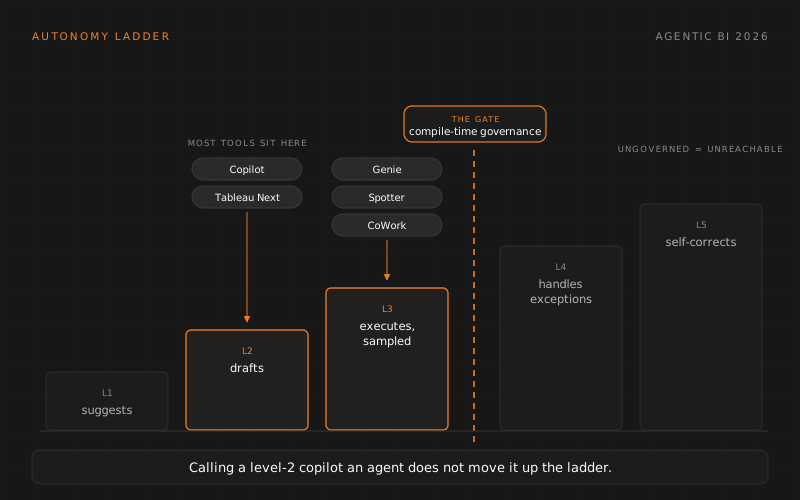
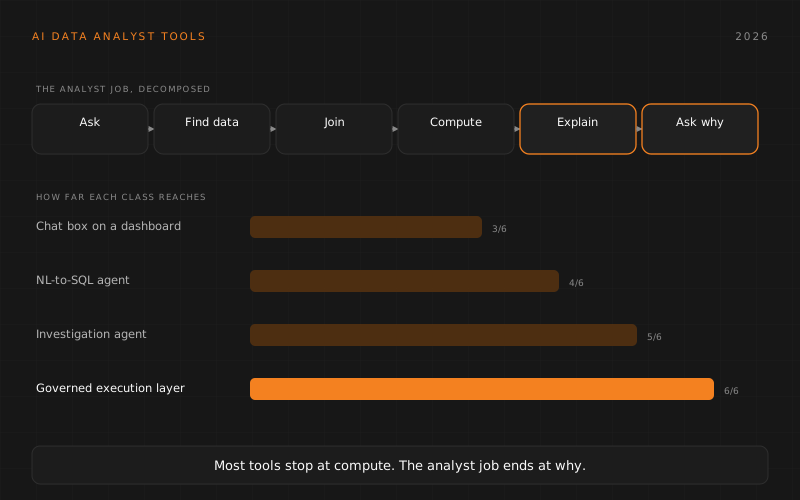
Agent mode reached general availability in July 2026, with its APIs following in August. It uses multi-step reasoning to answer exploratory questions and returns a report with citations, visualisations, and supporting tables. Agent mode moves Genie from answering what you asked to investigating why something changed. That is level 3 on the ladder in agentic BI tools.
4. Genie One and Genie Code - the two other Genies
Genie One is the business-user surface, with workspace instructions capped at 20,000 characters and file upload for CSV, Excel, and PDF. Genie Code is the developer agent that writes notebooks, SQL, dashboards, and pipelines. Databricks bills Genie Code while the other two run free, which is the most common budgeting mistake in this stack.
5. Genie Ontology - context without authoring
Genie Ontology builds a business-aware map from dashboards, notebooks, and pipelines, extracting and ranking what it finds. Databricks enabled it by default during 2026 while keeping it in public preview. Genie Ontology is the direct counterpart to Snowflake's Cortex Sense. Both vendors shipped their version in June 2026, which tells you what the field now treats as the bottleneck.
The 30-table cap is the real design constraint
The cap sounds generous until you plan against it. Databricks allows 30 tables or views per Genie Agent and its own best-practice documentation recommends five or fewer, because a narrower selection produces better answers.
Take the recommendation seriously and a 300-table estate becomes dozens of agents. Each one needs its own instructions, its own example queries, its own benchmark questions, and its own owner. The published limits around that are generous, at 100 instructions and 200 knowledge snippets per agent. The maintenance still grows linearly with the number of agents.
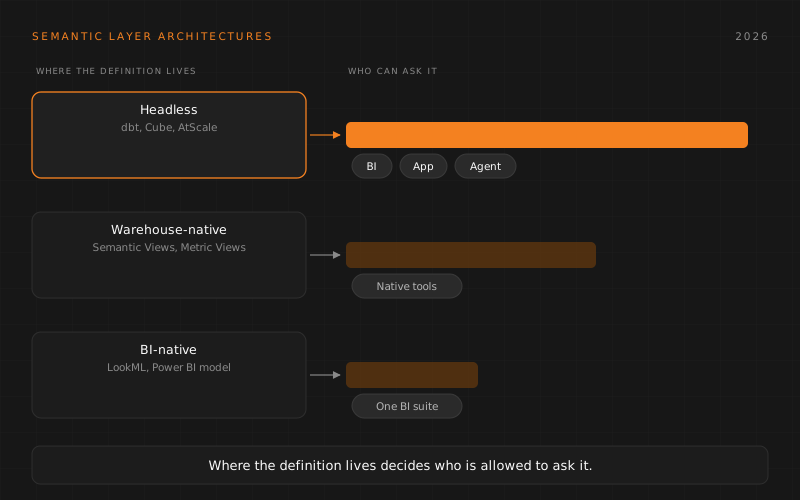
A semantic modelling problem is wearing a configuration UI here. A semantic layer exists to solve that problem once rather than many times, which is the argument in best semantic layer tools. Metric Views help, which is exactly why Databricks recommends them for Genie Agents. See governance tools for AI agents for how Unity Catalog enforces around them.
The free period is the procurement risk
Databricks paused billing for Genie One and Genie Agents, and extended free usage through 31 January 2027. There is no published price for what happens on 1 February 2027.
Two exclusions matter now rather than then. Service principals fall outside the free usage, so any programmatic or embedded workload is already a cost line. Genie Code stays billed with a monthly free allowance and a promotional discount above it. Databricks bills SQL warehouse compute separately throughout, so even the free products cost something to run.
Model the steady state before you standardise on it. Compare the meters in the semantic layer pricing comparison.
Three ways teams get this stack wrong
Comparing the wrong Genie. A comparison that scores Genie against a rival is scoring one of three products. Genie One is an interface, Genie Agents answers questions, and Genie Code writes pipelines. Their caps, their billing, and their maturity all differ.
Budgeting from the free tier. Genie One and Genie Agents run free only until 31 January 2027, and Databricks publishes no successor price. Databricks charges for Genie Code today. Service principals were never free, so anything programmatic already costs money.
Scoping an agent like a warehouse. Thirty tables is the ceiling and five is the recommendation. Teams that point an agent at a broad schema get worse answers, and then blame the model rather than the scope. The fix is narrower agents over a shared metric layer, and a benchmark set per agent, rather than a better prompt.
How to pick a layer
- You want consistent metrics first: Metric Views, before any agent touches the data.
- Business users need answers: Genie One over Genie Agents, scoped to five tables each.
- You need why, not what: agent mode, now generally available.
- Engineers want the agent: Genie Code, and budget it separately.
- Definitions must match Snowflake or BigQuery: a Databricks-only object cannot do that.
Compare the equivalent warehouse stack in Snowflake AI tools compared, and the two substrates in Semantic Views vs Metric Views.
Where Colrows changes the math (our product)
Metric Views are the right foundation inside Databricks, and Genie Agents work well when you scope them tightly. We would tell a Databricks-only shop to start there.
Two constraints survive that advice. The 30-table cap, with five recommended, means one agent cannot span a real estate, so you build and maintain many. And the definitions stay inside Databricks, so a second platform means a second set. Colrows compiles one governed graph across 16 or more engines, with no per-agent table ceiling. It applies policy before execution and returns the same SQL wherever the data sits.
A note on the claims
Product names, renames, statuses, caps, and billing come from Databricks release notes and documentation as of late August 2026. Where Databricks pages disagree with each other about a status we say so. Preview status in this stack changes monthly. Colrows sells a competing product, and we wrote the sections above with that disclosed. We review this page quarterly.
Frequently asked questions
What is the difference between Genie One, Genie Agents and Genie Code?
They are three products that share a name. Genie One is the business-user interface, renamed from Databricks One in April 2026 and then to Genie One in June 2026. Genie Agents is the natural-language-to-SQL layer, renamed from Genie Spaces in July 2026. Genie Code is the developer agent, renamed from Databricks Assistant in March 2026. Any comparison that treats Genie as one product is out of date.
How many tables can a Databricks Genie Agent use?
Thirty tables or views per agent, raised from twenty-five. The more useful number is in the best-practice documentation, which recommends five or fewer tables per agent because focus improves answer quality. Treat five as the working limit and thirty as the ceiling. Spanning a real data estate therefore means building and maintaining many agents.
Is Databricks Genie free?
Temporarily. Databricks paused billing for Genie One and Genie Agents and extended free usage through 31 January 2027, with no published price for the period after that. Two exclusions matter for planning. Service principals fall outside the free usage, so programmatic and embedded workloads still cost money. Genie Code also stays billed, with a monthly free allowance. Databricks bills SQL warehouse compute separately throughout.
Do I need Unity Catalog Metric Views for Genie?
Not strictly, but Databricks recommends them. Metric Views reached general availability in April 2026 and were open-sourced into Apache Spark. They pre-define metrics, dimensions, and aggregations, which is exactly the context an agent needs to avoid inventing its own arithmetic. The constraint is portability, because the definitions stay inside Databricks.