Copilot behaviour vs agent behaviour
| Dimension | Copilot | Agent |
|---|---|---|
| Who plans | The person decides the steps | The tool decomposes the question |
| Who approves | A person approves every query | A person reviews exceptions |
| Scope | Answers the question you asked | Answers why the number moved |
| Governance | Checked as the query runs | Enforced before the plan compiles |
The autonomy ladder
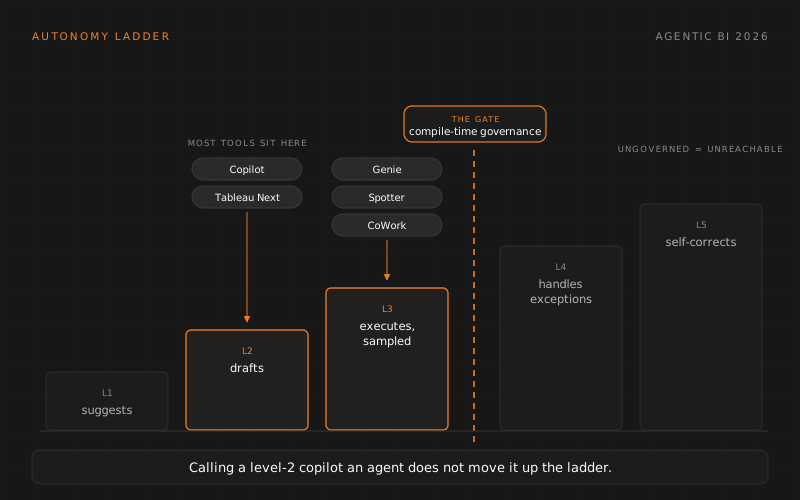
Autonomy is a spectrum, not a switch. Five steps describe it, and the step a tool reaches predicts how much work it removes.
- Level 1, suggests. The tool proposes. A person decides and executes.
- Level 2, drafts. The tool writes the query. A person approves it before it runs.
- Level 3, executes with sampling. The tool runs its own plan. A person spot-checks the output.
- Level 4, handles exceptions. The tool runs unattended and escalates only what it cannot resolve.
- Level 5, self-corrects. The tool detects its own errors and repairs them.
Most production analytics tools sit at level 2 or level 3 in 2026. Level 5 stays rare, and it stays limited to low-stakes work. Any vendor claiming level 4 on regulated data is really claiming something about governance, which the governance requirements for AI agents set out.
The scorecard
Scored on the ladder above, plus the three enterprise factors that decide fit. Directional, not lab numbers.
| Tool | Autonomy | Governance timing | Determinism | Reach |
|---|---|---|---|---|
| Colrows | Level 3, governed | Before execution | High | 16+ engines |
| ThoughtSpot Spotter | Level 3 | Platform | Medium | 5 warehouses |
| Snowflake CoWork | Level 3 | At execution (RBAC) | Medium | Snowflake only |
| Databricks Genie | Level 2, agent mode in beta | At execution (Unity Catalog) | Medium | Databricks only |
| Tellius | Level 3 | Platform | Medium | Multi-warehouse |
| Power BI Copilot | Level 2 | At query time | Medium | Microsoft estate |
| Tableau Next | Level 2 | At query time | Medium | Tableau and Salesforce |
Fix the Context, Not the Model. A well-governed semantic layer that understands business context creates more reliable AI-driven analytics than fine-tuning the model itself. Autonomy follows the same rule. A tool climbs the ladder when you can trust its plan, not when you give it a better model.
The tools, by the step they reach
1. Colrows - level 3, governed before execution
Colrows compiles a question into deterministic SQL across 16 or more engines. Governance runs at compile time, so the system never generates an unauthorised plan. That property is what lets a person sample the output instead of approving every query. See semantics for enterprise AI agents for the mechanism.
2. ThoughtSpot Spotter - level 3, broadest warehouse reach
Spotter adds step-by-step reasoning, Python analysis, and forecasting. Companion agents handle modelling and visualisation. It connects to Snowflake, BigQuery, Databricks, Redshift, and Postgres, which makes it the widest reach among the platform vendors here.
3. Snowflake CoWork - level 3 inside Snowflake
Snowflake renamed Snowflake Intelligence to CoWork at Summit 2026. Its Deep Research mode decomposes a question, pulls from several sources, and returns a cited report. Accuracy is the open question. Snowflake reports that Cortex Sense lifted accuracy from 24.1 percent to 86.3 percent on its own internal benchmark in June 2026. Cortex Sense was still in preview at that point, with no public documentation page.
Budget the consumption separately. Snowflake bills agent usage in AI Credits, which are a different currency from Platform Credits and carry their own rates. See Cortex Analyst alternatives and Snowflake Semantic Views.
4. Databricks Genie - level 2, with agent mode in beta
Genie inherits Unity Catalog governance and caps each Space at 30 tables. Agent mode APIs for Genie Agents reached beta in 2026 and add multi-step reasoning, which moves it toward level 3. Its semantic substrate, Unity Catalog Metric Views, reached GA on 2 April 2026. Metric views cannot join directly to other tables at query time, and the definitions stay Databricks-only.
5. Tellius - level 3, investigation first
Tellius sells autonomous investigation rather than query answering. It ranks drivers and decomposes variance before anyone asks, which is genuine level 3 behaviour. Governance depends on the connected warehouse rather than on a compile step.
6. Power BI Copilot - level 2, Microsoft-first
Copilot drafts and a person approves. Microsoft hosts it on rented Fabric capacity rather than licensing it, so cost tracks consumption and not seats. Determinism is the standing concern, covered in why Copilot returns wrong answers.
7. Tableau Next - level 2, task assistance
Tableau Next ships agents for data preparation, exploration, and alerting. Those agents assist with defined tasks. They do not run autonomous investigation, and they do not chain findings into multi-step workflows. See Tableau Pulse alternatives for the metric-feed comparison.
What breaks when a level-2 tool is sold as level 4
The approval step is load-bearing, and buyers remove it. A level-2 tool is safe because a person reads every query. Teams that believe the agentic label stop reading. The tool did not change, but the control did.
Nondeterminism compounds across steps. One query that varies is a nuisance. A five step chain where each step varies is unauditable. We set out the arithmetic in deterministic vs probabilistic text-to-SQL, and the accuracy gap in the text-to-SQL accuracy cliff.
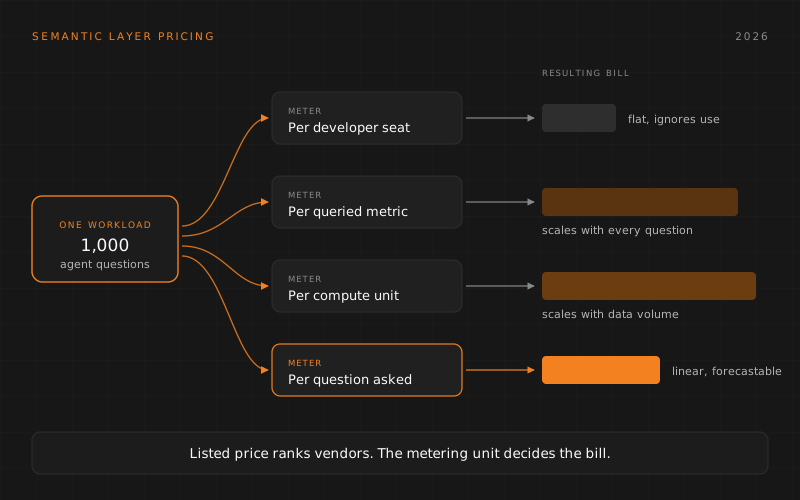
Per-step billing meets multi-step agents. An agent that decomposes one question into twenty calls bills twenty times on a per-query meter. Check the meter before you scale the agent, using the semantic layer pricing comparison.
How to test the claim in a demo
No vendor states its level. Five questions expose it inside a single demo call.
- Ask why a metric moved, not what it is. A level-2 tool returns the number. A level-3 tool ranks the drivers behind it.
- Ask the same question twice in a fresh session. Different SQL means the chain does not reproduce, so no audit can rely on it.
- Ask to see every query it ran. A tool that shows only the final query cannot account for the steps in between.
- Ask what happens when a user lacks permission on one table in the chain. The answer tells you whether governance runs before the plan or during execution.
- Ask how many billable calls the demo just made. Multi-step agents multiply per-query meters, and vendors rarely volunteer the count.
Question four separates the field faster than the other four. A vendor that governs at execution has already built the plan, so the tool decides what to ask and the warehouse decides what to refuse. A vendor that governs at compile time never builds the plan. Regulated buyers should start there and treat the rest as secondary.
How to choose
- You run one warehouse and want the native agent: CoWork on Snowflake, Genie on Databricks.
- You need reach across several warehouses: Spotter, or Colrows where definitions must also agree.
- You want driver analysis rather than answers: Tellius.
- You standardise on Microsoft: Copilot, and budget the capacity, not the seats.
- You work under a regulator: require compile-time governance and reproducible SQL before you compare anything else.
Run the semantic layer evaluation checklist against each candidate. If you are still choosing between chat and agent, the conversational BI tools comparison covers the previous generation of the same field.
Where Colrows changes the math (our product)
Colrows moves the governance check ahead of the plan. The compiler resolves the question against a typed semantic graph, proves the join path, and applies row and column rules before any SQL exists. An unauthorised plan is unreachable rather than blocked.
That ordering is what makes higher autonomy defensible. You can let the tool run its own steps because you know which steps it can take. The same question returns the same SQL, so a five step chain stays auditable end to end.
A note on the claims
Vendor capabilities come from each vendor's own documentation and release notes, on the dates given above. Preview and beta status changes quickly in this category. Autonomy levels are our assessment against the ladder in this page, not a vendor rating. Colrows sells a competing product, and we wrote the sections above with that disclosed. We review this page quarterly.
For the tools rather than the ladder, see AI data analyst tools, and data governance tools for AI agents for what controls them.
Frequently asked questions
What is agentic BI?
Agentic BI describes analytics tools where an AI agent plans and runs the steps that answer a business question. A copilot instead drafts one query for a person to approve. A true agent decomposes the question, runs several queries, and returns a finished answer. Most tools sold as agentic still stop at the draft stage.
What is the difference between a copilot and an agentic BI tool?
A copilot drafts and a human approves every step. An agent plans, executes, and only reports exceptions. The practical test is whether the tool answers a question you did not explicitly ask, such as why a metric moved. If a person still approves each query, the tool is a copilot whatever the marketing says.
Are agentic BI tools safe for regulated data?
Only when governance runs before the query executes. A tool that checks permissions at execution has already generated the plan, so an unauthorised join can reach the warehouse. Compile-time governance blocks the plan instead, which is why regulated buyers should ask when governance runs, not whether it exists.
Which agentic BI tool works across more than one warehouse?
Snowflake CoWork runs on Snowflake, and Databricks Genie runs on Databricks. ThoughtSpot Spotter connects to Snowflake, BigQuery, Databricks, Redshift, and Postgres. Colrows compiles across 16 or more engines from one governed graph. Cross-warehouse reach matters when definitions must agree across platforms.