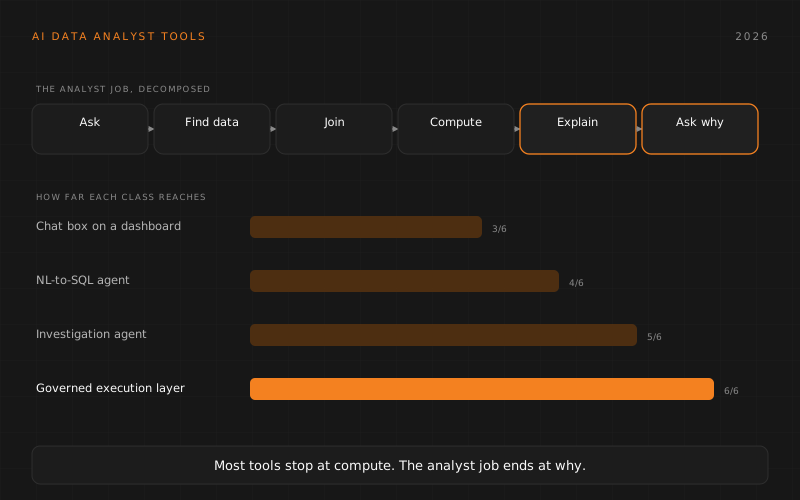
Answering a question is not doing the job
| Step | What most tools do | What the job needs |
|---|---|---|
| Find the data | Search a curated set | Resolve against the whole estate |
| Join it | Guess the path, sometimes | Prove the path every time |
| Compute | One query, one answer | Several queries, one conclusion |
| Explain why | Rarely attempted | Rank the drivers behind the change |
The gap between column two and column three is the whole category. Our analytics and search hub covers the adjacent tooling.
The scorecard
Pricing and caps come from each vendor's published pages. Accuracy evidence means an independently verifiable figure, which almost nobody has. Directional, not lab numbers.
| Tool | Multi-step | Published price | Hard cap to know | Accuracy evidence |
|---|---|---|---|---|
| Colrows | Yes, governed | Priced per question asked | None hidden | First-party benchmark |
| Tellius | Yes, investigation-first | No, contact sales | Not published | None |
| Hex | Yes, in a notebook | $36 and $75 per editor | Compute billed hourly | None, ships an eval framework |
| ThoughtSpot Spotter | Yes | $25 and $50 per user | 25 Spotter queries per user per month on Pro | None |
| Sigma | Yes, in Sigma Agents | No, contact sales | Runs on your warehouse compute | None |
| Zenlytic | Partial | No, contact sales | Not published | None |
| Snowflake Cortex Analyst | No, single-turn | 67 credits per 1,000 messages | No cross-query memory | Internal, 150 questions, 2024 |
| Databricks Genie | Yes, agent mode GA | Free to 31 Jan 2027 | 30 tables per agent | None |
Fix the Context, Not the Model. A well-governed semantic layer that understands business context creates more reliable AI-driven analytics than fine-tuning the model itself. The benchmark gap below is the evidence. Every vendor here runs a capable model, and the scores still diverge by forty points.
The number nobody publishes
Spider 2.0 is the closest thing this field has to an independent exam. It uses 632 real enterprise problems on BigQuery and Snowflake, and its databases frequently exceed a thousand columns. The strongest published systems on it score in the high fifties to low sixties.
Set that against the vendor claims. Snowflake reports more than 90 percent for Cortex Analyst. That figure comes from an internal set of 150 questions Snowflake wrote itself, published in August 2024. Snowflake has not refreshed it through two years of model turnover. In the same post Snowflake argues that easy benchmarks inflate scores, which cuts against its own figure. Databricks, ThoughtSpot, Tellius, Sigma and Zenlytic publish no accuracy number at all.
The honest position is that nobody in this category has proven accuracy in public. We hold ourselves to the same standard. Our own figures live on the research page with their method attached. Our benchmark write-up sets out what a benchmark must model to mean anything.
The eight, by the job they take on
1. Colrows - compiles the question, proves the join
Colrows resolves a question against a typed semantic graph and proves the join path before executing. The same question returns the same SQL, which is what makes a multi-step chain auditable rather than merely fast.
2. Tellius - the strongest investigation story
Tellius sells autonomous investigation rather than question answering. Its agent plans and runs multi-step work across variance, cohort, anomaly, and correlation analysis. It publishes no pricing and no accuracy figure, and its headline claim of far deeper insight carries no method.
3. Hex - the honest one on evidence
Hex puts an agent inside a notebook where it chains SQL and Python cells and writes up the result. Hex is the only tool here with real published seat pricing, at 36 and 75 dollars per editor per month. Rather than publishing an accuracy score, Hex ships an evaluation framework so customers can measure their own. An honest measuring tool beats an unverifiable number.
4. ThoughtSpot Spotter - capable, and metered
Spotter documents genuine multi-step behaviour, including breaking a question into sub-questions and reviewing its own results. Read the meter before you scale it. The 50 dollar Pro tier includes 25 Spotter queries per user per month, and unlimited use is an Enterprise line item. See ThoughtSpot pricing.
5. Sigma - two products under one story
Ask Sigma answers a single question at a time and shows its working. Sigma Agents is the multi-step layer, with conversational, human-in-the-loop, and autonomous modes. All processing runs on your own warehouse compute, which moves the cost rather than removing it.
6. Zenlytic - strong on setup, thinner on investigation
Zenlytic's 2026 work centres on a semantic layer that assembles itself from existing LookML, dbt, or Power BI definitions. That solves a real onboarding problem. The evidence for autonomous multi-step investigation is thinner than the marketing implies.
7. Snowflake Cortex Analyst - fast, bounded, single-turn
Cortex Analyst is low-friction inside Snowflake and now reads Semantic Views as the recommended substrate. Its own documentation states it has no access to results from previous queries, so genuine chaining requires Cortex Agents above it. Billing is 67 credits per 1,000 messages through the standalone API.
8. Databricks Genie - capable, free, and temporarily so
Genie reached general availability for agent mode in July 2026 and returns cited multi-step reports. Two procurement facts matter. It caps at 30 tables per agent. The free period runs only to 31 January 2027. Databricks publishes no price for the period after that, and service principals never qualified.
The caps that decide the bill
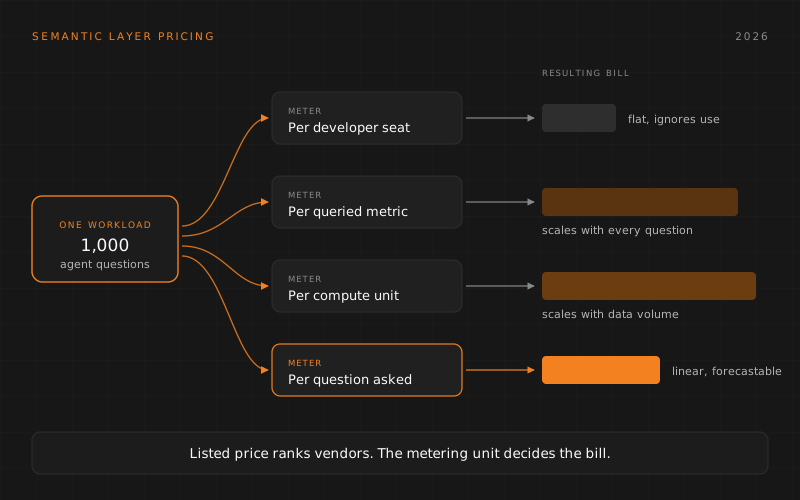
Headline prices in this category are not the constraint. Three published caps do more to shape cost and feasibility than any per-seat figure.
| Cap | Who publishes it | What it means at scale |
|---|---|---|
| 25 AI queries per user per month | ThoughtSpot, Pro tier | A daily user exhausts the allowance in the first week |
| 30 tables per agent | Databricks Genie | One agent cannot span a real estate; you build many |
| No cross-query memory | Snowflake Cortex Analyst | Genuine multi-step work needs the agent layer above it |
Databricks documentation goes further than its own cap and recommends five or fewer tables per agent for quality. Read that as the real working limit rather than the published one.
How to choose
- You want driver analysis, not answers: Tellius, and accept the pricing opacity.
- Your analysts live in notebooks: Hex, which is also the easiest to budget.
- You need thousands of business users self-serving: ThoughtSpot, with the query cap costed honestly.
- You run one warehouse: take the native option and revisit when the promotional pricing ends.
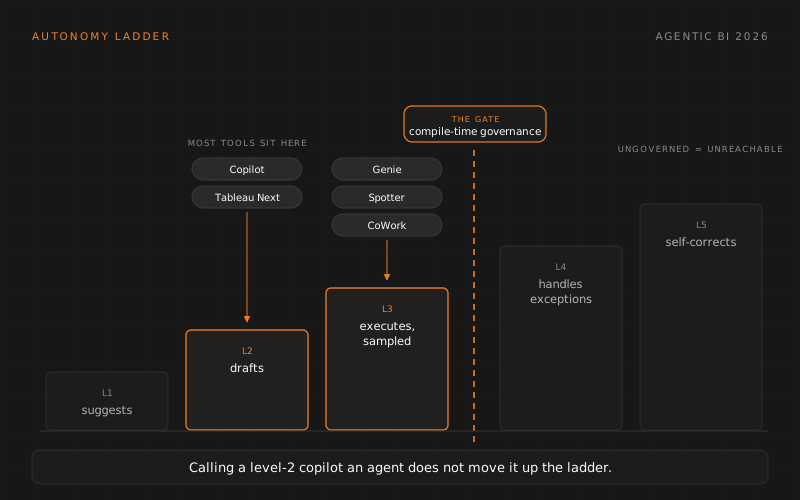
- Answers must reproduce under audit: require deterministic SQL and compile-time governance before comparing anything else.
Run the semantic layer evaluation checklist against the shortlist, and price it with the semantic layer pricing comparison.
Where Colrows changes the math (our product)
Colrows treats the six-step job as a compilation problem rather than a generation problem. The question resolves against a typed semantic graph, the join path is proven rather than guessed, and governance applies before execution.
The practical result is reproducibility. The same question returns the same SQL, which is what lets a five-step investigation stand up to an audit months later. We publish our own figures with their method attached on the research page. We hold them to the same standard we applied above.
A note on the claims
Pricing and caps come from each vendor's published pages as of late August 2026. Where a vendor publishes no price we say so rather than quote a third-party estimate as list price. Benchmark context comes from the public Spider 2.0 leaderboard and the papers behind it. Colrows sells a competing product, and we wrote the sections above with that disclosed. We review this page quarterly.
Frequently asked questions
What is an AI data analyst tool?
An AI data analyst tool answers business questions from company data without a person writing SQL. The weaker versions translate one question into one query. The stronger versions decompose a question, run several queries, rank the drivers behind a change, and return a written answer with citations. The difference decides whether the tool removes analyst work or simply relocates it.
How accurate are AI data analyst tools?
Nobody can tell you independently, because no major vendor has submitted to a public benchmark. On Spider 2.0, which uses realistic enterprise schemas, the strongest published academic systems score roughly 55 to 60 percent. Snowflake reports more than 90 percent for Cortex Analyst. That figure comes from an internal 150-question set published in August 2024, and Snowflake has not refreshed it since.
Which AI data analyst tools publish their pricing?
Very few. Hex publishes 36 dollars per editor per month on Professional and 75 dollars on Team. ThoughtSpot publishes 25 dollars per user per month on Essentials and 50 dollars on Pro. Tellius, Zenlytic, Sigma and Querio all require you to contact sales. Databricks Genie is free through 31 January 2027 with no published price after that date.
What usage caps should I check before buying?
Check the caps that bite at scale rather than the headline price. ThoughtSpot limits its Pro tier to 25 Spotter AI queries per user per month, with unlimited use reserved for Enterprise. Databricks limits a Genie Agent to 30 tables or views. Snowflake Cortex Analyst has no memory of previous query results within a conversation, which limits genuine multi-step work.