Platform-bound conversational BI vs governed conversational analytics
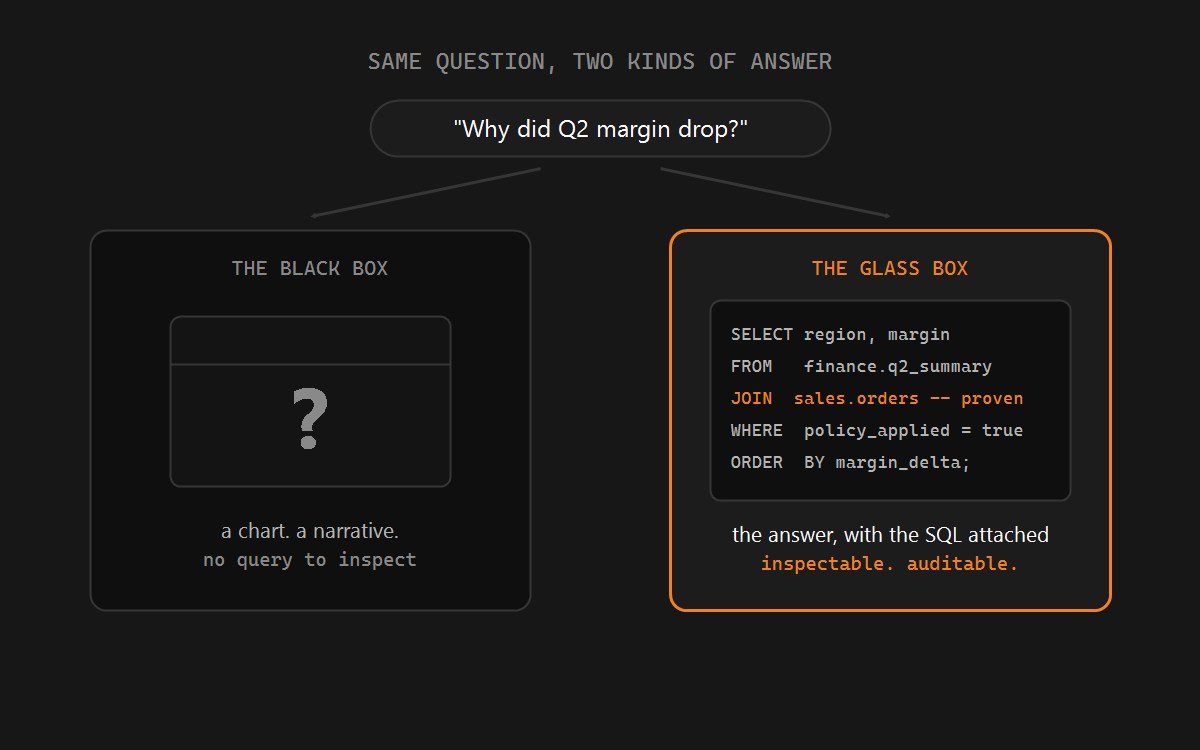
| Dimension | Typical conversational BI assistant | Governed conversational analytics (Colrows) |
|---|---|---|
| Reach | Bound to one BI suite or warehouse | 16+ engines, one governed graph |
| Governance | Applied at query time, platform-native | Compile-time; unauthorized plans cannot be generated |
| Determinism | Nondeterministic; answers can vary | Deterministic; same question, same answer |
| Audit | Partial query logs | Point-in-time reproducible audit trail |
The scorecard
Scored High / Medium / Limited on the four enterprise factors. Directional, not lab numbers.
| Tool | Governance timing | Determinism | Reach | Best for |
|---|---|---|---|---|
| Colrows | Before execution | High | 16+ engines | Governed, cross-warehouse agents |
| ThoughtSpot Spotter | Platform | Medium | Multi-cloud | Search-driven self-service at scale |
| Power BI Copilot | At query time | Medium | Microsoft ecosystem | Microsoft-first shops |
| Tableau Pulse | At query time | Medium | Tableau Cloud | Metric monitoring for Tableau users |
| Cortex Analyst | At execution (RBAC) | Medium | Snowflake only | Snowflake-native self-serve |
| Databricks Genie | At execution (Unity Catalog) | Medium | Databricks only | Lakehouse-native BI |
| Sigma | Warehouse-native | Medium | Snowflake/Databricks/BigQuery/Postgres | Governed spreadsheet exploration |
Fix the Context, Not the Model. Every tool here uses a capable model. What separates them is the context and governance around the model, not the model itself.
The tools, by job to be done
1. Colrows - governed, deterministic, cross-warehouse
Colrows compiles questions into deterministic SQL across 16+ engines with governance enforced before execution. Best when answers must reproduce and span more than one platform, especially in regulated settings.
2. ThoughtSpot Spotter - search-driven self-service
ThoughtSpot Spotter pairs a search-token architecture with an agentic semantic layer for thousands of business users across clouds.
3. Power BI Copilot - Microsoft-first
Power BI Copilot is the natural pick inside Microsoft. Watch determinism; see why Copilot gives wrong answers.
4. Tableau Pulse - metric monitoring for Tableau
Tableau Pulse is a metric-insight feed inside Tableau Cloud. Great for following metrics, bounded to one source per metric.
5. Snowflake Cortex Analyst - Snowflake-native
Cortex Analyst is fast and low-friction for Snowflake-only estates. Two 2026 changes matter for budgeting: since 1 April 2026 AI consumption bills against a separate AI Credit currency ($2.00 per credit global, $2.20 regional, roughly 67 credits per 1,000 messages), and Cortex now reads Snowflake Semantic Views in place of the older semantic models. Snowflake Intelligence was renamed Snowflake CoWork at Summit 2026.
6. Databricks Genie - lakehouse-native
Databricks Genie inherits Unity Catalog governance, capped at 30 tables per Space. Its semantic substrate, Unity Catalog Metric Views, reached GA on 2 April 2026 and was open-sourced into Apache Spark - but MEASURE() still cannot nest inside an aggregate, and the definitions stay Databricks-only.
7. Sigma - governed spreadsheet exploration
Sigma connects live to major warehouses with an "Ask Sigma" agent that respects warehouse roles and row-level security.
Conversational BI vs conversational analytics tools
The two names get used for the same software, and the difference is worth stating, because it changes which tool fits.
Conversational BI tools put a chat box on an existing business intelligence stack. Power BI Copilot, Tableau Pulse, and ThoughtSpot Spotter are all this shape. The assistant inherits that platform's semantic model, its permissions, and its boundary. Ask about data the platform does not hold, and it cannot answer.
Conversational analytics tools is the broader term. It covers the same chat interface. It also covers warehouse-native assistants such as Snowflake Cortex Analyst and Databricks Genie, which answer over the warehouse rather than a BI semantic model. The interface defines the category, not the stack underneath.
That breadth is exactly why the term is a poor buying filter on its own. Two products can carry the same conversational analytics tools label and still differ on what decides enterprise fit. Does governance run before or after the query? Does the same question return the same number twice? Can the tool reach data outside its home platform? Those are the three axes the scorecard above scores, and they matter more than which label a vendor uses.
How to choose
- Single BI suite or warehouse, want the native assistant: Copilot, Pulse, Cortex, or Genie.
- Search-driven self-service for thousands: ThoughtSpot Spotter.
- Deterministic, governed answers across warehouses, especially regulated: evaluate Colrows.
- Betting on portable definitions: track Open Semantic Interchange, which entered the Apache Incubator as Apache Ossie in June 2026 - but treat cross-vendor portability as a 2027 question, not a 2026 one.
Before shortlisting, run the semantic layer evaluation checklist against each candidate, and price the ones you keep against Power BI Copilot pricing and ThoughtSpot pricing - per-seat and per-capacity models diverge sharply once usage scales.
The same field has since rebranded. Agentic BI tools places these vendors on a five step autonomy ladder, and most of them stop at level 2.
For the wider field, AI data analyst tools scores these vendors on what they can actually prove, and not one of them has submitted to a public benchmark.
Frequently asked questions
What is conversational BI?
Conversational BI lets business users ask questions of their data in plain language and get governed answers, charts, or insights, without writing SQL or building dashboards. It is the natural-language front end to analytics.
What is the main weakness of most conversational BI tools?
Most are bounded to one platform (their own BI suite or warehouse), govern data at query time rather than before generation, and are nondeterministic, so the same question can produce different SQL and different numbers. That is a problem for regulated or cross-warehouse use.
Which conversational BI approach is best for regulated enterprises?
A compile-time semantic execution layer that produces deterministic SQL, enforces governance before execution, and spans warehouses. Colrows is built for this; platform-native assistants like Cortex Analyst, Genie, Copilot, and Pulse are strong inside their own ecosystems.
What is the difference between conversational BI and conversational analytics tools?
Conversational BI tools add a chat interface to an existing business intelligence platform, so they inherit that platform's semantic model and its boundary. Conversational analytics tools is the wider term, and it also covers warehouse-native assistants that answer over the warehouse directly. The label does not tell you how the tool governs access or whether its answers are reproducible.