Listed price vs what you actually pay
| Dimension | What the pricing page shows | What lands on the bill |
|---|---|---|
| The headline | A per-seat or per-developer figure | Seats plus a second consumption meter, plus warehouse compute |
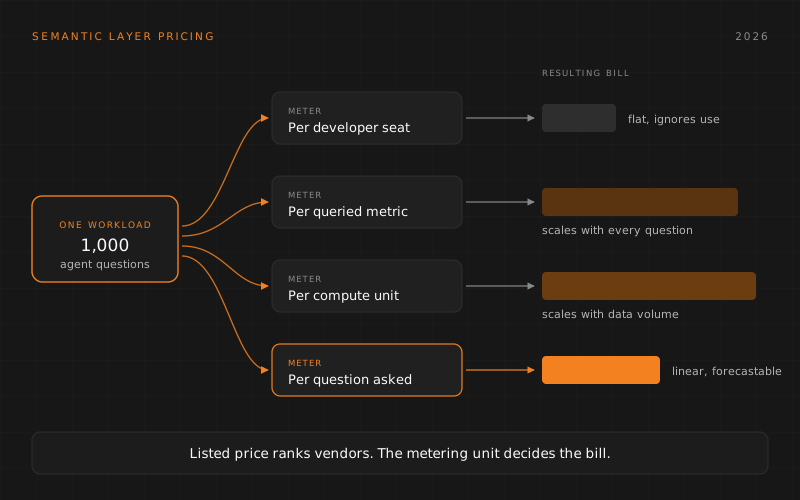
| The unit | Stated once, rarely explained | Decides whether agent traffic is free or ruinous |
| The spike | Not shown | Triggered by query volume, token burn, or capacity exhaustion |
| Forecasting | Implied to be linear in users | Linear in questions, which agents multiply without warning |
Our comparisons and evaluations hub covers architecture; this page covers the money.
The scorecard
Listed prices are the vendors' own, verified on the dates each teardown notes. Real-cost figures are third-party medians, and we label them as such. Directional, not quotes.
| Platform | Listed entry | Metering unit | What triggers overage | Forecastable |
|---|---|---|---|---|
| Cube | $40/developer/mo (Starter) | Developer seat plus Cube Compute Units | Query volume, pre-aggregation builds, AI beyond seat grant | Medium |
| dbt Semantic Layer | ~$100/developer/mo (Team) | Developer seat plus ~$0.075 per queried metric | Every metric a dashboard, notebook, or agent requests | Low |
| AtScale | No public list price | Per deployment, scoped by data volume and users | Aggregate storage and compute, added environments | Low |
| Looker | Call sales (all editions) | Per seat by role, plus Gemini data tokens | Token burn from 1 Oct 2026, extra instances, ~5% renewal uplift | Low |
| Power BI Copilot | $262.80/mo (F2) plus $14/user Pro | Rented Fabric capacity, drawn down in CU-seconds | Capacity exhaustion, which stops all workloads | Low |
| ThoughtSpot | $25/user/mo (Essentials) | User seat, plus ~$0.10/query past the Spotter allowance | The 51st user, the 26-millionth row, agent query volume | Medium |
| Colrows | Free POC, then custom annual | Natural-language requests submitted | Nothing hidden. Dashboards and re-runs are unmetered | High |
Fix the Context, Not the Model. A well-governed semantic layer that understands business context creates more reliable AI-driven analytics than fine-tuning the model itself. The same logic applies to cost. You do not fix an unpredictable bill by negotiating the rate. You fix it by changing what gets counted.
The six, by what they count
1. Cube - two meters, one of which is invisible
Starter is $40 per developer per month, Premium $80. The seat is the visible half; Cube Compute Units are the other. Starter bills about $0.10 per CCU against a $99 monthly minimum. Premium bills about $0.25 against a $10,000 annual commit.
AI adds a third meter, and the per-seat token grant is worth half the seat price. Cube Core stays Apache 2.0 and free to self-host, though you then own the infrastructure. Full detail in the Cube pricing teardown.
2. dbt Semantic Layer - the per-metric charge, not the seat
The Semantic Layer is not available on the free Developer tier, so real use starts at roughly $100 per developer per month. On top of that sits approximately $0.075 per queried metric. Every metric a dashboard, notebook, or agent requests counts. Public reports put ten to twenty developers at $40,000 to $95,000 per year. dbt Labs and Fivetran announced a merger in 2026, so packaging may shift. See the dbt Semantic Layer pricing teardown.
3. AtScale - no list price by design
There is no self-serve tier and no published entry price. AtScale sells a negotiated annual licence per deployment, scoped by data volume, user population, environments, and support tier. Public discussion points to mid-market deals in the low tens of thousands per year and large deployments well into six figures. AtScale bills semantic modelling and aggregate design as services. Those services can rival the licence over the first year. Detail in the AtScale pricing teardown.
4. Looker - unpriced platform, priced tokens
As of 21 August 2026 all three editions read "Call sales." Each edition includes one production instance, ten Standard Users, and two Developer Users. Google licenses additional seats per role and does not price those either.
The one published meter is Gemini data tokens. Standard allows 60M input and 1.2M output tokens monthly; Embed allows 1.2B and 24M. Overage is free within fair use until 30 September 2026, then bills at $3.00 per million input tokens and $20.00 per million output tokens. Reported platform fees run around $60,000 to $66,600 per year, and marketplace data attributed to Vendr across 355 analysed deals averaged about $150,000 per year. See the Looker pricing teardown.
5. Power BI Copilot - you rent capacity, not a licence
Microsoft hosts Copilot rather than licensing it. You rent Fabric capacity by the month, at $262.80 for an F2 and $8,409.60 for an F64. Copilot then draws tokens against that capacity at 100 capacity-unit seconds per 1,000 input tokens, and 400 per 1,000 output. Below F64 you also pay $14 per Pro seat.
When the capacity runs out, all operations stop, not just Copilot. Microsoft's worked example implies an F64 serves over 13,824 requests a day. One Fabric Community measurement recorded roughly 10,000 CU-seconds for a single question, about 25 times that example. Read the Power BI Copilot pricing teardown.
6. ThoughtSpot - the cleanest list price, the widest gap
Essentials is $25 per user per month billed annually, capped at 50 users and 25M rows. Pro starts at $50 per user per month and includes 25 Spotter AI queries per user per month, with roughly $0.10 per query after that. Vendr data from February 2026 covers 30 recorded purchases.
The median annual cost is $92,521, and the range runs from $36,736 to $231,060. Implementation typically adds a further 15 to 40 percent of first-year subscription value. Even the smallest recorded contract costs about twelve times what fifty Essentials seats would. Full workings in the ThoughtSpot pricing teardown.
Three traps that only appear once agents arrive
Vendors built per-query meters for humans. A person clicks a dashboard and issues one query. An agent answers one business question and may issue dozens of internal calls. Each of those calls bills separately on a per-metric or per-query meter. We see this budgeting error more than any other. Per-query billing is why conversational BI tools often cost more in month three than the pilot suggested.
Token meters compound quietly. Looker's tokens and Power BI's capacity seconds both scale with the volume of context handed to the model, not with the number of questions. A larger schema means a larger prompt means a larger bill for the same question. We covered the mechanism in the hidden token tax on brittle semantic layers.
Warehouse compute is nearly always a separate bill. Every tool here generates SQL that runs somewhere else. Warehouse-native options narrow that gap. If you standardise on one platform, check Snowflake Semantic Views and Databricks Metric Views first. Both platforms now include those objects at no extra licence cost.
How to budget for one
- Small team, code-first, dbt already in place: dbt Semantic Layer, but model the per-metric charge against your real query volume first.
- Embedded analytics or an API-first product: Cube, budgeting CCUs as a separate line from seats.
- Large OLAP or Excel estate: AtScale, with services costed at up to the licence again in year one.
- Single-platform shop: take the warehouse-native option first. Your platform usually includes it.
- Agent traffic at any real volume: insist on a meter where one question counts once. Anything per-step will surprise you.
Before you shortlist, run the semantic layer evaluation checklist against each candidate. Compare the architectures in dbt vs Cube vs AtScale. If you are weighing an in-house build, the build vs buy TCO analysis has the labour cost.
Where Colrows changes the math (our product)
Colrows meters the natural-language requests that people and applications submit. One agent call counts once, however many internal steps it takes to resolve. Colrows does not meter dashboards, reports, or re-runs. You already paid for that answer, so reading it again costs nothing.
This meter removes the agent-era trap above. It counts the same unit a business already forecasts, which is questions asked rather than steps executed. Proof-of-concept runs free, and we write the model into the contract rather than the FAQ. The Colrows pricing page carries the full model, and explains why SaaS and on-premise differ.
A note on the claims
Listed prices come from each vendor's own pricing page, on the verification dates the linked teardowns give. Real-cost figures come from third parties, chiefly Vendr. They are medians across recorded contracts, not quotes. Where a source publishes a range or a competing benchmark, we say so. Colrows sells a competing product, and we wrote the sections above with that disclosed. We review this page quarterly, because pricing in this category moves.
An agent that decomposes one question into twenty calls bills twenty times. Agentic BI tools shows which vendors actually run multi-step.
For the architectural comparison behind these meters, see best semantic layer tools.
Frequently asked questions
How much does a semantic layer cost in 2026?
It depends on the metering unit, not the listed price. Self-serve starts near $40 per developer per month on Cube and roughly $100 on dbt. Enterprise contracts land far higher: ThoughtSpot's median recorded annual cost is $92,521, and reported Looker deals average around $150,000 per year. AtScale publishes no list price at all.
Why is my semantic layer bill higher than the listed price?
Because seats are rarely the only meter. Cube adds compute units. dbt charges per queried metric. Power BI Copilot draws tokens against rented capacity, and ThoughtSpot Pro charges per query past its Spotter allowance. Your warehouse then bills the compute separately.
Which semantic layer pricing model is safest for AI agents?
Any model that meters the question rather than the step. Vendors built per-query meters for humans, and one agent question can trigger dozens of internal calls. Look for a meter that counts one natural-language request once, and that does not meter dashboards or re-runs.
Does AtScale publish a list price?
No. AtScale sells a negotiated annual enterprise licence per deployment, with no self-serve tier. Public discussion points to low tens of thousands per year for mid-market and well into six figures for large deployments, but treat those as directional. Multi-year commits and capacity minimums are common.