What the other listicles score, and what decides production fit
| Dimension | Scored by nearly every listicle | Scored here |
|---|---|---|
| Correctness | Absent | Published accuracy evidence, with the sample size |
| Governance | One column, yes or no | When the check runs, before or after the plan |
| Reach | Integration logos | Counted dialects the tool compiles |
| Agent access | A row labelled AI readiness | Which API, and which plan gates it |
We checked the pages currently ranking for this term. A vendor that appears in its own list wrote every one, and none scores output correctness at all. Our comparisons and evaluations hub holds the head-to-head versions of these matchups.
The scorecard
Accuracy figures are each vendor's own published benchmark, with the sample size stated so you can weigh them. Directional, not lab numbers.
| Tool | Published accuracy evidence | Governance timing | Dialect reach | Agent API |
|---|---|---|---|---|
| Colrows | First-party benchmark | Before execution | 16+ engines | Governed, no plan gate |
| Cube | 67.7 to 68.7 percent, n=100, arXiv | At execution | ~34 sources | MCP, Premium and above |
| dbt Semantic Layer | 98.2 to 100 percent, n=11, in-scope only | At execution | 6 platforms | GraphQL, JDBC, MCP |
| AtScale | 92.5 percent, n=40, TPC-DS, Aug 2024 | At execution | 11 platforms | MCP, SQL, MDX, Python |
| Snowflake Semantic Views | None published | At execution (RBAC) | Snowflake only | Read by Cortex |
| Databricks Metric Views | None published | At execution (Unity Catalog) | Databricks only | Read by Genie |
| Looker and LookML | None published | At query time | ~35 engines, BigQuery for headless | MCP, still preview |
| GoodData | None published | At execution | 22 sources | MCP, GA Jan 2026 |
Fix the Context, Not the Model. A well-governed semantic layer that understands business context creates more reliable AI-driven analytics than fine-tuning the model itself. The benchmarks below show the second half of that sentence. Context lifts accuracy sharply. Context alone does not finish the job.
Two vendor benchmarks that disagree
Two semantic layer vendors published accuracy numbers three weeks apart in April 2026, and they do not agree.
Cube published the more conservative figure. Its paired benchmark ran 100 natural-language questions across three frontier models, with and without a semantic layer document. Accuracy moved from roughly 46 to 50 percent on raw schema, up to roughly 68 percent with the layer. Cube released the code and the paper, and reported the gain as statistically significant.
dbt Labs published a much higher figure. Its update reported 90.0 percent rising to 98.2 percent on one model and 84.1 percent rising to 100 percent on another. That test used 11 questions, and the write-up states the perfect score applies to questions already within the semantic layer scope.
Read them together and the honest reading is this. A semantic layer is the largest single accuracy lever available, and roughly one question in three still fails at the layer alone. That gap is the argument for compiling and proving the query rather than retrieving a definition and hoping. We set out the mechanism in deterministic vs probabilistic text-to-SQL and the production shortfall in the text-to-SQL benchmark.
The eight, by what they are for
1. Colrows - compiles rather than retrieves
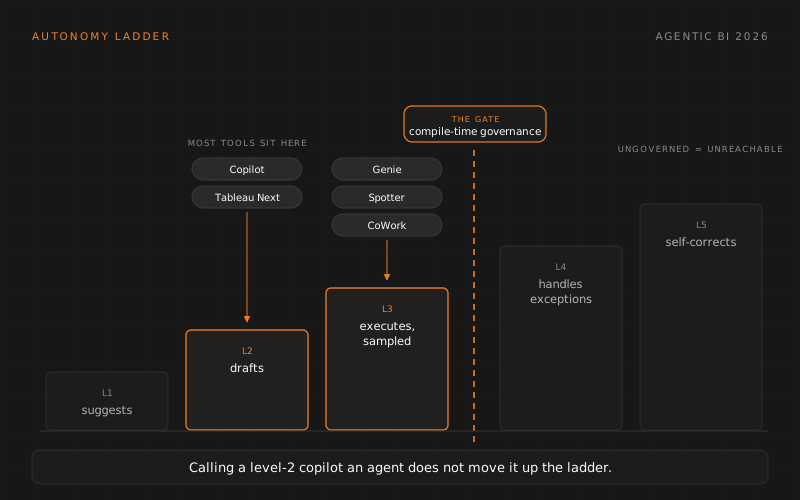
Colrows resolves a question against a typed semantic graph, proves the join path, and applies row and column rules before any SQL exists. Governance runs at compile time, so an unauthorised plan is unreachable rather than blocked. Best when answers must reproduce and span more than one platform.
2. Cube - the broadest headless option
Cube documents roughly 34 data sources and exposes REST, GraphQL, and a SQL API on the Postgres wire protocol. Its MCP server reached general availability with 23 tools, gated to Premium and Enterprise plans. One governance caveat sits in its own docs. Cube states that the accessible views setting is not a security control. Leaving it empty exposes every view.
3. dbt Semantic Layer - strongest if you already run dbt
dbt Semantic Layer compiles MetricFlow definitions into warehouse SQL. MetricFlow itself became Apache 2.0 in October 2025, but the Service Layer and the APIs stay cloud-only. Fivetran completed its merger with dbt Labs on 1 June 2026. Two operational notes matter for agents. The Fusion engine was still at preview build 218 in late August 2026. The remote MCP server also blocks every tool once the account runs out of Copilot actions.
4. AtScale - the OLAP and Excel estate
AtScale serves live aggregates to Excel and legacy BI through MDX as well as SQL. There is no public list price and no self-serve tier. AtScale bills modelling and aggregate design as services. Those services can rival the licence in year one.
5. Snowflake Semantic Views - included, and bounded
Semantic Views put definitions in the Snowflake catalogue where Cortex reads them directly. They cost no extra licence. They also do not leave Snowflake, so a second warehouse means a second set of definitions.
6. Databricks Metric Views - the same trade on the lakehouse
Unity Catalog Metric Views reached general availability on 2 April 2026 and were open-sourced into Apache Spark. MEASURE() still cannot nest inside an aggregate, and the definitions stay inside Databricks.
7. Looker and LookML - governed, and expensive to staff
LookML remains a mature modelling language with real governance. The cost is a specialist practice: LookML is a skill you hire for, and the definitions serve Looker first.
8. GoodData - API-first, with a large preview surface
GoodData renamed itself GoodData.AI on 30 April 2026 and shipped an MCP server in January 2026 across 22 documented data sources. Weigh the maturity honestly. Much of its AI surface, including column-level permissions, sat in beta or experimental status through mid-2026. GoodData also removed two connectors in August 2026.
How to read a vendor accuracy claim
Three vendors on this list publish an accuracy number. The numbers range from 68 percent to 100 percent, and the spread comes from method, not from product quality. Four questions separate a usable claim from a press release.
- How many questions? Cube used 100. dbt used 11. AtScale used 40. With a small set, one question can swing the score by many points.
- What counts as in scope? dbt reports a perfect score for questions already inside the layer scope. That scope excludes whatever the layer cannot answer.
- How old is the number? AtScale published 92.5 percent in August 2024, before two years of model turnover. AtScale has not refreshed it since.
- Can you rerun it? Cube published its code and paper. Most vendors publish neither.
AtScale made the fairest observation in the category. It noted that vendors generally do not share their data or evaluation methods. A 90 percent claim sounds impressive, and nobody outside the vendor can check it. Apply that standard to every number here, ours included. The honest summary is that no semantic layer vendor has submitted to a public, independent text-to-SQL benchmark.
How to choose
- You run one warehouse and nothing else: take the native option. Your platform includes it, and it is enough.
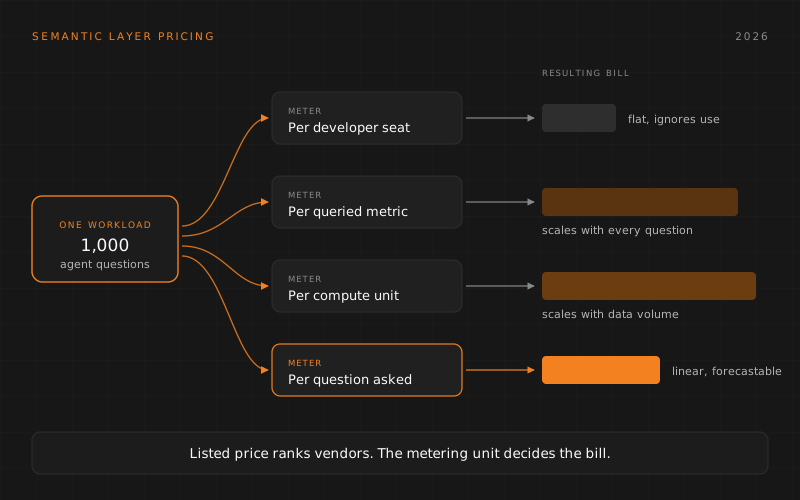
- You are a dbt shop: dbt Semantic Layer, but model the per-metric charge against real query volume first.
- You need embedded analytics or an API-first product: Cube.
- You have a large Excel and OLAP estate: AtScale.
- Answers must reproduce and cross platforms under a regulator: require compile-time governance and proven join paths.
Run the semantic layer evaluation checklist against every candidate. Price the shortlist with the semantic layer pricing comparison. If you are weighing an in-house build, build vs buy carries the labour cost. For the narrower question of which layer suits AI agents specifically, see best semantic layer for AI agents, and to score candidates against a fixed framework, the semantic layer buyer's guide.
A note on the claims
Accuracy figures come from each vendor's own published benchmark. We give the sample size beside every one, because the sample size decides how much a figure is worth. Product status, limits, and dates come from vendor documentation as of late August 2026, and preview status in this category changes quickly. Colrows sells a competing product, and we wrote the sections above with that disclosed. We review this page quarterly.
Frequently asked questions
What is the best semantic layer tool in 2026?
There is no single best tool, because the categories solve different problems. Cube and dbt Semantic Layer suit code-first teams that want a headless layer across several warehouses. The platform includes Snowflake Semantic Views and Databricks Metric Views at no extra licence cost, which settles the question if you run only that platform. LookML suits estates already standardised on Looker. Score on published accuracy evidence and governance timing rather than on feature counts.
Do semantic layers actually improve AI accuracy?
Yes, but the published gains are smaller than the marketing suggests. Cube ran a 100-question benchmark and published it on arXiv in April 2026. Accuracy rose from roughly 46 to 50 percent on raw schema, up to roughly 68 percent with the layer. dbt Labs published a competing figure three weeks earlier, of 98.2 to 100 percent. That test used 11 questions, and counted only questions already inside the layer scope. A semantic layer clearly helps. A layer on its own does not make the answer certain.
What is the difference between a semantic layer and headless BI?
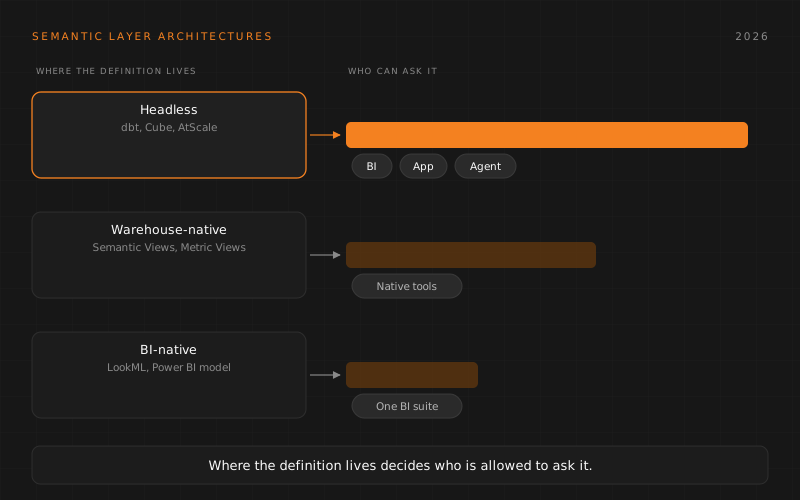
Headless BI describes the delivery model, and a semantic layer describes the content. A headless tool serves metric definitions over an API to any consumer instead of rendering its own dashboards. Every headless BI product contains a semantic layer. A semantic layer can also live inside a warehouse or a BI tool, where only that platform reads it.
Which semantic layer works across more than one warehouse?
Cube documents roughly 34 data sources across official and community drivers. GoodData documents 22. dbt Semantic Layer supports six platforms, and its own docs list five on one page and six on another. Snowflake Semantic Views and Databricks Metric Views work only on their own platform. Colrows compiles across 16 or more engines from one governed graph.