Two currencies, one invoice
| Path | Billed in | Unit |
|---|---|---|
| Cortex Analyst, standalone API | Platform Credits | 67 per 1,000 messages |
| Cortex Agents and CoWork | AI Credits | Per million tokens, per model |
| Cortex Search | AI Credits | Per GB indexed per month |
| Running the generated SQL | Platform Credits | Warehouse compute, always extra |
AI Credits are a separate currency, and Snowflake states that the Platform Credit discount does not apply to them. The semantic layer pricing comparison puts that meter beside the rest of the field. Our comparisons hub holds the cross-vendor versions of this analysis.
The stack, layer by layer
Status and dates come from Snowflake release notes. Directional, not lab numbers.
| Product | Answers | Status | Depends on | Limit to know |
|---|---|---|---|---|
| Semantic Views | What does this metric mean | GA, SQL access Mar 2026 | Tables and views | Snowflake only |
| Cortex Analyst | What is the number | GA | Semantic Views | No cross-query memory |
| Cortex Search | Where is this text | GA | Indexed columns | 20 QPS per service |
| Cortex Agents | Which tool should run | GA Nov 2025 | Analyst and Search | Token billed, no published caps |
| CoWork | Why did it move | GA Nov 2025, renamed Jun 2026 | Cortex Agents | Deep Research capped at 10 minutes |
| Cortex Sense | Builds context automatically | Preview, no docs page | Query history and metadata | Not generally available |
Fix the Context, Not the Model. A well-governed semantic layer that understands business context creates more reliable AI-driven analytics than fine-tuning the model itself. Snowflake reached the same conclusion. Its documentation now names Semantic Views as the recommended substrate for new work. Cortex Sense exists to build that context when nobody has authored it.
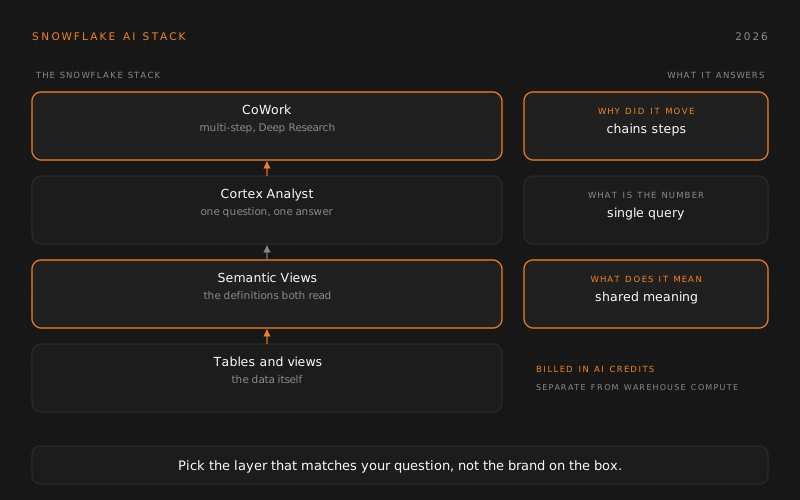
The layers, and the question each answers
1. Semantic Views - the definitions everything else reads
Semantic Views hold metrics, dimensions, and relationships as a schema-level object. Standard SQL can query them by name since March 2026, and Autopilot can generate a first draft from your schema. Snowflake now recommends them over the older stage-hosted YAML semantic models for new implementations. They cost no extra licence, and they do not leave Snowflake.
2. Cortex Analyst - one question, one query
Cortex Analyst is the text-to-SQL API. Cortex Analyst is fast, low-friction, and single-turn by design. Snowflake's own documentation states it has no access to results from previous SQL queries, so a genuine multi-step chain needs Cortex Agents above it. Its published accuracy figure of more than 90 percent comes from an internal 150-question set published in August 2024. Snowflake has not refreshed it since.
3. Cortex Search - the half people forget
Cortex Search is hybrid vector and keyword retrieval over text, and semantic search on corporate data covers why that half matters. Cortex Search is the piece that makes unstructured content answerable alongside your tables. Two published limits shape design. A service handles 20 queries per second, with 140 across the account. A materialised query set stays under 400 million rows. It bills per gigabyte indexed per month, plus embedding tokens and warehouse compute.
4. Cortex Agents - the orchestration loop
Cortex Agents runs the plan, call, and reflect loop that turns Analyst and Search into something that can answer a question requiring several steps. It reached general availability in November 2025 and gained AI guardrails and evaluations through 2026. Note the identity model. Agents run under the caller's role, so the agent inherits the human grant rather than a narrower one. Governance tools for AI agents examines that pattern across vendors.
5. CoWork - the application layer, formerly Snowflake Intelligence
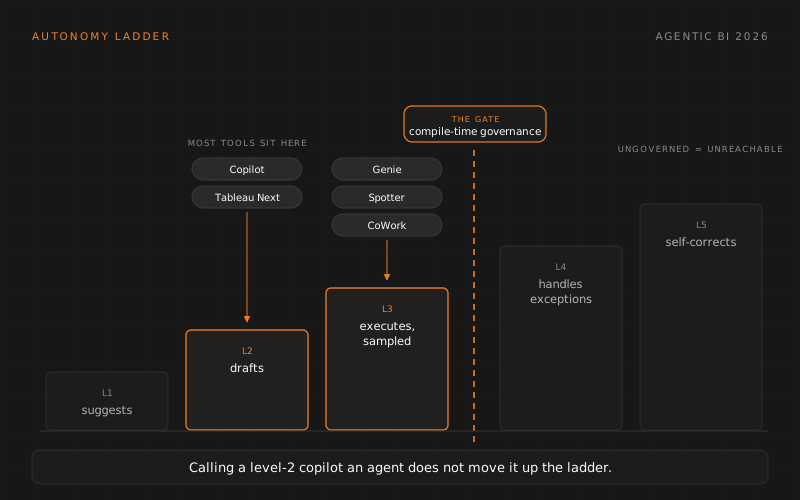
CoWork is what a business user actually opens, and it sits at the top of the ladder in agentic BI tools. Its Deep Research mode decomposes a question, pulls from several sources, and returns a cited report. Investigations cap at ten minutes. Snowflake renamed Snowflake Intelligence to CoWork at Summit 2026. It renamed Cortex Code to CoCo at the same event. The product reached general availability in November 2025, so the rename is not a launch date.
6. Cortex Sense - the context layer, still in preview
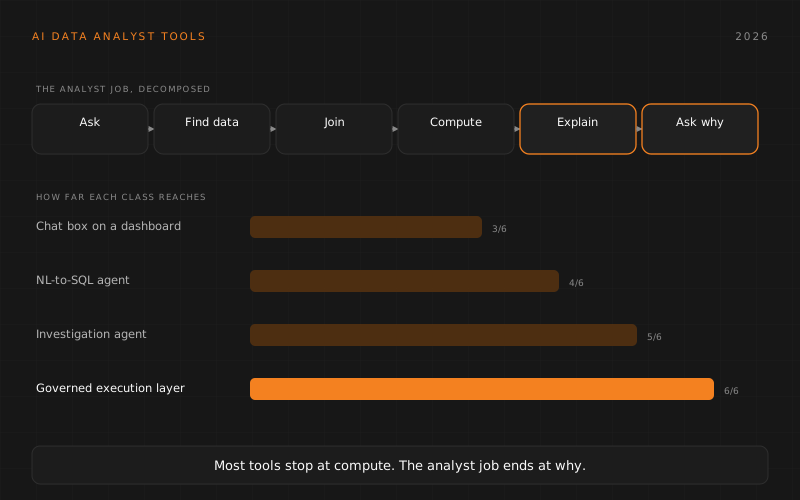
Cortex Sense mines query history, metadata, and dashboards to assemble context without anyone authoring a semantic model. Snowflake reports it lifted accuracy from 24.1 percent to 86.3 percent on an internal benchmark in June 2026. Treat that as directional, in the way AI data analyst tools treats every vendor accuracy claim. Cortex Sense was still in preview with no documentation page in late August 2026, and Snowflake's own pages described its status inconsistently.
Four ways teams get this stack wrong
Treating the rename as a launch. CoWork reached general availability in November 2025, and Snowflake renamed it in June 2026. A roadmap deck that treats the rename as a release date understates how long the product has existed. Consumption data still carries the old service identifier.
Mixing the two credit currencies. Cortex Analyst bills in Platform Credits through its own API and switches to token-based AI Credits when called through Cortex Agents. The same question costs differently depending on which door it came through, and the Platform Credit discount does not apply to AI Credits.
Forgetting the warehouse bill. Every figure above covers generating the SQL. Running it is separate warehouse compute in every case, which is the line most pilots forget until the second month.
Planning on a preview. Cortex Sense is the most interesting thing in this stack and the least available. It had no documentation page in late August 2026 and Snowflake's own pages disagreed about its status. Track it, do not schedule against it.
The identity model is the quiet risk
Cortex Agents run under the calling user's role. That sounds reasonable and it is, until an agent starts behaving like software rather than a person.
A human analyst with broad entitlements asks a handful of questions a day and opens a fraction of the tables they can reach. An agent with the same role can issue hundreds of queries an hour across every object in scope. The grant did not change, but the exposure did.
Snowflake's managed MCP server documents the tighter path and is worth following. Use OAuth rather than personal access tokens, which Snowflake explicitly does not recommend because a leaked token becomes a standing grant. Then scope the role you hand the agent to the question it exists to answer, rather than to the person who triggered it.
How to pick a layer
- You need one number reliably: Semantic Views plus Cortex Analyst, and nothing above it.
- You need to search documents and tables together: add Cortex Search.
- You need multi-step answers with citations: CoWork, and budget in AI Credits.
- You have nobody to author semantic models: watch Cortex Sense, but do not plan a rollout on a preview.
- Your definitions must match a second platform: a Snowflake-only object cannot solve that, by design.
Compare the equivalent lakehouse stack in Databricks AI and BI tools compared, and the head-to-head in Cortex Analyst vs Genie.
Where Colrows changes the math (our product)
Everything above is the right answer for a single-platform estate, and we say so plainly. Semantic Views cost nothing extra, Cortex Analyst is quick to stand up, and CoWork gives business users a real surface.
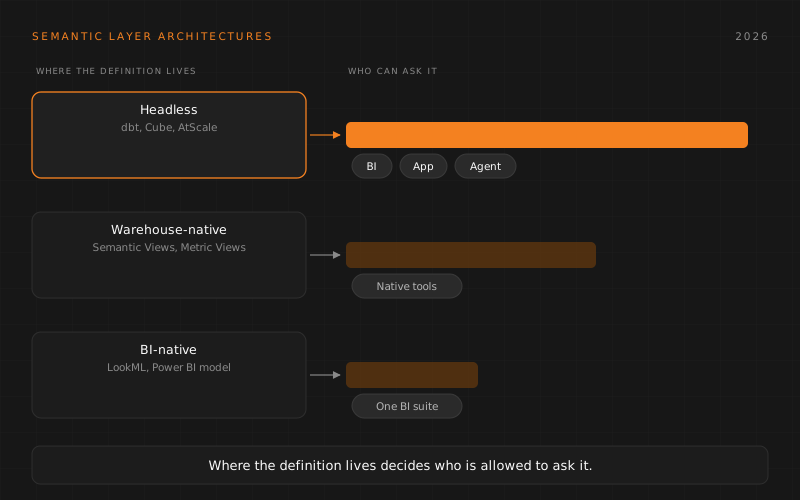
The calculus changes when definitions must agree across platforms. A Snowflake-only object cannot govern a question that touches Databricks or BigQuery. A second warehouse therefore means a second set of definitions, and a reconciliation problem nobody owns. Colrows compiles one governed graph across 16 or more engines. It applies policy before execution and returns the same SQL for the same question on every engine.
A note on the claims
Product names, statuses, dates, and limits come from Snowflake release notes and documentation as of late August 2026. Billing figures come from the published Service Consumption Table. Where Snowflake's own pages disagree about a status we say so rather than pick one. Colrows sells a competing product, and we wrote the sections above with that disclosed. We review this page quarterly.
Frequently asked questions
What is the difference between Cortex Analyst and Snowflake CoWork?
Cortex Analyst turns one question into one SQL query against a semantic object. Its documentation states it has no access to results from previous queries, so it is single-turn by design. CoWork is the agentic application above it, and its Deep Research mode decomposes a question into parallel sub-investigations and returns a cited report. Use Analyst for a number and CoWork for an explanation.
Was Snowflake Intelligence renamed?
Yes. Snowflake renamed Snowflake Intelligence to Snowflake CoWork at Summit 2026, in a blog dated 2 June 2026. Two details trip people up. The product reached general availability on 4 November 2025, well before the rename. Consumption data still carries the original Snowflake Intelligence service identifier. Snowflake renamed Cortex Code to CoCo at the same event.
How is Snowflake Cortex Analyst billed?
Through the standalone API it bills at 67 Platform Credits per 1,000 messages, and only successful responses count. Called through Cortex Agents or CoWork it switches to token-based AI Credits instead. AI Credits are a separate currency from Platform Credits and the Platform Credit discount does not apply to them. Snowflake bills warehouse compute for running the generated SQL separately in every case.
Do I still need a semantic layer if I use Snowflake Cortex?
Inside Snowflake, Semantic Views are the recommended substrate and they cost no extra licence, so use them. The question becomes real when definitions must agree across more than one platform. Semantic Views do not leave Snowflake, so a second warehouse means a second set of definitions and a reconciliation problem between them.