Short answer: The biggest company brain challenges are organizational: unclear ownership, stewardship burnout, absent urgency and missing executive sponsorship. The leading technical killers are ontology over-engineering, data fragmentation and vendor lock-in. Base rates are harsh: Gartner expects 80% of D&A governance initiatives to fail by 2027, and IDC finds 88% of AI proofs of concept never reach production. Pass four gates before scaling: crisis urgency, one accountable owner, data ready for the use case, and a 90-day lighthouse.
The Core Problem: Architectural Failure Modes
| Failure Mode | Standard RAG/LLM Approach | Colrows Deterministic Approach |
|---|---|---|
| Logic Drift | Data warehouse changes; AI context becomes stale. Manual sync loops. Hallucinations emerge when context does not match reality. | Compile-time binding. Semantic graph reflects current warehouse state. Changes propagate to the compiler. AI never sees stale context. |
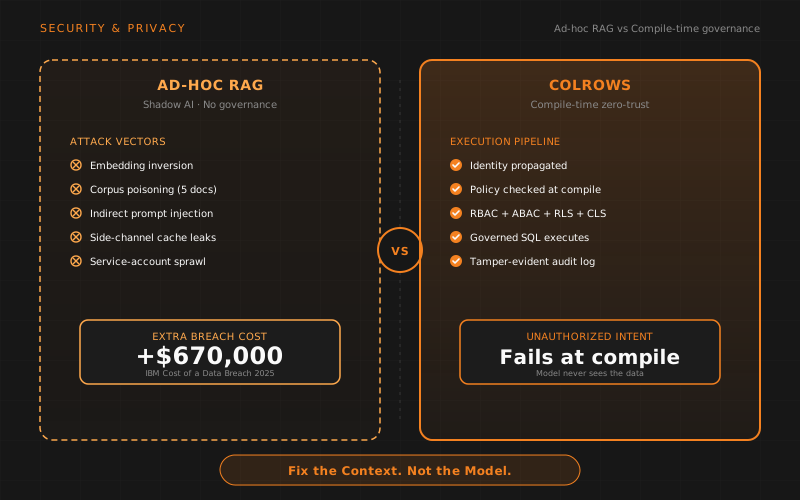
| Data Security | Runtime filters check access before returning results. Inference happens against the full dataset first, then filtered. | Compile-time RBAC/ABAC/RLS. SQL generated with security predicates baked in. AI never queries unauthorized data. |
| Complex Queries | LLM reasons over multi-hop relationships. Hallucination risk scales with query depth. Self-prompting is unreliable on structured data. | Semantic compiler resolves multi-hop joins at compile time. Query proof verified before execution. No hallucination on joins or logic. |
| Maintenance Burden | When schema changes, prompt engineering and retrieval augmentation become manual tasks. Drift is inevitable. | Governance-as-code. Semantic definitions version alongside data model. Drift detection triggers alerts. Maintenance is autonomous. |
TL;DR
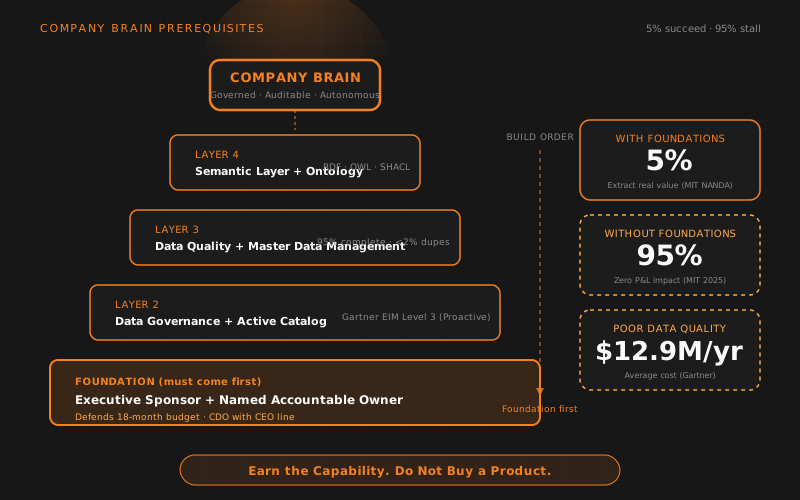
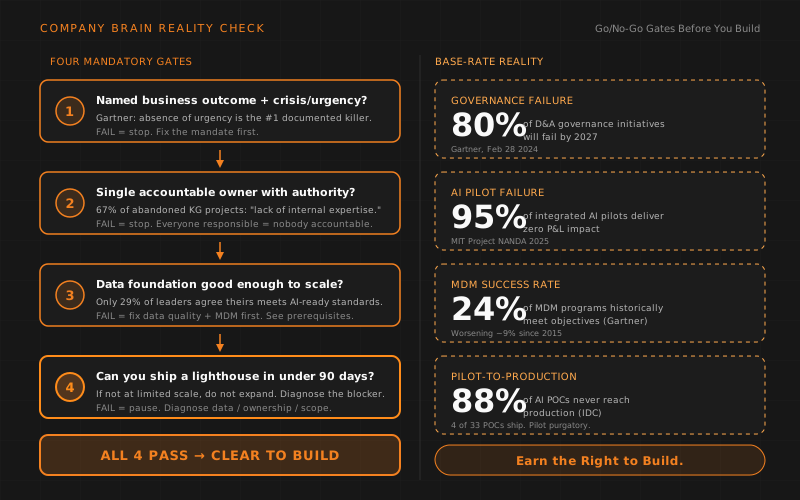
- The base-rate statistics are sobering: 80% D&A governance failure (Gartner), 24% MDM success rate, 88% pilot-to-production failure (IDC), 95% of AI pilots delivering zero P&L impact (MIT NANDA). These are not edge cases. They are the modal outcome.
- The failures are overwhelmingly organizational, not technical. Data fragmentation is technically solvable. Tribal knowledge is partially encodable. Ontology over-engineering and stewardship burnout are the most common technical killers. But unclear ownership, absent urgency, and missing executive sponsorship cause more abandoned projects than all technical problems combined.
- Four go/no-go gates identify the organizations that should build now versus build later versus stop: named business outcome with crisis urgency, single accountable owner with authority, data foundation readiness for the use case, and a lighthouse use case shippable in under 90 days. Fail any gate and fix the root cause before scaling.
- Hyperscalers (Google Knowledge Graph, Microsoft Satori) prove the concept at scale but have teams of hundreds, purpose-built infrastructure, and decade-long timelines. Extrapolating their success to a 20-person enterprise data team is category error. The evidence that works at enterprise scale without hyperscaler resources comes from narrow, well-governed implementations, not ambitious multi-year transformation programs.
The Base-Rate Statistics You Need to Know Before Starting
Any honest assessment of Company Brain and knowledge graph initiatives begins with the failure statistics. Not to argue against building, but because knowing the failure modes is the prerequisite for avoiding them.
The 88% IDC figure means that on average, 4 of every 33 AI proofs of concept reach production. The modal outcome is not a delayed success. It is a cancelled project, a sunk-cost write-off, and a team that moves on to the next initiative without a post-mortem.
Gartner's interpretation of the 80% governance failure rate is direct: initiatives fail primarily because of the absence of a real or manufactured crisis creating urgency. Without urgency, every competing priority wins. Governance becomes a background task until it is cancelled.
The 24% MDM success rate has worsened by approximately 9% since 2015. The data suggests that as data environments become more complex (more sources, more cloud services, more API integrations), organizations are finding MDM harder, not easier, despite better tooling.
The Three Architectural Gaps That Enable Failure
The Context Drift Gap
Your data warehouse schema changes. A table gets a new column. A column gets renamed. A dimension gets reorganized. The semantic model that your AI depends on becomes stale the moment the warehouse changes. Manual syncs between the data model and the AI context fail because teams cannot maintain perfect fidelity across hundreds of tables and thousands of relationships. The hallucinations multiply when the AI's understanding of what "customer" means no longer matches what the warehouse actually stores. This is not a model problem. The model is fine. It is a context problem. The fix is compile-time binding. When the warehouse schema changes, the semantic graph reflects that change immediately. The compiler regenerates SQL against the new schema. The AI never queries against stale context.
The Inference Gap
Your data requires reasoning across multiple hops. "What is the customer's total revenue, accounting for all related orders and returns, filtered by region and product line?" This is not a one-table query. It is a join-path problem that requires reasoning over relationships. LLMs cannot reliably reason over multi-hop structured joins without hallucinating. When the model has to decide which tables to join and in what order, the self-prompting approach breaks. The semantic compiler solves this by resolving join paths at compile time, not at inference time. The joins are proven before execution. The logic is correct by construction, not by luck. Multi-hop queries become reliable.
The Governance Ceiling
Your security requirements mandate that a sales analyst cannot see data from competitors. A finance person cannot see individual customer records. An AI agent querying on behalf of a user must respect these boundaries. Runtime filtering creates the illusion of security. The system filters results after the model has already reasoned over the full dataset. This means the model has already computed outputs based on data the user should not see. The risk remains even if the results are filtered. Compile-time governance solves this by building access control into the SQL itself. The query is generated with RBAC, ABAC, and row/column-level predicates already embedded. The AI never queries unauthorized data in the first place. Governance moves from a filter on results to a constraint on what the query can do.
Fix the Context, Not the Model. Do not fix the model when your context is the bottleneck. Stop the hallucination at the compilation layer. A well-governed semantic layer that understands business context creates more reliable AI-driven analytics than fine-tuning the model itself.
The Seven Documented Failure Modes
1. Unclear Ownership: Everyone Responsible, Nobody Accountable
This is the most common root cause and the least technical. When the governance charter says "all stakeholders are responsible for data quality," nobody fixes the problem when a definition drifts or a critical entity gets 37 different spellings across 12 systems. Gartner and DAMA surveys consistently find unclear ownership at the top of governance failure causes. The fix is not better tooling. It is named accountability: one person who owns each domain, answers to a CDO, and has the authority to force a decision when departments disagree.
2. Stewardship Burnout
Gartner and DAMA surveys indicate 45% of data professionals report burnout from governance-related tasks. The pattern is consistent: a governance program launches with enthusiasm, recruits volunteers from business units to serve as data stewards, assigns them responsibility for classifying assets and resolving quality issues, gives them no additional time, no tooling, and no career recognition, and then wonders why participation collapses within six months.
Prevention requires treating stewardship as a formal role, not a volunteer committee. Time allocation, tooling that automates the mechanical parts of curation, and management reporting lines that reward data quality outcomes, not tagging counts. The catalog as shelfware problem (beautifully populated metadata that nobody uses) is usually a stewardship burnout problem in disguise.
3. Ontology Over-Engineering
This is the most common technical failure mode. Teams design a complete, theoretically correct conceptual model of the enterprise: a grand unified ontology that accurately represents every entity, relationship, and constraint across the business. The ontology is elegant. It takes 12-24 months to produce. When the first business sponsor review asks "what can it actually do?", the answer is "we are not quite ready yet."
Improvado documents that teams pursuing enterprise knowledge graphs without preconditions typically abandon implementations within 18 months. The fix is minimal viable ontology: model only what the first use case needs, prove it works against real queries, extend incrementally. Only 27% of organizations surveyed have knowledge graphs in production. Of those, the successful ones started narrow and proved the value case before expanding the scope.
Start with the smallest ontology that makes the first use case demonstrably better than the current state. "Customer" defined consistently across three systems is a viable ontology. A complete enterprise taxonomy of all entities and relationships is a research project. Ship the first; fund the second from its results.
4. Data Fragmentation
Data fragmentation is a structural problem where the same entity exists in multiple systems with different identifiers, naming conventions, and attributes. It is technically solvable with MDM and a federated architecture. What makes it hard is that it is politically unresolvable without executive sponsorship. Different departments treat their system as authoritative. Finance says the customer ID in the CRM is wrong. Sales says finance's revenue attribution is wrong. Without an executive who can force the "whose definition wins" decision, the fragmentation persists indefinitely regardless of how much tooling you purchase.
This is why we argued in The Company Brain Prerequisites that executive sponsorship with real authority is the first prerequisite, not a nice-to-have. The semantic graph cannot compile against entities that are spelled three different ways with three different keys. The fix is not in the software.
5. Tribal Knowledge Encoding
Tribal knowledge is the undocumented heuristics, contextual judgments, and relationship-based decisions that live in people's heads. It is partially but not fully encodable. The semantic layer can capture and compile explicit business rules, definitions, and metric logic. What it cannot capture is tacit judgment that experts cannot articulate.
The harder problem is that experts often do not know what they know. When you ask a senior analyst why their sales forecast model adjusts by 12% for Q4 in the retail vertical, the answer is often "experience" or "the numbers just feel off." That is not a limitation of the technology. It is a limitation of making tacit knowledge explicit.
The right framing, which we developed in Capturing Tacit Knowledge at Scale, is: encode the parts that can be made explicit (definitions, hierarchies, calculations, decision rules), surface them as governed context for AI agents, and use the agent to surface the tacit cases for human review rather than trying to replace the expert's judgment. The goal is institutional memory plus human-in-the-loop for the hard cases, not a complete replacement of human judgment.
6. Resource and Timeline Underestimation
Knowledge graph and semantic layer projects consistently run over budget and timeline. The most common underestimated components are: ontology development (estimated in weeks, usually months), data quality remediation (estimated as "cleanup," usually a multi-quarter project), stewardship overhead (frequently budgeted at zero), and change management for the organizational shift from report-and-retrieve to compile-and-execute. The rule of thumb from practitioner post-mortems: multiply the initial timeline estimate by 2.5 and the budget estimate by 2x. Projects that survive are those that built that buffer in from the start and had a sponsor who defended it.
7. Vendor Lock-In Without Exit Strategy
Proprietary graph databases, vendor-specific ontology formats, and closed API designs create switching costs that compound over time. Organizations that have adopted proprietary graph query languages (rather than SPARQL or open standards) or vendor-specific triple stores (rather than standards-based storage) report being unable to migrate without rebuilding substantial infrastructure when the vendor relationship changes. The mitigation is straightforward but requires discipline: adopt open standards (RDF, OWL, SPARQL, SHACL) wherever the use case does not specifically require proprietary features. Require data portability clauses in vendor contracts. Build the exit strategy before you need it.
Two Documented Case Studies: What Failure Looks Like at Scale
MD Anderson Cancer Center and IBM Watson: $62M Over Six Years
The most widely cited enterprise AI failure is the MD Anderson Cancer Center and IBM Watson collaboration. From 2013 to 2017, the project consumed approximately $62 million attempting to build an AI oncology advisor that could recommend cancer treatments by analyzing clinical notes, research literature, and patient records.
The University of Texas Audit Office review identified several root causes. Clinical notes were written in varied formats that Watson could not reliably interpret. Physicians who disagreed with Watson's recommendations changed treatment plans without flagging the disagreement as a training signal, so the system did not learn from clinical override patterns. The project scope expanded beyond the data infrastructure's capacity to support it. By 2017, the project was placed on hold without producing a working clinical system.
The case is not evidence that AI cannot assist oncology. It is evidence that prerequisite data infrastructure (structured clinical data, reliable ingestion pipelines, feedback loops for model improvement) must be in place before the AI layer is built. The $62M was not wasted on bad AI. It was wasted on AI built on top of a data foundation that could not support it.
UK NHS care.data: £8M and a Complete Shutdown
The UK National Health Service's care.data program (2013-2016) attempted to link patient data from GPs and hospitals into a central database for research and planning. The program was shut down after spending approximately £8 million on a campaign to inform the public about opt-out options.
The primary causes were trust and governance failures, not technical ones. The initial communication to patients was unclear about who would have access to the data and for what purposes. Commercial access by insurance companies became a public concern. The opt-out process was confusing. Public trust collapsed. The program was shut down before the technical architecture was ever fully deployed.
The NHS case is the canonical reference for what happens when data governance and stakeholder trust are treated as implementation details rather than prerequisites. The semantic layer and knowledge graph architecture were technically sound. The program failed on the organizational and trust dimensions that the security and privacy prerequisites are designed to address.
Challenge Category Analysis
| Category | Challenge | Frequency | Root Cause | Mitigation |
|---|---|---|---|---|
| Organizational | Unclear ownership | Very high | Shared accountability = no accountability | Named stewards, CDO arbitration |
| Organizational | Stewardship burnout | High | Volunteer role, no tooling, no recognition | Formal role, time allocation, career path |
| Organizational | Absent urgency | High | No crisis, no mandate, competing priorities | Executive sponsor creates and maintains urgency |
| Technical | Ontology over-engineering | Very high | Grand unified model before first use case | Minimal viable ontology, prove then extend |
| Technical | Data fragmentation | High | Multiple authoritative sources, no golden record | MDM + executive decision on master |
| Technical | Vendor lock-in | Medium | Proprietary formats, no portability clause | Open standards (RDF/OWL/SPARQL), exit planning |
| Resource | Timeline/budget underestimate | Very high | Ontology and remediation costs invisible at planning | 2.5x timeline, 2x budget from practitioner post-mortems |
| Strategic | Over-ambitious scope | High | Enterprise-wide first, narrow later | Lighthouse use case in 90 days, expand from win |
The Hyperscaler Fallacy
Google Knowledge Graph, Microsoft Satori, and Amazon's internal knowledge graph infrastructure are frequently cited as proof that Company Brain-scale knowledge graphs are achievable. They are, but the comparison requires context.
Google's Knowledge Graph, launched in 2012, represents more than a decade of investment by hundreds of engineers, building on structured data from Freebase and Wikipedia, refined continuously by search query feedback from billions of users. Satori (Microsoft) has a similar investment profile. These are not templates. They are illustrations of what is possible with decade-long timelines and hyperscaler resource budgets.
The evidence that applies to enterprise implementation at human-team scale is narrower but still substantial: BNY Mellon, Bosch, NASA, and Boehringer Ingelheim in the Stardog TEI study; AstraZeneca's BIKG; Siemens' supply-chain knowledge graph; JPMorgan Chase's data mesh implementation. These succeeded because they were scoped narrowly, governed tightly, and funded with realistic expectations. None of them started enterprise-wide. All of them earned the right to expand by proving the first use case before committing to the second.
The deeper analysis of ROI evidence from these implementations is in The ROI of a Company Brain: What the Evidence Actually Shows Executives.
The Four Go/No-Go Gates
These gates are not a checklist for checking boxes. They are diagnostic questions that identify the specific root cause to fix before you attempt to build at scale. An honest failure on any gate does not mean "never build." It means "fix this first."
Gate 1: Named Business Outcome + Crisis Urgency
The question: Is there a specific, measurable business outcome tied to a KPI that a CFO already tracks, and is there urgency that will sustain executive attention through the first 12 months?
Gartner's diagnosis of the 80% governance failure rate is direct: the absence of a real or manufactured crisis is the documented #1 killer. "We should know our data better" is not a crisis. "We lost a regulatory review last quarter because we could not trace how our risk metrics were calculated" is a crisis. "Our sales team spends 40% of its time reconciling reports that give different revenue numbers" is a crisis. If you cannot name the business pain that this initiative resolves, you do not have Gate 1.
FAIL action: Do not launch a governance or semantic layer program. Find the business pain first. Build the program around solving it.
Gate 2: Single Accountable Owner With Authority
The question: Is there one named person accountable for this initiative who has budget authority, reports to the CEO or equivalent, and can force a decision when departments disagree on whose definition of "customer" is correct?
A steering committee is not an accountable owner. "The CDO and the CTO will jointly own this" is not an accountable owner. The IBM CDO Study finds CDOs reporting into CIO/CTO measurably weaker in influence than those reporting to CEO. When the finance team and the sales team disagree on customer definition, someone needs the authority to say "this is the definition, this is the master system, end of discussion." That authority must exist before the build starts. 67% of abandoned knowledge graph projects cite lack of internal expertise and ownership as a primary cause.
FAIL action: Do not proceed. Everyone responsible means nobody accountable. Find the owner or escalate to create the role.
Gate 3: Data Foundation Readiness for the Priority Use Case
The question: Is the data feeding the first use case complete enough, consistent enough, and governed enough to produce a trustworthy result?
Only 29% of senior data leaders in the Precisely/Drexel LeBow 2026 survey report their data meets AI-ready standards. This is not a reason to delay forever. It is a reason to assess specifically for the first use case, not for the enterprise overall. You do not need a complete enterprise data catalog before starting. You need the right data for the first use case to be discoverable, accurate, and governed. If it is not, the technical build will produce a result that cannot be trusted, and the project will be cancelled after the first business user demo.
FAIL action: Fix data quality and MDM on the specific entities the first use case requires. Do not attempt to fix all data. Fix the data for this use case. Then reassess.
Gate 4: Lighthouse Use Case Shippable in Under 90 Days
The question: Can you identify a narrow, high-impact use case where the data is ready, the owner is named, the urgency is felt, and a working result can be demonstrated in 90 days or less?
If no such use case exists, do not scale. Diagnose why. Either the data is not ready (Gate 3), the ownership is unclear (Gate 2), the urgency is not felt (Gate 1), or the scope is too broad. The lighthouse use case is not a warmup. It is the proof that the pattern works on your data, with your team, given your organizational constraints. Without it, the second use case is not "adding value to an existing investment." It is adding complexity to an unproven hypothesis.
FAIL action: Pause expansion. Diagnose the blocker. If it is data, go back to Gate 3. If it is ownership, go back to Gate 2. If it is scope, narrow the use case until it fits in 90 days. This framing connects to the full prerequisite sequence we outlined in Before You Build the Company Brain.
Mitigation Strategies That Change the Odds
The Lighthouse Use Case Strategy
Every successful enterprise knowledge graph and semantic layer implementation in the published evidence base started with one narrow, high-value, low-complexity use case that could produce a demonstrable result in under 90 days. Not because 90 days is a magic number, but because 90 days is short enough to survive the organizational attention span and long enough to produce something real.
Choose a use case with: a single contested metric that different departments currently calculate differently; data that is already relatively complete for the entities involved; a business owner who will champion the result publicly; and a CFO metric that the result moves. The lighthouse proves the compile-then-execute pattern works. It funds the next domain. It changes the organizational conversation from "governance cost" to "governance ROI."
Phased Ontology: Start Small, Earn the Right to Expand
The minimal viable ontology covers exactly the concepts needed for the first use case: the entities, their key attributes, the relationships between them, and the business rules governing the calculations. Nothing more. As each use case is proven, the ontology expands to cover the next domain. This approach keeps the ontology grounded in production requirements rather than theoretical completeness, and it ensures that every ontology expansion is tied to a business case.
The governance-as-code pattern, described in Governance as Code and Governance as Semantics, is the production pattern here: business rules encoded at compile time, versioned alongside the data model, reviewed by business owners, and audited by default.
Federated Architecture: Avoid the Central Data Lake Trap
The central data lake or data warehouse was the dominant architecture pattern of the 2010s. The failure mode is well documented: a monolithic repository that becomes a bottleneck for ingestion, a single point of failure for governance, and a political battleground where every team fights over whose schema wins. A federated architecture (data mesh, virtual semantic layer, distributed ownership) keeps data where it is, adds a semantic coordination layer that produces a consistent logical view, and allows domain teams to own their data while sharing a common vocabulary.
The compile-then-execute pipeline in Colrows is designed around federated reality: data stays in the warehouse, semantic graph defines the relationships and rules, query compiles to dialect-perfect SQL against the authoritative source. The full SaaS Architecture documentation describes how this works in practice.
Stewardship Budget: Make It a Job, Not a Committee
The single most underfunded element in enterprise knowledge graph programs is stewardship. Every program intends to have stewards. Few programs budget them. The result is the burnout pattern documented above. The mitigation: include stewardship as a formal line item in the program budget, not a voluntary contribution from business units. Define stewardship roles as careers, not committees. Use tooling that automates the mechanical parts of curation (profiling, lineage tracking, alert generation) so stewards spend their time on judgment calls, not data-entry tasks.
Open Standards and Exit Strategy
Adopt RDF, OWL, SPARQL, and SHACL wherever use-case requirements do not specifically mandate a proprietary extension. Require data portability in vendor contracts. Maintain export capability in open formats. Design the architecture so that the ontology and business rules live in your infrastructure, not the vendor's SaaS. The semantic graph is institutional knowledge. It should not be held hostage to a vendor relationship.
The build vs buy analysis, including the vendor lock-in risk assessment, is in The Build vs Buy Decision for Enterprise Semantic Layers.
The Decision Framework: Build Now, Build Later, or Stop
| Gate status | Recommended action | What to fix first |
|---|---|---|
| All four gates pass | Build now. Start with the lighthouse use case. 90-day delivery target. | N/A |
| Gates 1 and 2 pass, Gate 3 or 4 fails | Build the foundation, not the brain. Data quality and MDM first. | MDM on 1-2 domains, data quality thresholds for first use case |
| Gate 1 fails (no urgency) | Stop. Governance without urgency produces shelfware. Find the business pain. | Executive conversation about the cost of the current state |
| Gate 2 fails (no accountable owner) | Stop. Do not distribute ownership. Name one owner or escalate. | CDO appointment, reporting line, budget authority |
| Gate 4 fails (no 90-day lighthouse) | Narrow the scope. The use case is too broad or the data is not ready. | Reduce use case to a single contested metric; assess Gate 3 |
| All gates fail | Stop completely. Run a governance maturity assessment. Rebuild the business case. | Governance assessment before any technology decision |
What Colrows Is Designed to Address
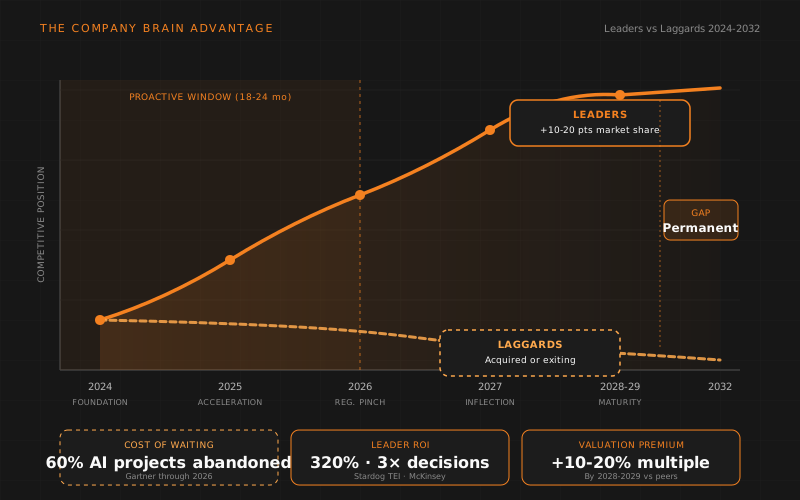
The Colrows compile-then-execute pipeline is designed for the organizations that have passed the four gates: they have executive sponsorship, a named accountable owner, a data foundation ready for their priority use case, and a lighthouse use case that can be demonstrated. This is the opening described in The Company Brain Advantage and the Closing Competitive Window. The window to move is narrow.
The semantic compiler turns the semantic graph into governed, dialect-perfect SQL at compile time, with RBAC, ABAC, and row/column-level predicates enforced before execution rather than at the UI layer. The autonomous maintenance handles drift detection so that the semantic graph does not rot when the underlying schema changes. The knowledge drift problem is addressed by design, not by hope.
The organizations that have not yet passed the gates do not need a semantic compiler. They need a governance maturity assessment, an MDM program, and an executive willing to name an owner and define the first use case. The tool solves the compile problem. The four gates solve the organizational problem. Both are required.
If you are evaluating where your organization sits against the four gates, the first step is not a vendor demo. It is a candid conversation about sponsorship, ownership, and data foundation readiness. How to govern AI agents that operate across these data systems is described in How to Govern AI Agents That Query Enterprise Data.
Several quantified claims in this post trace to vendor-commissioned research (Stardog TEI is Forrester, commissioned by Stardog; Improvado's 18-month abandonment statistic is based on their customer base). The Gartner 80% figure (February 2024 report) and MIT NANDA study (2025) are the most independently documented claims. MDM success rate statistics vary by study; Gartner's 24% figure dates to 2019 and derives from a survey of organizations already engaged in MDM programs, so it may understate success rates among organizations with strong governance foundations. The case studies (MD Anderson, NHS care.data) are based on publicly available audit reports and investigative journalism; primary source links are available on request.
The underlying thesis: Failure is organizational more than technical. The failure modes follow predictable patterns. This claim is supported by the full body of practitioner evidence even where individual statistics are approximate.
The Bottom Line
The failure statistics are real. They are also navigable. The organizations that succeed with Company Brain and semantic layer implementations are not the ones with better AI or better graph technology. They are the ones that earned the right to build: executive sponsor who will defend the budget through 12 months, single owner who can force a definition decision, data foundation ready for one use case, and a lighthouse that ships in 90 days and proves the pattern before the second is funded.
The sequence is the strategy. Pass the four gates, start narrow, prove the value, expand from the win. Fail a gate, fix the root cause before writing another line of configuration. The modal outcome — 80%, 88%, 95% failure — belongs to organizations that built before they earned the right to build. The 5% belongs to organizations that did not.
For the prerequisite sequence, see Before You Build the Company Brain. For the competitive case for moving now, see The Company Brain Advantage and the Closing Competitive Window. For the ROI evidence, see The ROI of a Company Brain.
Frequently asked questions
Why do most Company Brain and knowledge graph initiatives fail?
The primary causes are organizational, not technical. Gartner (2024) found 80% of D&A governance initiatives fail due to the absence of crisis urgency. Only 24% of MDM programs meet their objectives. The documented root causes include unclear ownership (everyone responsible, nobody accountable), stewardship burnout when governance is treated as an IT project, ontology over-engineering that produces elegant abstractions nobody uses, and data fragmentation that becomes politically hard to resolve even when technically solvable. MD Anderson's $62M IBM Watson abandonment and the UK NHS care.data £8M shutdown are the two most-cited cautionary cases.
What are the four go/no-go gates before building a Company Brain?
Gate 1: Is there a named business outcome tied to a measurable KPI and crisis urgency? Absence of urgency is Gartner's documented #1 killer. Gate 2: Is there a single accountable owner with budget authority? 67% of abandoned KG projects cite lack of internal expertise and ownership. Gate 3: Is the data foundation good enough for the priority use case? Only 29% of organizations report AI-ready data. Gate 4: Can you ship a lighthouse use case in under 90 days? If not, diagnose the blocker before expanding. All four must pass before you commit to enterprise-scale build.
What happened with MD Anderson and IBM Watson?
MD Anderson Cancer Center and IBM spent approximately $62 million over six years (2013-2017) attempting to build an AI oncology advisor using IBM Watson. The project was abandoned without producing a working clinical system. The audit cited data-quality problems (clinical notes in varied formats the system could not reliably interpret), physicians who changed treatment plans overriding the AI rather than trusting it, and scope that exceeded what the data infrastructure could support. The case is now a reference example for over-scoped AI initiatives that skip prerequisite data foundations.
What is ontology over-engineering and why does it kill projects?
Ontology over-engineering is the most common technical failure mode: teams design a complete, theoretically correct conceptual model of the enterprise before building anything. The result is a beautiful architecture that takes 12-24 months to produce, cannot be demonstrated to a business sponsor, and is abandoned when the next budget cycle arrives with no visible win. The fix is minimal viable ontology: model only what the first use case needs, prove it works, and extend incrementally. Improvado documents that teams pursuing enterprise knowledge graphs without preconditions typically abandon within 18 months.
What is stewardship burnout and how do you prevent it?
Stewardship burnout occurs when governance programs treat data stewardship as a volunteer activity on top of existing jobs. Gartner and DAMA surveys find 45% of data professionals report burnout from governance-related tasks. Stewards are asked to classify, document, and resolve data issues without budget, tools, or recognition. Prevention requires: (1) formal stewardship roles with time allocation, not voluntary committees; (2) tooling that automates the mechanical parts of curation; (3) a management reporting line that treats stewardship as a career path; (4) success metrics that reward data quality outcomes, not tagging activity.
How does data fragmentation differ from a data quality problem?
Data fragmentation is a structural problem where the same entity (customer, product, supplier) exists in multiple systems with different keys, names, and attributes. It is solvable with MDM and federated architecture. Data quality is the accuracy and completeness of individual records. Fragmentation becomes politically hard when different departments treat their system as the master and refuse to cede authority. The technical fix (a golden record) is straightforward. The governance fix (agreeing whose definition wins) requires executive sponsorship to force the decision. Without that authority, fragmentation persists indefinitely regardless of tool investment.
Is tribal knowledge actually encodable in a Company Brain?
Tribal knowledge (the undocumented heuristics, contextual judgments, and relationship-based decisions that live in people's heads) is partially but not fully encodable. The semantic layer can capture and compile explicit business rules, definitions, and metric logic. What it cannot capture is tacit judgment that experts cannot articulate. The right framing is: encode the parts that can be made explicit (definitions, hierarchies, calculations), surface them as governed context for AI agents, and use the agent to ask the human about the rest. The goal is institutional memory, not expert replacement.
At what data-source count does a Company Brain become worth building?
The enterprise knowledge graph breakeven is typically 10-15 heterogeneous data sources where shared business context (shared definitions, metrics, entities) creates coordination value greater than the overhead of maintaining the semantic layer. Below roughly 8 sources, a lightweight ETL and dashboard layer is usually the better choice. The threshold also depends on use-case complexity: a single high-value use case (e.g., unified customer view across 20 systems) can justify the build even below the source-count threshold if it is tied to a material KPI.