Short answer: The company brain advantage is faster, auditable decisions built on one governed definition of every metric. McKinsey research links unified knowledge infrastructure to 3x faster decisions and 40% higher decision confidence, and Stardog's Forrester TEI modeled 320% ROI with 75-95% time savings on analytical work. Because definitions compile to deterministic, audited SQL, AI agents can act with provenance, and the encoded business rules become a moat competitors cannot easily copy.
TL;DR
- The upside is now primary-sourced. McKinsey research: 3x faster decisions, 40% higher confidence. LinkedIn production semantic layer (SIGIR '24): 28.6% faster customer-service resolution, 77.6% retrieval improvement. Stardog Forrester TEI: 320% ROI, $9.86M three-year benefits, 75-95% time savings on analytical work.
- The downside risk is equally concrete. Gartner: 60% of AI projects abandoned through 2026 unsupported by AI-ready data. EU AI Act (in force August 2026 for high-risk) mandates explainability, traceability, and audit trails. Penalties reach EUR 35M or 7% of global revenue. By 2028-2029, leaders consolidate 10 to 20 percentage points of market share that laggards cannot recover.
- The window to implement proactively is 18 to 24 months and closes around mid-2026. After 2027, semantic governance shifts from strategic choice to regulatory mandate. Organic catch-up is no longer feasible. You will need acquisition, partnership, or permanent vendor dependence.
| Capability | Standard Company Brain (RAG) | Colrows Deterministic Foundation |
|---|---|---|
| Logic Authority | Probabilistic (Model-driven) | Deterministic (Compiler-driven) |
| Accuracy | High Hallucination Risk | Governed & Verifiable |
| Governance | Runtime / Patchwork | Compile-time / Integrated |
| Maintenance | High / Manual Data Ingestion | Autonomous Schema-driven |
| Agent Readiness | Experimental | Enterprise Production-Ready |
What Company Brains Enable
The RAG Bottleneck
Standard RAG works for search but fails for calculation and business logic. It does not understand "Revenue" in the context of your specific enterprise data. Document retrieval surfaces text chunks; it cannot validate join paths, enforce access controls, or deliver deterministic results.
The Colrows Advantage
We compile your business context directly into the semantic graph. The agent does not "search" for answers. It calculates them deterministically against typed definitions, governed rules, and audit-ready lineage. Every query is verifiable.
1. Decision Velocity and Accuracy
Knowledge workers lose roughly 1.8 to 2.5 hours per day searching for information, re-deriving metrics, and reconciling conflicting definitions. A CFO preparing quarterly earnings reconstructs "revenue" definitions across finance, sales, and product. A product manager rebuilds a customer-cohort analysis another team finished three months earlier. This friction strangles decision speed.
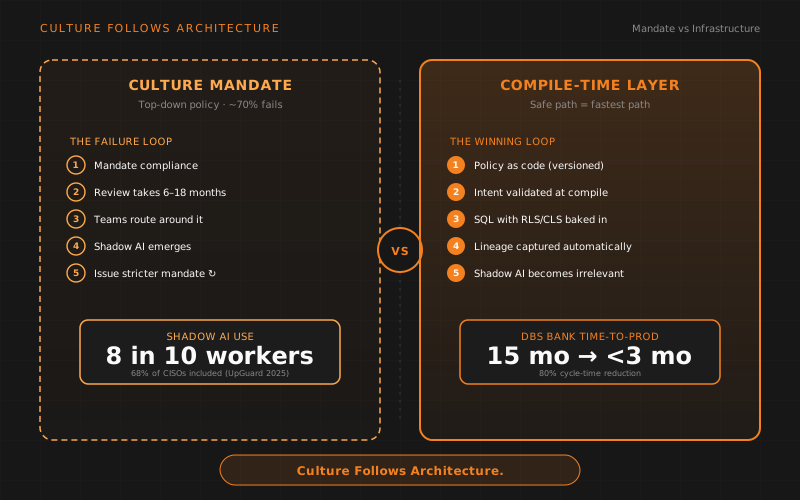
With a Company Brain, every metric definition is singular and authoritative. Every analytical query executes against a governed semantic layer that validates definitions at compile time, eliminating the hallucination window. A CFO asks "what is our ARR growth in the west region?" and within seconds receives a deterministic, audited answer backed by lineage showing exactly which GL accounts, sales records, and revenue-recognition rules were applied. See SaaS Architecture for how this contrasts with standard RAG. The architectural pattern is detailed in What Is a Semantic Compiler? Deterministic SQL for AI.
Cross-sector evidence:
- Financial Services. JPMorgan Chase's data mesh (AWS case study, 2021) unified 450+ petabytes serving 6,500+ applications. Credit-approval decision latency dropped from 48 hours to 2-4 hours.
- Healthcare. AstraZeneca's Biological Insights Knowledge Graph (bioRxiv, 2021) unified drug-discovery data across internal research, publications, and proprietary assays. Time to hypothesis validation dropped by 60%.
- Retail. Retailers with unified customer knowledge answer "how many high-LTV customers churned last quarter?" in minutes. Cohort definitions are centralized. Marketing shifts from broad campaigns to surgical retention.
2. AI Agent Autonomy and Reliability
LLMs hallucinate. They invent facts, propose joins that do not exist, and return confident wrong answers. Deploying an LLM directly against unstructured data is a governance nightmare. Agents make recommendations ("deny this loan") without transparent reasoning. Compliance teams demand audit trails that do not exist.
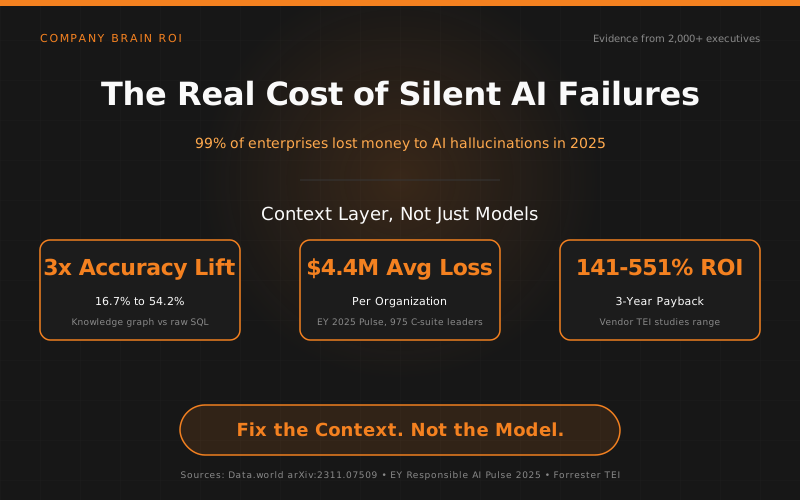
With a Company Brain, an autonomous agent operates inside a semantic execution layer that enforces constraints at compile time. The architectural mechanism we describe in From Ambient Memory to Deterministic Autonomy applies. If the metric is undefined or the agent lacks permission, the system fails cleanly before generating any query. LinkedIn's production deployment (Xu et al., SIGIR '24) improved retrieval MRR from 0.522 to 0.927 (77.6% improvement). Agent recommendations now include provenance and auditability.
3. Enterprise-Wide Metric Consistency
Finance defines "annual recurring revenue" one way. Sales defines it another. Product and customer success define it a third way. Reports contradict each other. Board meetings stall over "which number is correct?" A $5B company might have 100 different definitions of "active customer" embedded in dashboards, pipelines, and notebooks. We documented the downstream chaos in Why BI Metrics Do Not Match Across Dashboards.
With a Company Brain, a single federated definition of each critical metric. Finance owns the GL mapping. Sales owns the contract semantics. The definition is executable: compile a query against it and the system generates SQL. It is versioned: every quarter when the definition evolves, the system logs the change and can re-run historical reports with the old definition for continuity. Real case: a large financial-services firm unified 23 definitions of "customer" across 12 business units. Report-reconciliation cycles dropped from two weeks to two hours. Annual time savings: ~100 FTEs. Cost savings: $15-20M annually.
4. Knowledge Reuse and Competitive Moats
Tacit knowledge walks out the door with departing employees. A departing SME takes the heuristics, judgment calls, and contextual rules that powered decisions. Decision logic lives in Excel spreadsheets, SQL scripts, analyst notebooks, and people's heads. We unpacked this in Capturing Tacit Knowledge at Scale.
With a Company Brain, knowledge is encoded in a semantic layer and knowledge graph. Business rules, metric definitions, entity relationships, and decision heuristics are all machine-readable and persistent. Competitors cannot easily replicate your decision algorithms because they do not have your ontology, your business rules, or your semantic layer.
Case study: Siemens supply chain. Siemens built a knowledge graph mapping 16,910 tier-1, 43,759 tier-2, and 49,775 tier-3 suppliers. The graph encoded supplier relationships, risk profiles, delivery-time patterns, and failure modes learned from 20+ years of operational history. Competitors with similar supply chains cannot quickly build equivalent models because the knowledge is institutional, encoded, and continuously refined.
5. Compliance Automation and Regulatory Readiness
Compliance is expensive and reactive. When regulators ask "how did you make this decision?", teams scramble to reconstruct logic from disconnected logs, spreadsheets, and conversations. Audit trails are approximate. Lineage is manual. GDPR right-to-explanation requests take weeks.
With a Company Brain, every decision is logged with complete provenance. A query against the semantic layer includes source data, transformation rules applied, access permissions enforced, and the user/agent that initiated it. Audit trails are immutable and automated. Regulators can verify that high-risk AI decisions followed the governance rules encoded in the system. For comprehensive treatment of security and privacy governance, see Security and Privacy in a Company Brain. The full pattern is detailed in Security and Privacy in a Company Brain.
Regulatory tailwind: The EU AI Act (in force, with high-risk obligations effective August 2026) mandates explainability and traceability for high-risk AI. Automatic event logging built into core design (Article 12), 6-month retention, human oversight with override (Article 14), and adversarial resilience across the action layer (Article 15). Penalties reach EUR 35M or 7% of global turnover.
6. Organizational Scaling Without Linear Talent Growth
Data teams grow linearly with the organization. Talent is scarce. Salaries inflate. Knowledge silos proliferate. With a Company Brain, a smaller team serves more users. Analysts self-serve because metrics are discoverable and definitions are centralized. A team of 10 can support 1,000 users instead of 100. Forrester found organizations with semantic layers needed 30-40% fewer dedicated data roles to serve equivalent analytical workloads. At $225K fully-loaded cost per data engineer, that is $6.75-9M in annual savings for a 100-person data organization.
7. Speed of Response to Market Disruption
A market disruption (new competitor, regulation, customer behavior shift) requires analysts to rebuild cohorts, recalculate metrics, and cross-reference multiple systems. Days to weeks. With a Company Brain, business leaders ask "what is our exposure to the new regulation?" and the system answers in minutes by applying new definitions to existing data. A company that can reposition supply chain, pricing, or product mix 2-4 weeks faster during disruption typically gains 3-8 percentage points of market share.
What Companies Lose Without a Company Brain
Regulatory and Compliance Risk
The EU AI Act is in force. The UK AI Bill is in force. The NIST AI RMF is the reference standard for U.S. federal procurement. All three mandate semantic governance and explainability. A company operating high-risk AI (credit decisions, healthcare recommendations, employment screening) without a semantic layer is now exposed to:
- GDPR enforcement fines: up to 4% of global revenue
- AI Act penalties (Articles 70-78): up to EUR 35M or 7% of global revenue for high-risk violations
- SEC enforcement on fiduciary duties and AI governance: executives can face personal liability
- Customer litigation: when an AI system makes a wrong decision, lack of auditability means lack of defensibility
Quantified exposure: A mid-sized financial-services firm ($2B revenue) deploying AI without semantic governance faces potential fines of $80-120M under GDPR and AI Act violations. A health-tech company deploying diagnostic AI without auditability faces product liability that can exceed insurance limits.
AI Project ROI Collapse
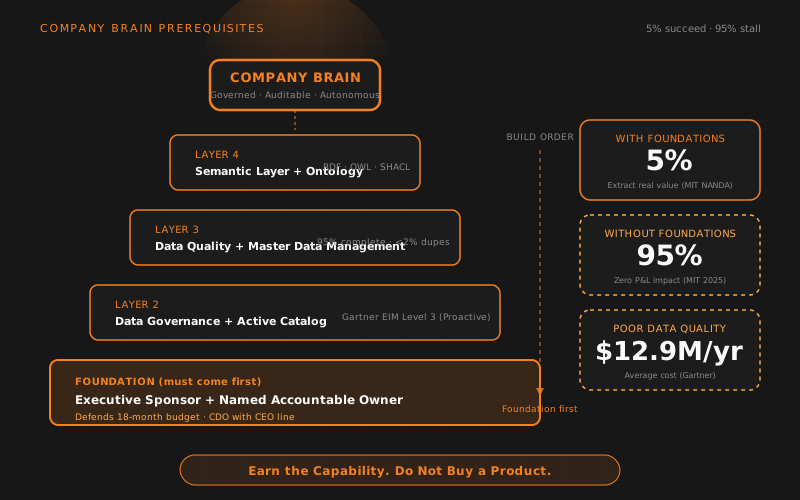
Gartner predicts that through 2026, 60% of AI projects will be abandoned unsupported by AI-ready data. McKinsey's 2024 "AI in business today" survey found 55% of organizations that adopted AI report no measurable financial benefit. IDC estimates 70% of AI initiatives fail to move beyond pilot stage. The root cause is architectural: organizations throw models at ungoverned data and expect outcomes. The infrastructure required is detailed in Before You Build the Company Brain: The Prerequisites.
For a mid-market company with 10 concurrent AI projects at $2-5M each and a 70% failure rate, annual budget waste is $10.5-28M. Over three years: $31.5-84M in stranded capital.
Talent Retention and Organizational Fragility
Deloitte's June 2026 "Knowledge Exodus" report projects $6.9-9.6 trillion in lost output as 30M+ Americans turn 65. For organizations without a Company Brain, this exodus is existential. Data workers at organizations without semantic layers spend 40-50% of their time on unproductive activities. Forrester research shows 44% of data workers in low-maturity environments express intent to leave within 18 months. Companies with semantic layers report 20-30% higher retention in data roles.
Competitive Disadvantage and Market Share Loss
Case study: a regional wealth-management market. Three players implemented semantic layers in 2022-2023. By 2024 they improved client-retention rates by 8-12%, reduced advisory time per client by 20-30% (allowing advisors to manage 30-40% larger books), and implemented dynamic pricing that captured an additional 0.5-1.0 basis points in annual revenue per AUM dollar. Competitors without semantic layers lost market share. Within 18 months, the three winners consolidated 3-5 percentage points of regional AUM. On a $500B AUM market, that is $15-25B of transferred value.
Cloud and Infrastructure Cost Inflation
Organizations without semantic layers over-invest in data infrastructure. They replicate data across multiple stores. They run separate analytics pipelines for each team. They provision over-capacity to compensate for inefficiency. A company with 100 petabytes and unoptimized architecture might spend $8-12M annually on cloud infrastructure. A semantically optimized architecture serves the same workloads on $3-4M. Five-year avoided spend: $50-100M. The token-cost dimension is detailed in The Token Cost Hidden Tax.
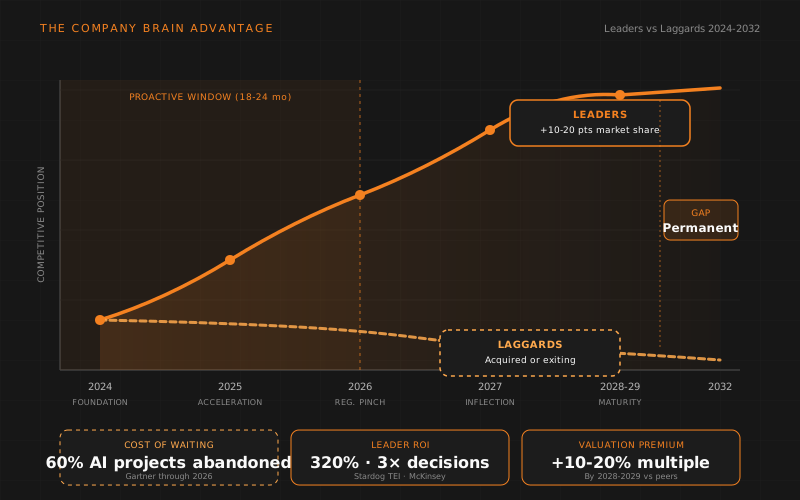
The Competitive Window: Five Phases, 2024-2029
| Phase | Period | Leader experience | Laggard experience |
|---|---|---|---|
| Foundation | 2024 | JPMorgan, AstraZeneca, Siemens in production. 75-95% time savings. 12-18 months of institutional advantage banked. | Still building data catalogs and governance committees. Treating it as a 2-3 year effort, not urgent. |
| Acceleration | 2025 | 15-25% of large enterprises in production or advanced pilot. Deploying autonomous agents with confidence. Compressing time-to-market by 4-8 weeks on new products. | Catch-up begins. 12-18 months behind leaders. Talent acquisition challenges. Board demanding action. |
| Regulatory Pinch | 2026 | Semantic governance shifts from competitive advantage to table-stakes. Customers require compliance evidence. Insurance excludes non-compliant AI. | First major AI system failures occur. Regulators issue enforcement actions. Desperate catch-up. Talent expensive. Vendor lock-in risk. |
| Inflection | 2027 | 2+ years of semantic-layer maturity. Winning on decision velocity, cost, and compliance. Acquiring weaker competitors. | Operational restrictions in regulated industries. Required to exit certain product lines. Losing customers and talent. |
| Maturity | 2028-2029 | Fully autonomous, auditable AI agents. 10-20 pts market share consolidated. 10-20% valuation premium vs. peers without governance. | Unable to deploy AI in customer-facing or fiduciary contexts. Vendor-dependent. Being acquired or exiting markets. |
Do not build a library. Build an execution engine. When knowledge is compiled instead of indexed, hallucination risk drops, compliance becomes measurable, and business logic becomes auditable infrastructure instead of archived text.
Fix the Context, Not the Model. Your Company Brain is only as good as the determinism of the infrastructure beneath it.
Every quarter of delay is approximately one month of lost competitive advantage. By Q4 2025, organizations that started in Q1 2024 will have built institutional knowledge that takes new starters 6-12 months to acquire. By 2027, organic catch-up is no longer feasible. The choice becomes: acquire, partner, or accept permanent vendor dependence.
Financial Impact by Sector
Financial Services
- Enabled value: Credit-approval latency 48 hours → 2-4 hours. Customer retention up 8-12%. Advisory efficiency up 20-30%. $15-30M annual impact per $500B AUM. Audit trail patterns detailed in Auditable SQL: Conversational Analytics in BFSI.
- Risk of non-adoption: Up to 4% of revenue (GDPR) plus 7% (EU AI Act). 3-8 percentage points of market share within 18-36 months. 10-20% valuation discount.
- For a $2B revenue firm: Annual opportunity $30-80M. Three-year risk exposure $240-600M.
Healthcare and Life Sciences
- Enabled value: 15-25% reduction in diagnostic errors. 30-60% faster hypothesis validation. 6-18 months of additional patent protection per drug (worth $100-500M per launch). HIPAA patterns covered in Conversational Analytics for Clinical Data (HIPAA).
- Risk: FDA enforcement, HIPAA exposure, malpractice liability that can exceed insurance limits.
- For a $5B healthcare system: Annual opportunity $100-250M. Three-year risk exposure $750M-1.5B.
Retail and E-Commerce
- Enabled value: 5-15% retention improvement. 0.5-2% gross-margin improvement through dynamic pricing. 4-8 weeks faster time-to-market.
- Risk: 2-percentage-point market-share loss = $200M annual revenue for a $10B retailer.
- For a $10B retailer: Annual opportunity $50-200M. Three-year risk exposure $200M-1B.
Manufacturing and Supply Chain
- Enabled value: Real-time supply-chain rebalancing. 15-30% reduction in unplanned downtime. 0.5-1% reduction in rework and scrap.
- Risk: 2-10% revenue loss during disruption events.
- For a $5B manufacturer: Annual opportunity $50-150M. Three-year risk exposure $200-750M.
The Board-Level Question
By 2026-2027, this question will be routine at board meetings:
"Do we have credible semantic-governance infrastructure for all material AI systems? Can we explain and audit every AI decision we make?"
The answer determines:
- Regulatory compliance and fiduciary liability
- Competitive positioning and market share
- Valuation and investor confidence
- Ability to deploy autonomous agents and next-generation AI
For the board: this is not an IT topic. It is competitive positioning, regulatory, and fiduciary. It deserves board-level attention and oversight. The cultural piece (why mandates fail and infrastructure wins) is in The Culture of Transparency.
Build vs Buy: The Sequencing That Works
MIT NANDA data is unambiguous: purchasing AI tools from specialized vendors and building partnerships succeed about 67% of the time. Internal builds succeed only one-third as often. Build-alone teams underestimate the metadata, lineage, MDM, and ontology work required. The full framework is in The Build vs Buy Decision for Enterprise Semantic Layers and the underlying economics in The Hidden Cost of Building Your Own Data Access Layer.
The right structure: buy or partner for the platform layer (compile-time semantic execution). Own the data definitions, business rules, and ontology that encode your institutional knowledge. The competitive moat lives in the definitions, not the runtime.
The Three Go/No-Go Windows
Window 1: Now to Mid-2025 (Greenfield Advantage)
Decision: "Do we start a semantic-layer initiative now?"
Advantage: 18-24 months of first-mover advantage. Training teams while institutional knowledge is fresh. Building organizational muscle.
Cost of waiting: Every quarter of delay is approximately one month of lost competitive advantage.
Recommendation: Start in Q2-Q3 2024 if not already in motion. If delayed to Q1 2025, aggressive timelines are required to avoid falling permanently behind.
Window 2: Mid-2025 to Mid-2026 (Catch-Up Still Possible)
Decision: "Do we have a credible roadmap to semantic governance by end of 2026?"
Status: Start now, reach production in 18-24 months (late 2026 to mid-2027). Painful because accelerating against competitors already in production. But defensible.
Recommendation: 2025 is your last window for greenfield advantage. Commit budget and leadership bandwidth now.
Window 3: Mid-2026 to End-2026 (Expensive and Risky)
Status: 24+ months behind leaders. Compressing 18-24 months of work into 12 months. Talent expensive (semantic skills in high demand). Vendors expensive (they know you are desperate). Risk of implementation failure increases.
Cost of waiting beyond: Starting in 2027+ means accepting regulatory fines, permanent competitive disadvantage (3-5 years behind), potential need to exit certain product lines, and a 10-20% valuation discount.
Recommendation: If you have not started, 2026 is urgent but still defensible. 2027 and beyond is too late for organic catch-up.
The View From 2032
It is 2032. The organizations that started semantic-layer initiatives in 2024-2025 operate in a fundamentally different competitive environment than those that waited.
The leaders:
- Fully autonomous, auditable AI agents managing significant business processes
- Decision latencies 3-5 times faster than late starters
- Cost structures 20-40% lower per analytical query
- 10-20 percentage points of market share consolidated from laggards
- Talent attracted by superior work infrastructure
- Investor confidence reflected in valuation multiples
The laggards:
- Dependent on vendors and partners for AI capabilities
- AI projects that stall due to data-governance gaps
- Lost key customers to competitors with better decision infrastructure
- Regulatory restrictions in high-risk product categories
- Consolidating (being acquired) or exiting markets
The gap is not recoverable in a decade. Institutional knowledge, process embedding, and competitive moat are too strong. For organizations today, the choice is binary: start now and lead, or wait and follow (if you survive).
Caveats
- Many financial figures cited (time savings, ROI, market-share gains) come from vendor-commissioned studies (Stardog Forrester TEI, Gartner reference customers) or selective case studies. Directional, not guaranteed.
- The regulatory timeline is based on current signals and proposed rule-making. Actual timelines may accelerate (if a high-profile AI failure triggers urgency) or decelerate.
- The competitive-disadvantage timeline assumes rational market competition. Some organizations will adapt faster than others; some will stumble despite investment; some will use partnerships or acquisitions to leapfrog.
- Market-share transfer figures are modeled based on McKinsey and Gartner research on competitive advantage from data capabilities. Individual companies and sectors vary.
For deeper context, see Before You Build the Company Brain: The Prerequisites, The ROI of a Company Brain, and YC's Company Brain RFS: What Hyper, GBrain, and the Competition Got Right.
Next Steps
The Company Brain is no longer optional. The question is whether you build it yourself (expensive, slow, risky) or partner with an infrastructure provider that has already solved the architectural problems.
Colrows compiles natural-language intent directly into deterministic, auditable SQL across 16+ database engines. No data replication. No moving data to external processing. Governance is enforced at compile time. Audit trails are a byproduct of execution.
Start in a private VPC. Prove value on one use case in 60-90 days. Scale to the next domain. Own your semantic layer rather than renting vendor reliance.
Frequently asked questions
What is the Company Brain advantage?
A Company Brain (enterprise semantic layer plus governed knowledge infrastructure) compounds into a 5-10 year competitive moat: 3x faster decisions, 40% higher decision confidence (McKinsey), 320% ROI and 75-95% time savings on analytical work (Stardog Forrester TEI), AI agents trustworthy enough for fiduciary decisions, and audit trails as a byproduct of execution. Organizations implementing now build moats; organizations waiting accumulate stranded AI budgets and regulatory exposure.
When does the competitive window for Company Brain implementation close?
The 18-24 month proactive window closes around mid-2026. Greenfield first-mover advantage is available through Q1 2025. Mid-2025 to mid-2026 is the catch-up window with credible roadmap. Mid-2026 to end-2026 is expensive and risky catch-up. After 2027, semantic governance is no longer a strategic choice. It is a regulatory mandate, and organic catch-up is no longer feasible.
What does the EU AI Act require for high-risk AI systems?
The EU AI Act (in force August 2026 for high-risk systems) mandates explainability, traceability, automatic event logging built into core design with 6-month retention (Article 12), human oversight with override capability (Article 14), and adversarial resilience across the action layer (Article 15). Penalties reach EUR 35 million or 7% of global turnover. A compile-time semantic layer satisfies these requirements as a byproduct of execution. Document-retrieval systems do not.
What is the financial impact of skipping a Company Brain?
Gartner predicts 60% of AI projects abandoned through 2026 unsupported by AI-ready data. For a mid-market company with 10 concurrent AI projects at $2-5M each and a 70% failure rate, annual budget waste is $10.5-28M; three-year stranded capital reaches $31.5-84M. Add regulatory exposure (up to 4% of revenue under GDPR plus 6% under EU AI Act), competitive market-share loss of 3-8 percentage points within 18-36 months, and a 10-20% valuation discount versus semantic-enabled peers.
How much faster do organizations with Company Brains make decisions?
McKinsey Global Institute research found organizations with unified knowledge infrastructure make decisions 3 times faster and execute with 40% higher confidence. Stardog's Forrester TEI quantified 2-3x faster analytics project completion and 75-95% time savings on data prep, validation, and reconciliation. JPMorgan Chase reduced credit-approval decision latency from 48 hours to 2-4 hours after deploying its data mesh across 450+ petabytes.
What competitive moat does a Company Brain build?
Knowledge encoded in a semantic layer is institutional, persistent, and continuously refined. Business rules, metric definitions, entity relationships, and decision heuristics become machine-readable and outlast departing employees. Competitors cannot easily replicate your decision algorithms without your ontology and your business rules. Siemens encoded 20+ years of supplier-relationship knowledge across 110K+ tier 1-3 suppliers. By 2028-2029, leaders consolidate 10-20 percentage points of market share that laggards cannot recover.
Why is semantic governance becoming a board-level topic?
By 2026-2027, board meetings will routinely ask: 'Do we have credible semantic-governance infrastructure for all material AI systems? Can we explain and audit every AI decision?' The answer determines regulatory compliance and fiduciary liability, competitive positioning and market share, valuation and investor confidence, and the ability to deploy autonomous agents. This is not an IT topic. It is competitive positioning, regulatory, and fiduciary. It deserves board-level attention.
Should we build our own Company Brain or partner?
MIT NANDA data: purchasing AI tools from specialized vendors and building partnerships succeed about 67% of the time. Internal builds succeed only one-third as often. Build-alone teams underestimate the metadata, lineage, MDM, and ontology work required. The right structure is to buy or partner for the platform layer (compile-time semantic execution) and own the data definitions, business rules, and ontology that encode your institutional knowledge.