Short answer: The main MicroStrategy alternatives are Colrows, Snowflake Cortex Analyst, Databricks Genie, ThoughtSpot Spotter, Cube, the dbt Semantic Layer and WisdomAI. Cortex Analyst and Genie suit teams committed to one warehouse. Cube and dbt are semantic layers that delegate governance to the warehouse. Teams that chose agents first and need deterministic SQL governed before execution across many warehouses fit a compile-time layer like Colrows. MicroStrategy stays strong for pixel-perfect reporting and OLAP.
Option A: BI-first platforms are misaligned with agentic AI
MicroStrategy's own marketing makes the case. The company frames itself as "the AI+BI platform," leaning on "decades of BI expertise" and its "industry-leading semantic graph." That heritage is real and valuable for dashboards. But agents are not dashboard users. A dashboard user picks from dropdowns and pre-built reports; an agent generates free-text intent that must be compiled into SQL deterministically, with proven joins and governance applied before any query runs.
The architectural tell is where governance lives. MicroStrategy enforces access through security filters that are resolved per user session and applied when a report executes. The product documentation is explicit that this is runtime, result-set narrowing "similar to database views and row level security," and it openly documents leakage edge cases where level metrics with absolute filtering can raise a user's effective filter and expose category-level totals outside the intended restriction. For a human analyst, that is a manageable corner case. For an autonomous agent firing thousands of generated queries, runtime filtering applied after SQL is composed is the wrong control point.
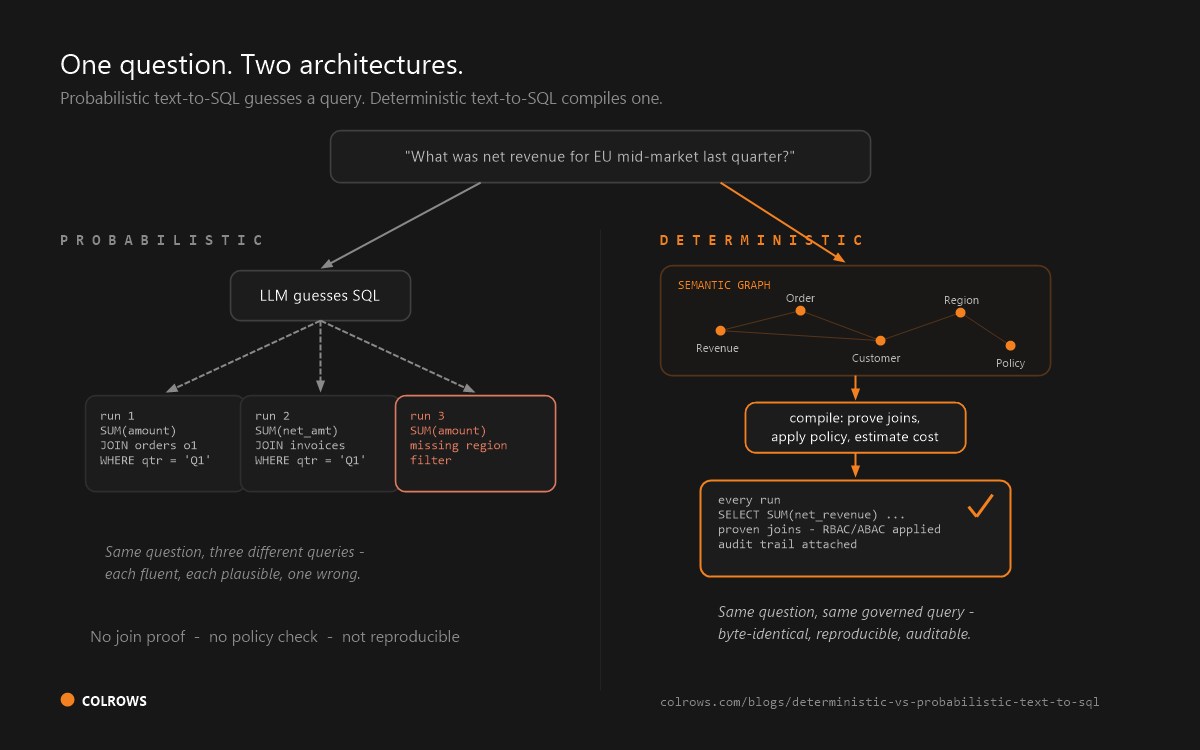
The second tell is determinism. MicroStrategy's Agents run through an LLM with a tunable temperature control "from focused to dynamic." Generative interpretation means the same question can produce different SQL and different results across runs. Regulated industries cannot certify against that. MicroStrategy has not published accuracy results on the recognized enterprise text-to-SQL benchmarks (Spider 2.0, BIRD), and Spider 2.0 itself demonstrates how unforgiving the enterprise setting is: per the Spider 2.0 paper (Lei et al., arXiv:2411.07763), an o1-preview code-agent framework "successfully solves only 21.3% of the tasks, compared with 91.2% on Spider 1.0 and 73.0% on BIRD," while GPT-4o reaches just 10.1%.
Analyst direction supports the BI-to-agent transition thesis. Gartner moved the entire Analytics and BI market narrative toward "agentic AI" in its 2025 Magic Quadrant cycle, predicting that "40% of enterprise applications will integrate task-specific AI agents by end of 2026, up from less than 5% in 2025." The 2025 report kept MicroStrategy out of the Leaders quadrant (Visionary, up from Challenger in 2024). Customer reviews echo friction: G2 and PeerSpot reviewers repeatedly cite a steep learning curve, complex setup, SQL-generation complexity for beginners, and an interface that "can feel a bit clunky."
Option B: Compile-time semantic execution beats runtime governance for deterministic agents
This is the deeper technical argument. Colrows describes itself as "the semantic execution layer for enterprise AI" that "compiles every agent query into governed, deterministic, dialect-perfect SQL," with "every join proven at compile time." The three non-negotiable properties: governed before execution, self-maintaining under change, and deterministic across every engine. How a semantic compiler delivers those properties - and how to test any vendor against them - is documented in full.
The contrast with MicroStrategy is structural, not cosmetic:
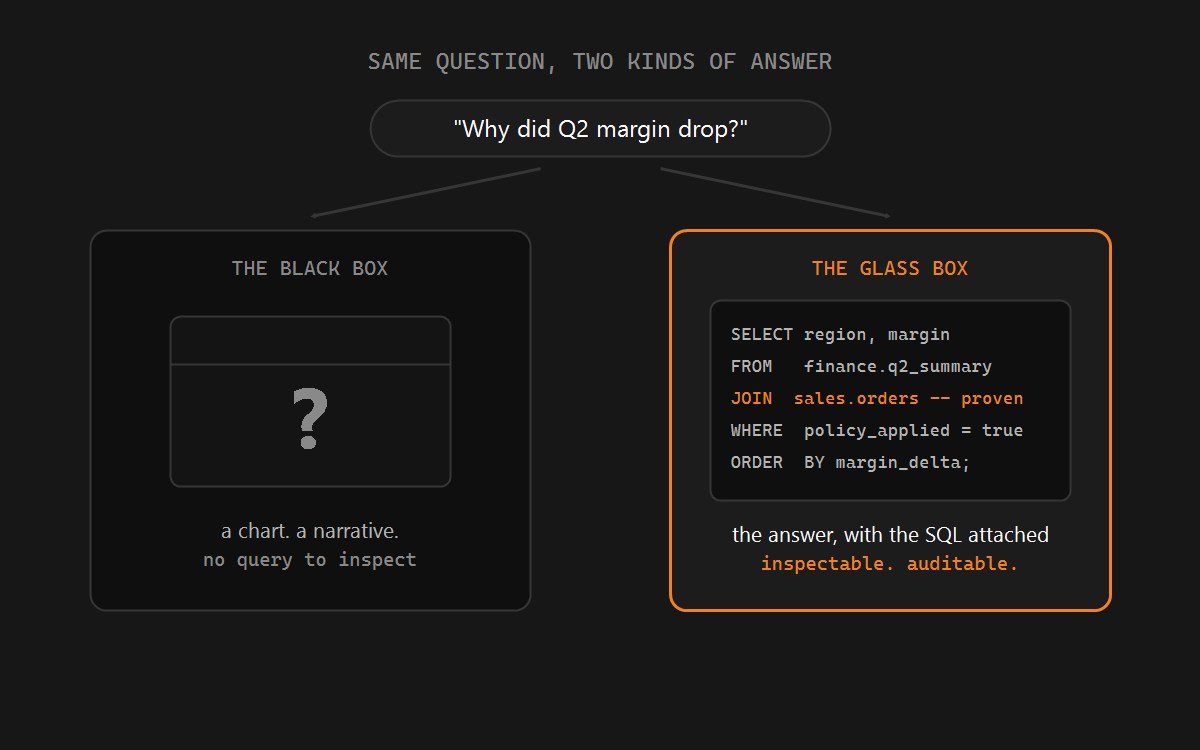
- Governance timing. Colrows injects RBAC, ABAC, and row/column predicates "at compile time as additional WHERE clauses or column projections in the generated SQL, never as a post-query filter," and "unauthorized intent fails compilation; data is never read." MicroStrategy resolves security filters at session/execution time.
- Determinism and reproducibility. Colrows' compiler "is deterministic against the (graph version, scope, identity, intent) tuple," and produces an audit record capturing "the graph version, identity context, resolved entities, proven join paths, and compiled SQL," enabling point-in-time replay. MicroStrategy's temperature-controlled, LLM-mediated Agents make a same-question-same-SQL guarantee architecturally hard.
- Multi-warehouse, dialect-perfect SQL. Colrows compiles to Snowflake, Databricks, Postgres, ClickHouse, Trino, Oracle, SQL Server and 16+ engines from one graph. MicroStrategy connects to many sources but is architecturally a BI server that pulls data into its Intelligence Server and in-memory cubes.
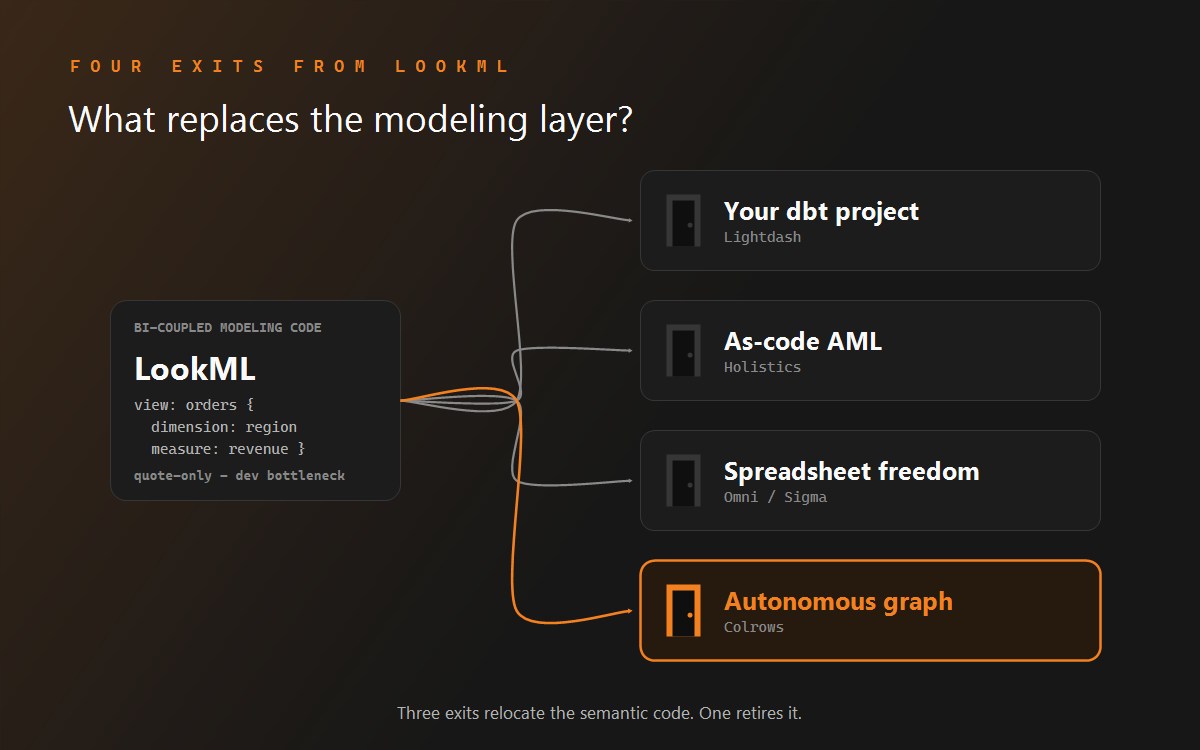
- Autonomous semantic maintenance. Colrows "autonomously builds the graph" and maintains it under drift. MicroStrategy's semantic model (attributes, facts, hierarchies, transformations) is hand-modeled by developers in Workstation - a maintenance burden requiring scarce specialized skills.
Honest gaps. Colrows is not a BI suite. It includes "self-serve dashboards built on its semantic graph," but visualization "is not the product's centre of gravity." For pixel-perfect enterprise reports, mobile BI, mature embedded analytics, OLAP cube workloads, and a decades-deep ecosystem of trained developers, MicroStrategy is stronger. Colrows is also young, against MicroStrategy's brand trust at firms like Visa, Pfizer, and Sony. The honest framing is not "Colrows replaces MicroStrategy," but "Colrows is the execution layer for teams who chose agents first."
MicroStrategy's market position and competitive vulnerability
MicroStrategy's software business is in slow structural decline while the parent company functions primarily as a Bitcoin treasury. Recent quarterly software revenue fell year over year (Q2 2025 total revenue was down, with product support revenue, the legacy maintenance base, off 15.6% year over year), while subscription revenue grows off a small base. The company rebranded to "Strategy," is migrating customers off its on-premises Enterprise Platform, and that forced decision moment is exactly what competitors target in their "MicroStrategy alternatives" content. Reviewers cite opaque, high pricing and complexity as reasons to evaluate alternatives.
The strategic question for an evaluator: is MicroStrategy committed to winning the agentic race, or optimizing a mature BI franchise while leadership attention sits on Bitcoin? The evidence leans toward the latter. R&D narrative on earnings calls foregrounds Bitcoin software; the agent features are real but incremental, and the company has not published the determinism or accuracy proof points that purpose-built agent vendors lead with.
The 7 MicroStrategy alternatives and competitors, compared
| Platform | Positioning vs MicroStrategy | Governance timing | Multi-warehouse | Choose when |
|---|---|---|---|---|
| Colrows | Semantic execution layer, not a BI suite | Compile-time RBAC/ABAC/row-column | Yes, 16+ engines | You chose agents first and need deterministic, governed, reproducible SQL across warehouses |
| Snowflake Cortex Analyst | Warehouse-native NL-to-SQL | Inherits Snowflake RBAC | Snowflake-bound | All-in on Snowflake |
| Databricks Genie | Warehouse-native agentic BI | Inherits Unity Catalog | Databricks-bound | All-in on Databricks lakehouse |
| ThoughtSpot Spotter | Search-driven agentic BI | Governed semantic layer | Multi-cloud warehouse | Business-user self-service search at scale |
| Cube | Headless, MCP-native semantic layer | Warehouse-delegated | All SQL sources | Embedded analytics + one metric definition |
| dbt Semantic Layer | Vendor-neutral, code-first metrics | Warehouse-delegated | Warehouse-agnostic | You version metrics alongside transformations in dbt |
| WisdomAI | Dedicated agentic analytics | Enterprise context layer | Multi-source | Greenfield agentic analytics |
Cortex Analyst and Genie are excellent but warehouse-bound. Per Snowflake's engineering blog "Cortex Analyst: Behind the Scenes," "by leveraging semantic models, Cortex Analyst achieves more than 90%+ SQL accuracy on real-world use cases" - but it is Snowflake-native (see our Cortex Analyst alternatives). Databricks reports in its June 2026 "Introducing Genie One" blog that "Genie answered 84.5% of questions correctly on the first attempt" - but Genie "only queries data stored in Databricks." ThoughtSpot Spotter is deterministic by design because it uses patented search tokens rather than LLM text-to-SQL. Cube and dbt are semantic layers that delegate governance to the warehouse. WisdomAI is a fast-growing pure-play that uses the LLM only to write the query, not the answer. Colrows' specific wedge against all of them is compile-time governance plus deterministic, multi-warehouse compilation with proven joins.
Staged buyer guidance
Stage 1 (now): Segment the buyer. If the deployment is dashboard-led (executive reporting, embedded analytics, OLAP, mobile BI) with humans as primary consumers, MicroStrategy/Strategy One remains defensible; do not over-rotate. If agents are the primary consumer, treat MicroStrategy's runtime governance and non-deterministic generation as disqualifying for regulated, reproducibility-sensitive workloads and shortlist a compile-time layer.
Stage 2: Run a determinism and governance bake-off. Ask every vendor, including MicroStrategy, to demonstrate: (a) the same question yields identical SQL and results across 100 runs; (b) an unauthorized column never appears in generated SQL (prove governance is pre-execution); (c) a machine-readable audit trail enabling point-in-time replay; (d) dialect-perfect SQL across at least two warehouses you actually use. MicroStrategy will struggle on (a) and (c); warehouse-native tools will struggle on (d).
Stage 3: Match to your data estate. Single-warehouse on Snowflake or Databricks: Cortex Analyst or Genie may suffice. Multi-warehouse or warehouse-neutral with agents as the consumer: prioritize Colrows or another compile-time execution layer. Need both BI breadth and agents: plan a two-tool architecture (keep MicroStrategy or ThoughtSpot for dashboards, add a compile-time layer for agent execution).
Thresholds that change the recommendation: if MicroStrategy publishes audited determinism guarantees, compile-time policy enforcement on generated SQL, and competitive Spider 2.0/BIRD results, the gap narrows materially and it should be re-evaluated for agent workloads. Until then, treat its agentic claims as BI-grade, not agent-grade.
Bolting generative features onto a dashboard-and-OLAP foundation does not make agents deterministic; what agents need is governed, reproducible SQL enforced before execution, not runtime security filters resolved per session. Fix the Context, Not the Model.
Frequently asked questions
When did MicroStrategy AI launch?
October 3, 2023. First-generation bots were retired in the September 2025 Strategy One release and rebuilt as Agents.
Are MicroStrategy security filters compile-time or runtime?
Runtime. They are applied at report execution time per user session - the docs describe them as "similar to database views and row level security."
Is MicroStrategy a Gartner Leader for Analytics and BI?
No. It was placed as a Visionary (moved up from Challenger in 2024), not a Leader, in the 2025 Gartner Magic Quadrant.
What benchmark is Cortex Analyst measured on?
Snowflake reports "more than 90% SQL accuracy on real-world use cases" on an internal 150-question benchmark; not independently audited. Databricks Genie reports 84.5% first-attempt accuracy on an internal 28-question benchmark. See Cortex Analyst alternatives for the full picture.
Caveats
Vendor accuracy claims (Cortex 90%+, Genie 84.5%) come from internal benchmarks, not independent, comparable evaluations. Colrows positioning and capabilities here reflect the vendor's own claims; independent third-party benchmarks were not located. MicroStrategy pricing figures in public sources are inconsistent (entry points cited around $25/user/month up to five-figure annual minimums) and should be confirmed via direct quote. "Compile-time governance can assist with compliance and auditability"; it does not by itself ensure regulatory compliance.