Abstract
Modern enterprises operate on heterogeneous data ecosystems - data warehouses, operational databases, streaming pipelines, and SaaS platforms - accessed by analysts, dashboards, and increasingly by autonomous AI agents. Despite decades of investment in business intelligence tooling, a foundational problem persists: business meaning is never agreed upon in a single place.
This paper presents Colrows, a deterministic semantic execution layer that formalizes enterprise meaning as a typed, versioned, dependency-aware knowledge graph and compiles every analytical request against that graph before execution. We describe the full system architecture, the formal algorithms underlying the join-path proof engine, ontology construction strategies, semantic drift and conflict detection, multi-layered semantic search, and the governance model that makes policy enforcement structural rather than advisory. We draw on techniques from knowledge representation, graph theory, constraint programming, and information retrieval to show why compile-time semantic resolution is both necessary and achievable at enterprise scale.
Keywords: semantic layer, knowledge graph, ontology, deterministic compilation, join-path proof, semantic drift, enterprise analytics, graph reasoning, vector search, compile-time governance.
The Problem: Why Enterprise AI Fails in Production
Enterprises are rapidly deploying AI agents to automate analysis, monitoring, and decision-making. Yet most of these efforts fail beyond controlled demos. The failure is not due to model quality, data availability, or compute constraints. It is caused by a missing layer: shared, executable business meaning.
Large language models can generate fluent answers and syntactically valid SQL, but they do not understand enterprise-specific semantics - what a metric truly means, which relationships are valid, or what actions are allowed. Without this understanding, AI agents hallucinate joins, misuse metrics, violate governance, and produce results that cannot be trusted. This is the same accuracy cliff we document empirically in Why Current Tools Fall Short, where raw LLM-to-SQL accuracy on realistic enterprise schemas collapses to 16-21%.
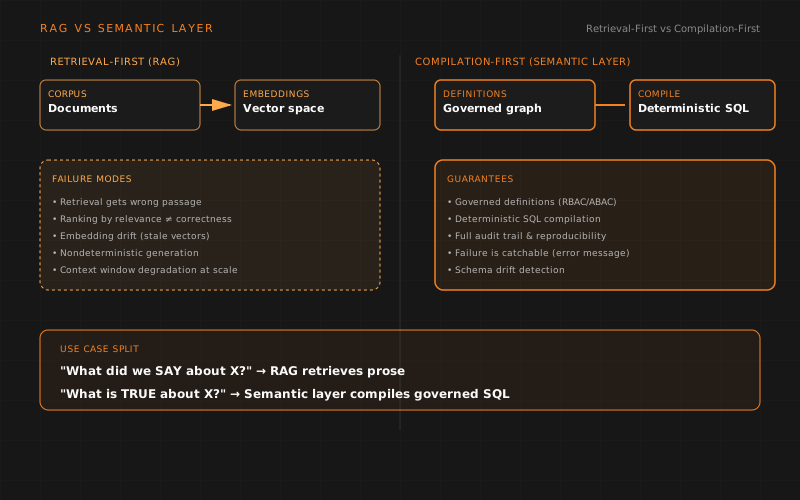
The term "Monthly Revenue" can legitimately mean six different things depending on which team defines it, which date filter is applied, and whether refunds are netted. A traditional BI semantic layer solves this partially, but only for the queries it was manually configured to handle. When a new metric is needed, a new join path encountered, or a schema change propagates, human intervention is required. Retrieval-Augmented Generation (RAG) pipelines add a further failure mode: the same query may produce different SQL on consecutive runs, hallucinated join paths are common, and governance is advisory rather than structural. We compare these architectures in depth in RAG vs Semantic Layer.
Analytics Semantics Are Not Enough
Traditional semantic layers were built to support dashboards and business intelligence tools. They focus on simplifying query construction for humans and standardizing metric definitions. AI agents, however, are not analysts. They must operate autonomously, continuously, and across domains. They require semantics that go far beyond metrics and dimensions: state, causality, constraints, event lifecycles, and organizational rules. Using an analytics semantic layer as AI infrastructure results in brittle systems that work only for narrow query patterns and collapse under real-world complexity.
Ambiguity in enterprise analytics must be resolved at compile time, not inferred at runtime. Every query must be proven semantically correct against a versioned, governed knowledge graph before any physical SQL is executed.
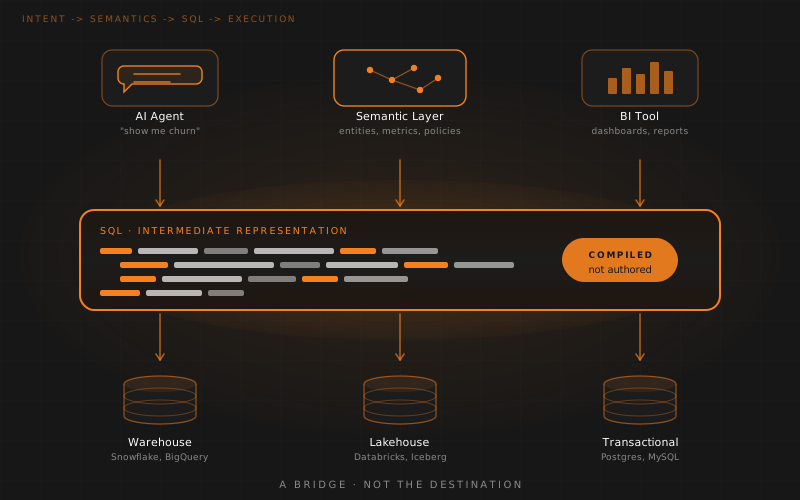
Colrows positions itself not as a reporting tool or a chatbot wrapper, but as a semantic compiler embedded within the enterprise data control plane. For the conceptual foundation of what a semantic compiler is and why SQL becomes a compile target rather than a hand-written artifact, see What Is a Semantic Compiler and SQL as a Compiler Target.
The Missing Layer: Semantic Infrastructure
Semantic infrastructure is the layer that turns raw data into executable meaning for machines. It defines what exists, how things relate, which events matter, what actions are permissible, and which constraints must be enforced. Without this layer, AI agents guess: they infer meaning probabilistically, drift as systems evolve, and fail silently. With semantic infrastructure, AI agents reason deterministically - operating on explicit entities, events, metrics, and constraints rather than implicit assumptions.
This is precisely the distinction that separates a semantic execution layer from the data catalogs and metadata tools it is often confused with. Catalogs document meaning for humans; they do not execute it. We unpack that gap in Why Data Catalogs Can't Execute AI Agents and The Decline of Metadata Tools.
What Is Consensus
Consensus is an AI-native semantic execution and reasoning substrate designed to serve as the semantic control plane for enterprise AI. It creates a living semantic graph that captures enterprise meaning in a form that autonomous agents can reason over - before they query data, make decisions, or take action. Consensus continuously learns from data schemas, documentation, metadata, and real system interactions, ensuring that semantic understanding evolves alongside the enterprise. While analytics is one consumer of this system, AI agents are its primary beneficiaries.
Semantic Primitives for Agent Reasoning
Consensus models enterprise meaning using first-class semantic primitives that together define the semantic state space in which AI agents operate:
- Entities represent core business objects such as customers, orders, or subscriptions.
- Events capture things that happen over time, such as payments, logins, or cancellations.
- Metrics represent derived semantic state rather than raw numbers, encoding how business reality changes over time.
- Concepts encode higher-level business abstractions, while relationships formalize causality, derivation, applicability, and hierarchy.
- Examples, tags, vocabulary, and definitions are modeled as first-class semantic signals - allowing agents to reason under partial understanding, navigate ambiguity, and autonomously infer new hypotheses, emerging concepts, and causal pathways as the enterprise evolves.
Together, these primitives form a shared, executable semantic foundation that enables safe, explainable, and scalable AI reasoning across the organization.
Metrics as State, Not Queries
In Consensus, metrics are not treated as SQL expressions or reusable query fragments. They are modeled as derived semantic state - a continuously interpretable representation of business reality that AI agents can reason over. A metric such as Net Revenue does not merely define how to compute a number. It encodes:
- Business meaning - what Net Revenue represents and how it differs from related metrics such as Gross Revenue or Bookings
- Valid grain - the level at which the metric is well-defined (per order, per invoice, per customer, per day)
- Dependencies - which entities, events, and other metrics contribute to its value (orders, refunds, chargebacks, discounts)
- Constraints - rules that govern how the metric can be filtered, grouped, or compared
- Downstream impact - which analyses, agents, or decisions rely on this metric
When an AI agent observes a decline in Net Revenue, Consensus allows it to reason semantically, not procedurally: it can determine whether the change is driven by reduced order volume, increased refunds, pricing changes, or shifts in customer mix - because those relationships are explicitly encoded in the metric's semantic state. In contrast to query-centric metrics, which must be recomputed and reinterpreted each time, stateful metrics act as stable semantic anchors that let agents reason consistently, explain outcomes clearly, and operate safely across complex environments. This is the same "metric consistency" failure that produces contradictory dashboards; we trace its root cause in Semantic Layer vs Knowledge Graph.
System Architecture
Architectural Thesis
Colrows is designed as a deterministic semantic compiler for enterprise analytics. Unlike traditional query proxies or BI semantic layers that resolve meaning at presentation time, Colrows formalizes business semantics prior to physical execution. The system separates semantic reasoning from physical planning and treats business logic as a versioned, dependency-aware graph that can be validated, compiled, and proven correct before interacting with any underlying SQL engine. The core premise: ambiguity must be resolved at compile time, not at runtime. Every query undergoes semantic proof, constraint validation, and policy enforcement before cost-based planning and dialect generation occur.
Layered Architecture and Separation of Concerns
The system is partitioned into four computational domains:
- Intent Parsing - syntactic parsing and AST construction
- Semantic Resolution - binding, constraint solving, join-path proof
- Logical Planning - warehouse-agnostic relational plan
- Physical Execution - cost-based planning and dialect specialization
Incoming requests are processed by stateless platform nodes responsible for syntactic parsing and abstract syntax tree (AST) construction. The resulting AST is not immediately lowered into SQL. Instead, it is transformed into a Semantic Intermediate Representation (SIR) that abstracts business intent independently of any physical schema. This intermediate form becomes the input to the semantic control plane, where validation and graph resolution occur. Only after semantic correctness is established does the SQL engine perform physical planning and dialect specialization. This strict staging prevents leakage of physical structure into business reasoning and ensures warehouse independence.
High-Level Architecture Components
| Component | Responsibility | Technology |
|---|---|---|
| Enterprise Load Balancers | Route and distribute incoming query requests across stateless compute nodes | NGINX / AWS ALB |
| Platform Nodes (Stateless) | Syntactic parsing, AST construction, SIR generation | Custom parser runtime |
| Semantic Control Plane | Intent normalization, lexical resolution, concept binding, metric validation, join-path enforcement, policy & scope resolution | Colrows Engine + Neo4j |
| Semantic Stores | Semantic state, metrics, dimensions; vector recall & synonym similarity; lineage graph & dependency DAGs | MongoDB, Weaviate, Neo4j |
| Colrows SQL Engine | Dialect mapping, pushdown planning, schema evolution, late materialization | Custom SQL compiler |
| Universal Connectors | Adapters to Snowflake, Databricks, Oracle, SQL Server, Exasol, PostgreSQL, Trino, ClickHouse, and others | JDBC / native connectors |
Runtime Request Flow
At runtime, the request lifecycle follows a deterministic path. A user or AI agent submits a natural-language or semantic query; load balancers route it to a stateless platform node; the node parses it into an AST (preserving identifiers symbolically) and lowers it into the SIR; the semantic control plane binds SIR symbols to nodes in the Consensus Semantic Graph; join paths are proven via constrained graph traversal, constraints are solved, and policies are evaluated; the validated semantic graph is lowered into a warehouse-agnostic logical plan; cost-based physical planning selects join ordering and pushdown; and dialect specialization generates warehouse-specific SQL dispatched to the appropriate connector. Failure at any stage yields a structured error - never silent degradation.
The Query Compilation Pipeline
Colrows follows a compile-then-execute model structurally analogous to modern language compilers. The compilation pipeline consists of seven deterministic, staged phases. Failure at any stage results in a structured compilation error - never silent degradation.
Phase I - Syntactic Parsing and AST Construction
The incoming query is parsed into an Abstract Syntax Tree. The parser validates grammar and structural correctness but does not resolve business meaning; identifiers such as metrics, dimensions, and entities are preserved as symbolic tokens. The grammar is defined over a superset of standard SQL extended with semantic annotations, G = (Vn, Vt, P, S), and is parsed by an LL(k) recursive-descent parser with lookahead k=3, guaranteeing O(n) parse time for well-formed inputs.
Phase II - Semantic Binding
Symbolic references in the SIR are resolved against the Consensus Semantic Graph Gs = (V, E, τ, σ). Resolution is graph-based rather than catalog-based: metrics are not treated as SQL expressions but as nodes within a dependency graph. Binding resolves the function:
Resolution operates within the allowed subgraph Gp ⊆ Gs defined by the requesting persona's scope. If a symbol cannot be uniquely resolved - i.e. |bind(s)| ≠ 1 - compilation fails with an ambiguity error. This is a critical departure from fuzzy-match approaches: no guess is made.
Phase III - Join Path Proof Algorithm
One of the core engine innovations is join-path proof. When a metric references entities spanning multiple datasets, the engine must prove the existence of a deterministic join path - not infer it probabilistically. Let D = {d₁, ..., dₖ} be the datasets referenced by a query. The join graph J = (D, R) is a directed multigraph where each edge encodes a cardinality type (1:1, 1:N, N:M), a foreign-key relationship, a grain-compatibility flag, and a canonical flag. The algorithm proceeds in three steps:
Step 1 — Candidate Enumeration: Π_candidates = BFS(J, a, h_max) // default h_max = 4
Step 2 — Pruning: keep π where grain compatible ∧ fan-out ≤ θ_cardinality ∧ acyclic
Step 3 — Ranking: R(π) = 0.5·hop_count⁻¹ + 0.35·canonical_score + 0.15·anchor_proximity
If no valid path exists, or if the top-ranked path is not unique after ranking, a COMPILATION_FAILURE is raised. This is why Colrows never fabricates a join the way LLM-generated SQL does - a point we develop in What Is a Semantic Compiler.
Phase IV - Constraint Solving
Constraints are formal predicates attached to metric and dimension nodes. The solver operates over the semantic dependency graph rather than over SQL fragments, in three sequential phases: aggregation-grain validation (verify grain_compatible(d, m) to prevent spurious fan-out), filter-compatibility analysis (build a predicate-logic formula and test for contradiction via unit propagation, a restricted form of DPLL), and scope enforcement (every referenced node must belong to the persona scope subgraph Gp). The solver is formally sound: if it returns SAT the query is guaranteed semantically consistent; if it returns UNSAT, no execution is attempted.
Phase V - Logical Plan Construction
Once semantic validation succeeds, the validated graph is lowered into a logical relational plan. Metrics are expanded into expression trees; derived metrics are topologically sorted by dependency order using Kahn's algorithm; common-subexpression elimination avoids redundant computation; and predicate-pushdown rules are applied symbolically. The logical plan remains fully warehouse-agnostic - no dialect-specific syntax or physical schema references.
Phase VI - Cost Estimation and Physical Planning
The logical plan is transformed into a physical execution plan. Cost estimation uses ingestion-time metadata (cardinality estimates, partition metadata, available indexes) with a per-join cost model Cost(j) = C_io·scan + C_cpu·cpu + C_net·net. The planner applies dynamic programming over the join-order search space, bounded by the Selinger algorithm for plans up to n=8 relations and greedy heuristics beyond that, with join reordering, projection pruning, and early-vs-late aggregation selection.
Phase VII - Dialect Specialization
The final stage translates the physical plan into dialect-aware SQL, handling syntax variation, function mapping, and quoting semantics across Snowflake, Databricks, Oracle, SQL Server, Exasol, PostgreSQL, Trino, and ClickHouse. Because semantic resolution is finalized upstream, dialect translation is guaranteed semantics-preserving - the physical plan is a pure efficiency artifact, not a semantic one. The architectural case for treating SQL as a compile target rather than a hand-authored artifact is made in SQL as a Compiler Target and, for the warehouse-native comparison, in Why Snowflake and Databricks Can't Be Your Enterprise Semantic Layer.
Knowledge Graph Construction and Ontology Management
The Consensus Semantic Graph (CSG) is the foundational data structure of the platform. It is defined as a typed, directed, versioned multigraph Gs = (V, E, τ, σ, Λ), where the vertex set V is partitioned into entities, metrics, dimensions, datasets, columns, constraints, policies, personas, and scopes; the typed edge set E includes relations such as derives_from, measured_by, anchored_at, constrained_by, applies_to, governed_by, and maps_to; τ assigns node types; σ assigns versions (timestamp, semver, author_id); and Λ captures edge properties (cardinality, grain, canonical flags).
Every node is versioned. Changes do not overwrite prior definitions but create new semantic states: update(v, v') ≡ create(v') where σ(v') > σ(v), and v remains immutable. This enables exact reproduction of any historical query against the semantic state that produced it - essential for audit and regulatory reconstruction.
Three Ontology Layers
The CSG is organized across three ontological layers, following the standard enterprise knowledge-engineering pattern:
- Upper Ontology - domain-agnostic concepts shared across all verticals: Entity, Metric, Dimension, Dataset, Policy, Persona. Fixed and versioned separately from domain content.
- Domain Ontology - vertical-specific extensions (financial services: Persistency, Lapse Rate, Net Written Premium; healthcare: Episode of Care, Readmission Rate, DRG), modeled as extensions of the upper ontology via is-a and part-of relations.
- Application Ontology - enterprise-specific instantiations: the actual metric definitions, data-source mappings, and policy bindings for a specific customer deployment.
Ontology alignment across layers uses OWL-compatible description logic - concept subsumption (C ⊑ D), equivalence (C ≡ D), and disjointness (C ⊓ D ⊑ ⊥) - encoded as graph constraints and checked at ingestion time. The distinction between this graph-native model and a flat semantic layer is explored in Semantic Layer vs Knowledge Graph.
Multi-Source Knowledge Ingestion
Enterprise knowledge is distributed across structured and unstructured sources. The ingestion pipeline integrates four major source types:
- Structured sources - database schemas (DDL), dbt models, and data-catalog exports (Atlan, Collibra, Alation) are parsed to extract entity-column-dataset triples, with foreign-key inference (explicit declarations plus naming-convention heuristics) and grain detection via cardinality analysis.
- Semantic-layer import - existing dbt Semantic Layer YAML, LookML, and Power BI .bim definitions are imported and enriched with graph relationships that static YAML cannot express: join-path constraints and persona-level scope restrictions.
- Documentation & natural language - business glossaries, wikis, and Confluence pages are processed by a three-stage NLP pipeline: Named Entity Recognition (domain-adapted BERT), Relation Extraction ("Revenue is calculated as Gross Sales minus Returns" → derives_from), and Synonym Clustering ("Revenue", "Turnover", "Top Line" → a synonym set in the vector store).
- Usage pattern learning - historical query logs yield (query_text, resolved_SIR) pairs that fine-tune intent resolution, creating an enterprise-specific semantic fingerprint that increases both resolution quality and switching cost over time.
Knowledge Graph Reasoning Algorithms
The CSG combines symbolic, embedding-based, and path-based reasoning. Symbolic reasoning uses OWL Description Logic for subsumption, instance classification, and consistency checking (via tableau algorithms), and applies association-rule mining (AMIE+) to discover latent business rules; rules above a confidence threshold (τ_rule = 0.85) are proposed to administrators before being added as soft constraints. Embedding-based algorithms embed entities and relations into a low-dimensional space for link prediction and synonym discovery:
| Model | Approach | Use case in Colrows |
|---|---|---|
| TransE | h + r ≈ t in Euclidean space | Initial link prediction for simple 1:1 relations |
| RotatE | Relations as rotations in ℂⁿ | Symmetric, inverse, and compositional relationships between metrics |
| ComplEx | Complex-valued factorization | Asymmetric relation scoring (derives_from is not symmetric) |
| R-GCN | Relational graph convolution message passing | Entity classification and multi-hop reasoning over the CSG |
| GraphRAG | LLM + KG retrieval hybrid | Natural-language intent resolution augmented by CSG traversal |
Embeddings serve only as candidate generators; structural validation always makes the final determination of whether a proposed link is valid. Path-based reasoning adds the Path Ranking Algorithm (weighted relation paths via random walks), centrality analysis (PageRank flags high-influence nodes for stricter change governance), and Dijkstra shortest-path routing within the join-proof engine. Finally, a hybrid enrichment loop ties these together: embeddings propose candidate links, association-rule mining validates them, structural constraint checking filters them, administrators endorse survivors, and endorsed links are added as versioned edges before embeddings are retrained - a continuous improvement cycle that makes the graph progressively more complete and domain-calibrated. This is the same mechanism we describe operationally in Agents That Maintain Your Data Systems.
The Semantic Execution Graph in Action
All semantic primitives - entities, events, metrics, concepts, and constraints - are connected through a semantic execution graph. This graph is not a passive knowledge store or documentation artifact; it is an active runtime structure that AI agents consult while reasoning, deciding, and acting. Rather than issuing queries blindly, agents traverse the graph to determine what paths are valid, what relationships are permissible, and what constraints must be respected. Every step is validated against the graph before any query is generated or any action is taken.
When an agent is asked to analyse a drop in Net Revenue, it does not simply join tables and aggregate values. It follows semantic paths that link Net Revenue to its contributing events - orders, discounts, refunds, and chargebacks - while honouring constraints such as valid grain, time windows, and organizational policies. When evaluating customer churn risk, it traverses paths connecting user-activity events, subscription state, billing failures, and support interactions; the graph ensures only meaningful causal chains are explored, preventing speculative or logically inconsistent reasoning. Operating on this execution graph at runtime lets agents discover valid semantic pathways, enforce business and governance constraints automatically, guarantee semantic correctness before any query or action, and produce explainable reasoning traces showing why a conclusion was reached.
Autonomous Semantic Agents and Drift Detection
Consensus is maintained and operated by a coordinated set of autonomous semantic agents that continuously construct, validate, and evolve enterprise meaning. These are not workflow automations; they are reasoning components that operate over the semantic execution graph to keep enterprise semantics accurate, consistent, and actionable:
- Discovery agents ingest schemas, metadata, and documentation to identify entities, events, metrics, and candidate relationships.
- Architecture agents enforce semantic correctness by validating grain, dependencies, and constraints, ensuring new or evolving definitions do not violate business logic.
- Learning agents observe how humans and AI systems use semantics in practice - queries, analyses, decisions - and refine definitions based on real-world usage.
- Monitoring agents continuously detect semantic drift, anomalies, and broken assumptions as data models, business processes, and behaviours change.
Together, these agents let Consensus function as self-maintaining semantic infrastructure, eliminating constant manual curation while preserving governance and trust. Enterprise data environments are never static - schemas evolve, business definitions shift, and new sources are onboarded - so drift detection is a first-class subsystem, not an afterthought. The broader phenomenon of semantic decay is covered in Knowledge Drift and Semantic Decay.
Categories of Semantic Drift
| Drift type | Description and detection method |
|---|---|
| Schema Drift | Column additions, removals, type changes, or table renames in underlying datasets. Detected via structural diffing of dataset node snapshots. |
| Distribution Drift | Statistical distribution of column values shifts (e.g., a currency field that now contains multi-currency values). Detected via statistical fingerprinting. |
| Definition Drift | Business definition of a metric or entity changes (e.g., "Active Customer" threshold moves from 30 to 90 days). Detected via CSG version diff. |
| Relationship Drift | Previously valid join paths become invalid (FK dropped, cardinality changes). Detected via join-graph re-validation. |
| Policy Drift | Access policies change, invalidating previously compiled query plans. Detected via persona-scope subgraph diff. |
Statistical Fingerprinting and Structural Diffing
Column distribution drift is quantified with KL-divergence KL(P∥Q) = Σ P(xᵢ)·log(P(xᵢ)/Q(xᵢ)) and, for numerical columns, the Kolmogorov-Smirnov statistic D_KS = supₓ|F_P(x) − F_Q(x)|. A drift alert is raised when KL > 0.1 nats or D_KS > 0.05; fingerprints are computed incrementally using reservoir sampling to avoid full-table scans. Schema drift treats dataset schemas as labelled trees and computes the tree edit distance between snapshots using the Zhang-Shasha algorithm, classifying changes by severity: non-breaking additions (low, logged), type widening (medium, affected metrics flagged for revalidation), and breaking changes such as column removal (high, all dependent CSG paths invalidated).
Conflict Detection and Resolution
Conflicts arise when two definitions are semantically equivalent but diverge in derivation logic, grain, or constraints. Two metric nodes are structurally equivalent if their normalized expression trees are isomorphic under canonical reordering (commutativity rewriting, constant folding, dependency-set comparison). Because structural equivalence alone cannot catch natural-language-defined metrics that are semantically equal but syntactically different, Colrows applies a hybrid approach: sentence-transformer embeddings generate candidate duplicate pairs (cosine similarity > 0.90), and structural comparison then determines final equivalence - preventing both false positives and false negatives. Detected conflicts are surfaced to administrators with a structured workflow: Merge (one definition becomes canonical, the other an alias, dependent plans recompiled), Split (definitions are genuinely distinct; anchors force explicit disambiguation), or Defer (logged and tolerated pending investigation).
Multi-Layered Semantic Search
Effective semantic search in an enterprise context requires more than lexical matching or vector similarity. A query for "last quarter's sales by region" must resolve region to the correct geographic dimension, sales to the correct metric definition (not the closest embedding match), and last quarter to a time-bounded filter computed relative to the request timestamp - all deterministically. Colrows implements a four-layer semantic search architecture.
- Layer 1 - Lexical Resolution. Exact and near-exact string matching over an inverted index of tokenized node labels, scored as BM25(q, label) + α·exact_match_bonus (α = 2.0), giving a strong bonus for exact matches and discouraging spurious fuzzy matches.
- Layer 2 - Synonym and Vector Recall. Query terms are expanded through the synonym graph ("Churn Rate", "Attrition Rate", "Customer Loss Rate") and dense bi-encoder retrieval scores cosine(emb_query, emb_node), using HNSW approximate-nearest-neighbour search for sub-millisecond recall. The top-K candidates (default K=20) pass to structural validation.
- Layer 3 - Graph Traversal and Structural Validation. Candidates are validated through CSG traversal: reachable from the persona scope subgraph, grain-compatible, not deprecated, not in conflict. Crucially, graph traversal performs semantic enrichment - the full dependency subgraph (source entities, constraints, join paths) is retrieved. This is what distinguishes Colrows from pure vector search: the result is not a document snippet but a structured, executable semantic plan.
- Layer 4 - Intent Disambiguation and Re-Ranking. A learned re-ranking model scores remaining candidates as λ₁·lex + λ₂·vec + λ₃·graph + λ₄·persona, where the persona term captures historical co-occurrence of persona and node in successful compilations, learned via listwise learning-to-rank (LambdaMART). If the top candidate does not exceed the confidence threshold, the system requests disambiguation rather than proceeding with an uncertain resolution.
This is the deterministic counterpart to retrieval-only RAG pipelines; the trade-offs are compared directly in RAG vs Semantic Layer.
Search Performance
| Metric | Value |
|---|---|
| Layer 1 (Lexical) latency | < 5 ms p99 |
| Layer 2 (Vector recall) latency | < 15 ms p99 (HNSW ANN) |
| Layer 3 (Graph traversal) latency | < 40 ms p99 for graphs up to 1M nodes |
| Layer 4 (Re-ranking) latency | < 10 ms p99 |
| End-to-end semantic resolution | < 80 ms p99 |
| Resolution accuracy (MRR@1) | 0.91 on benchmark enterprise datasets |
Governance as Compile-Time Enforcement
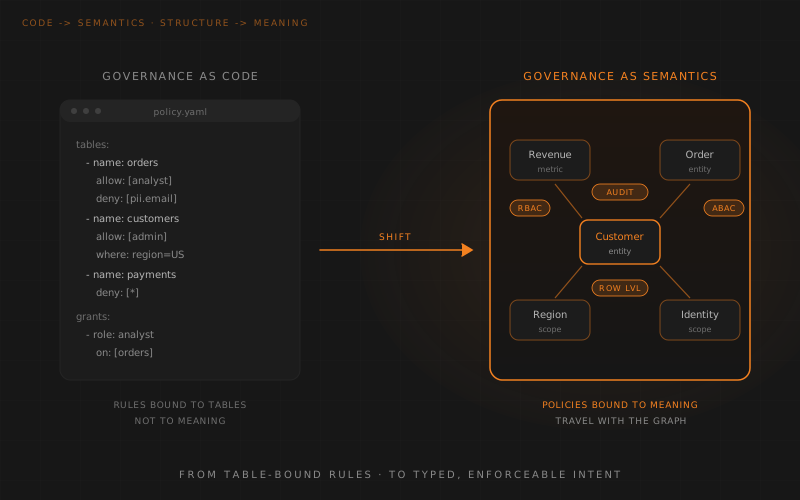
Traditional data governance in analytics is procedural: access controls are enforced at the database layer after query execution, or through post-hoc output masking. This has fundamental weaknesses - expensive queries can be partially executed before authorization failures are detected, masking can be bypassed through indirect queries, and violations are caught reactively. Colrows implements governance structurally within the compilation pipeline. Policy enforcement is not a post-processing step; it is a precondition for query compilation. The full architectural argument is in How to Govern AI Agents That Query Enterprise Data and Governance as Code, Governance as Semantics.
The Policy Node Model
Governance rules are embedded as Policy nodes in the CSG. Each encodes a scope (the metric, dimension, and dataset nodes it governs), persona bindings (the personas it applies to), a predicate (a formal condition such as a time-window restriction, regional filter, or row-level filter), and an enforcement mode (BLOCK or FILTER). During semantic binding, the requesting persona is resolved to its scope subgraph:
Three Structural Guarantees
- Completeness. If a metric node M is outside G_p, it is unreachable during semantic binding. No query can reference M for that persona - not through direct reference, not through derived metrics, not through synonym resolution. The constraint is enforced at the graph-traversal level.
- Non-bypassability. Because compilation operates within G_p, there is no mechanism by which a well-formed query can produce an unauthorized result. The unauthorized plan cannot be generated - not masked, then generated and masked. It simply cannot exist.
- Auditability. Every compiled plan carries a complete provenance record: the CSG node versions resolved, the policy nodes evaluated, the persona scope applied, and the compilation timestamp - a full audit trail for regulatory purposes.
No post-execution masking or filtering is required because unauthorized plans cannot be generated. Policy enforcement is structural, not procedural - enforced at the graph level, not the result level.
Constraints as Executable Semantics
In traditional systems, constraints live in scattered places: application code, SQL queries, dashboards, or human processes. In Consensus, constraints are modeled directly as semantic rules that govern how meaning can be used - a metric may only be aggregated at specific grains; certain metrics may not be compared across incompatible time windows; sensitive fields may not be used by specific agents or personas; certain actions may only be triggered under approved semantic conditions. Because these constraints are part of the semantic execution graph, they are enforced automatically during reasoning: agents cannot accidentally violate business logic, regulatory requirements, or organizational policy, because the reasoning path itself becomes invalid.
Safe Autonomy and Explainability
Consensus enables bounded autonomy: agents are free to reason, explore, and infer, but only within the semantic boundaries defined by the organization. Agents can adapt to new data and evolving definitions without breaking rules; risky or ambiguous actions are flagged or blocked; and human oversight is applied where required without micromanaging every decision. For example, an agent may detect a potential revenue anomaly but be restricted from triggering customer-facing actions without higher-confidence validation or human approval. Because governance is embedded in the semantic layer, every decision is explainable in semantic terms - which metric definitions were used, which relationships and causal chains were traversed, which constraints were evaluated, and why alternative paths were rejected. The system also maintains a complete semantic audit trail recording what changed, who or what initiated the change, when, why, and which agents, analyses, or decisions are impacted.
Building an AI Agent with Consensus
Consider an AI agent tasked with detecting and responding to revenue risk. The agent does not begin by querying tables or writing SQL. Instead, it operates entirely within the semantic execution context, in five stages:
- State Awareness. The agent observes a change in semantic state - a sustained decline in Net Revenue. Because Net Revenue is modeled as derived semantic state, the agent understands its definition, valid grain, and dependencies before taking any action.
- Semantic Traversal. Using the execution graph, the agent traces Net Revenue to its contributing events and entities - orders, discounts, refunds, chargebacks - following only valid semantic paths and avoiding speculative joins.
- Causal Reasoning. The agent evaluates recent events and identifies an increase in payment failures triggering refunds. Because causality and derivation are explicitly encoded, it distinguishes volume-driven declines from refund-driven erosion.
- Constraint Enforcement. Before acting, the agent evaluates governance constraints - time windows, organizational policies, metric applicability. Conclusions are semantically valid and compliant by construction.
- Explanation and Action. The agent generates a human-readable explanation of its reasoning - why revenue is declining, which factors are responsible, and how confident the conclusion is - and can safely trigger alerts, initiate investigations, or recommend corrective actions.
Without Consensus, building such an agent would require hardcoded logic, fragile heuristics, and constant manual tuning; the agent would be tightly coupled to schemas, vulnerable to drift, and incapable of explaining its decisions. With Consensus, the agent is semantically grounded, self-adapting, governed by default, and explainable.
Agent-Centric Enterprise Use Cases
Consensus enables a new class of AI agents that operate on semantic state, causal relationships, and governed meaning rather than brittle queries or heuristics. Five representative examples across major enterprise domains:
1. E-Commerce: Revenue Risk & Margin Erosion Agent
E-commerce businesses experience unexplained drops in revenue or margin caused by a combination of refunds, promotions, payment failures, and fulfilment issues; traditional monitoring detects anomalies but struggles to explain why. The agent continuously monitors semantic state such as Net Revenue, Gross Margin, and Refund Rate, and when a deviation is detected it traverses the execution graph to trace dependencies across orders, payments, promotions, refunds, and logistics events. Outcome: a precise explanation - for example, a spike in payment failures for a specific gateway driving refunds in a high-margin category - and it can trigger alerts or recommend corrective actions.
2. Technology / SaaS: Churn Prevention & Expansion Agent
In SaaS, churn is rarely a single signal; it emerges from usage patterns, billing issues, support interactions, and product changes. The agent reasons over concepts such as Active Users, Subscription State, Billing Events, and Support Escalations, correlating behavioural events with lifecycle state transitions and applying organizational definitions consistently. Outcome: instead of a generic churn score, the agent explains why specific customers are at risk - e.g., declining usage after a feature change combined with repeated billing failures - and triggers targeted retention workflows.
3. SRE / Platform Engineering: Incident Root-Cause Agent
SRE teams face alert floods and incidents spanning infrastructure, applications, and business impact. The agent reasons across relationships linking system events (latency spikes, error rates), application services, user actions, and business metrics such as conversion or revenue, understanding causal chains like service degradation → checkout failures → revenue loss. Outcome: it identifies not just what failed but why it matters, prioritizing incidents by semantic business impact.
4. Sales & Go-To-Market: Pipeline Health Agent
Sales leaders struggle to understand why pipeline conversion slows or deals stall across regions, products, and segments. The agent reasons over Leads, Opportunities, Accounts, and Sales Activities alongside metrics like Win Rate, Sales Cycle Time, and Pipeline Velocity, comparing performance across segments without semantic drift. Outcome: it explains, for example, that stalled pipeline in a region is driven by reduced demo activity following a territory change - rather than market demand - and surfaces targeted recommendations.
5. Finance: Close & Reporting Integrity Agent
Finance teams spend significant time reconciling reports during month-end close due to metric inconsistencies, late adjustments, and semantic drift across systems. The agent monitors governed semantic state for core metrics such as Revenue, COGS, and Deferred Revenue, enforcing consistent definitions across reports, detecting deviations caused by late events or definition changes, tracing discrepancies to source events, and blocking or flagging semantically invalid reports. Outcome: reduced close-time friction, with published numbers that are semantically correct and auditable.
Without semantic infrastructure, each of these agents would require hardcoded business logic, fragile schema-dependent rules, manual updates as definitions evolve, and limited explainability. These are not analytics bots - they are enterprise-grade AI agents built on semantic infrastructure.
Scalability Model
Colrows is designed for horizontal scalability at every layer, with semantic state and physical planning kept strictly decoupled to allow independent scaling.
- Stateless compute layer. Platform nodes (parsing, SIR construction) are stateless and scale horizontally behind load balancers; scaling is purely additive. Request routing is hash-consistent on query signature to maximize cache hit rates on repeated compilations.
- Semantic graph store. The CSG is stored in Neo4j with partitioned graph storage; large graphs (10M+ nodes) are partitioned by domain-ontology subgraph. Entity resolution is O(log n) via a composite index; join-path BFS is O(V + E) bounded by h_max, typically < 40 ms for h_max = 4 on graphs up to 5M nodes; metric-dependency topological sort is O(V + E) via Kahn's algorithm.
- Warehouse load reduction. Because semantic validation precedes execution, invalid or ambiguous queries are rejected before reaching compute-intensive stages. Empirically, Colrows rejects an average of 23% of AI-generated queries at the semantic compilation stage - queries that would otherwise consume warehouse compute and return incorrect results - providing a direct cost reduction proportional to the volume of AI-assisted analytics.
- Compilation caching. Compiled plans are content-addressed and cached; the cache key is a hash of the semantic plan fingerprint (CSG node versions, join path, constraint set). Plan invalidation is event-driven: when a CSG node is updated, all cached plans referencing it are invalidated, ensuring correctness without TTL-based expiry.
Competitive Landscape
The market for enterprise analytics tooling is crowded, but no existing category combines all three foundational properties required for production-grade enterprise AI: semantic correctness proven before execution, autonomous maintenance, and structural governance at compile time.
| Category / Product | What it does | What it lacks vs. Colrows |
|---|---|---|
| Data Catalogues Atlan, Alation, Collibra | Document meaning for human readers. Observability tools: tell people what data exists and what it means. | Do not resolve meaning at query execution time. Do not enforce semantic correctness. Do not generate governed execution plans. |
| Semantic Layers dbt, LookML / Looker | Developer-maintained, static configuration layers. Expose pre-defined metrics and relationships. | No autonomous drift detection. No versioned graph. No compile-time join-path proof. Not built for AI agent execution. |
| LLM + RAG Copilots | Infer meaning at query time from retrieved context. Probabilistic by design. | Non-deterministic results. Hallucinated joins common. Governance is advisory. Structurally unfit for regulated enterprise use. |
| BI Semantic Layers Power BI, Tableau, MicroStrategy | Resolve meaning at presentation time within a single vendor ecosystem. | Not warehouse-agnostic. Not AI-native. No cross-system semantic governance. Designed for humans, not machine execution. |
| Text-to-SQL Tools Databricks DBRX, etc. | Generate SQL from natural language using LLMs with schema context. | Output is a suggestion, not a proven plan. Join paths may be inferred wrongly. Governance is not embedded. |
| Colrows | Semantic execution layer: resolves context at runtime, compiles intent to governed execution deterministically. | N/A - this is the gap being filled. |
The key distinction is that Colrows does not merely store or retrieve semantic context - it resolves context deterministically at runtime and converts intent into a governed execution plan. This positions it as infrastructure rather than tooling. For buyers weighing whether to assemble this themselves, see The Build vs Buy Decision for Enterprise Semantic Layers.
Why This Is Foundational for Enterprise AI
As enterprises move from experimentation to real deployment of AI agents, a hard truth emerges: AI systems cannot be safely or reliably deployed without shared, executable semantics. Models alone are not enough. Data alone is not enough. Even sophisticated orchestration and guardrails fail if AI agents do not understand what enterprise data actually means. Large language models operate probabilistically; they are excellent at pattern completion, but they do not possess intrinsic understanding of business context, causal relationships, or organizational rules. In enterprise environments, this gap manifests as hallucinated joins, misapplied metrics, inconsistent reasoning, and actions that appear plausible but are fundamentally incorrect. These are not edge cases - they are structural limitations.
Consensus addresses this by acting as the semantic control plane for enterprise AI: a persistent, governed layer of meaning that agents must consult before reasoning, querying, or acting. By externalizing business meaning, agents reason over semantic state rather than raw data; valid relationships, causal paths, and constraints are enforced at runtime; organizational definitions remain consistent across agents, tools, and time; and semantic drift is detected and corrected before it impacts decisions. This transforms AI behaviour from probabilistic guessing into deterministic, context-aware reasoning - and trust follows not from accuracy alone but from explainability, because every decision is grounded in explicit semantic constructs.
Just as databases became foundational for applications and cloud platforms became foundational for infrastructure, semantic infrastructure is becoming foundational for enterprise AI. It is the missing layer that makes AI agents reliable instead of fragile, explainable instead of opaque, governed instead of risky, and scalable instead of bespoke. This is the same thesis we develop in our companion whitepaper, The Rise of Semantic Gravity, and in the pillar guide What Is a Semantic Layer?
Conclusion
This whitepaper has presented Colrows - a deterministic semantic execution layer for enterprise analytics and AI. We described a system architecture that separates semantic reasoning from physical planning through a seven-stage compilation pipeline; a formal knowledge-graph model (the Consensus Semantic Graph) that treats business meaning as a typed, versioned, dependency-aware graph; algorithms for multi-source ontology construction drawing on symbolic reasoning, embedding-based models, and path-based graph algorithms; an autonomous drift and conflict detection subsystem using statistical fingerprinting and structural equivalence analysis; a four-layer semantic search architecture combining lexical, vector, graph, and persona-aware retrieval; and a structural governance model that enforces policy at compile time rather than post-hoc.
The central architectural insight is that enterprise analytics is fundamentally a compilation problem, not a retrieval problem. Business meaning must be resolved before execution, not inferred during or after it. This distinction is what separates a system capable of supporting regulated, auditable, AI-driven enterprise analytics from one that merely approximates it. As AI agents increasingly operate autonomously within enterprise environments - querying databases, triggering workflows, and making decisions - the need for a semantic execution layer that can mediate between agent intent and enterprise systems in a deterministic, governed manner becomes not merely desirable but essential. Colrows is designed to be that layer.
Stop retrieving. Start executing. Prove the query, then run it.
Frequently Asked Questions
What is a semantic execution layer?
A semantic execution layer is infrastructure that sits above the data warehouse and below the AI agent or BI tool. It formalizes enterprise business meaning as a typed, versioned, dependency-aware knowledge graph and compiles every analytical request against that graph - proving it semantically correct - before any physical SQL is executed. Unlike a BI semantic layer that resolves meaning at presentation time, or an LLM that infers SQL probabilistically, a semantic execution layer resolves ambiguity at compile time and generates a governed, deterministic execution plan.
How is Colrows different from a data catalog like Collibra or Alation?
Data catalogs document meaning for human readers - they are observability tools that tell people what data exists and what it means. They do not resolve meaning at query execution time, do not enforce semantic correctness, and do not generate governed execution plans. Colrows does not merely store or retrieve semantic context; it resolves context deterministically at runtime and converts intent into a proven, governed execution plan. This makes it infrastructure rather than documentation.
What is the join-path proof engine?
When a metric references entities spanning multiple datasets, the Colrows engine must prove the existence of a deterministic join path rather than infer one probabilistically. It enumerates candidate paths via bounded breadth-first search, prunes them against grain-compatibility, cardinality, and cycle constraints, then applies a deterministic ranking function. If no unique valid path exists, compilation fails with a structured error rather than guessing. This is why Colrows never hallucinates joins the way LLM-generated SQL does.
Why do enterprise AI agents fail in production?
Most enterprise AI agent efforts fail beyond controlled demos - not due to model quality, data availability, or compute, but because of a missing layer: shared, executable business meaning. Large language models generate fluent answers and syntactically valid SQL, but they do not understand enterprise-specific semantics - what a metric truly means, which relationships are valid, or what actions are allowed. Without this, agents hallucinate joins, misuse metrics, violate governance, and produce untrustworthy results.
What is the Consensus Semantic Graph?
The Consensus Semantic Graph (CSG) is the foundational data structure of Colrows: a typed, directed, versioned multigraph whose nodes are entities, metrics, dimensions, datasets, columns, constraints, policies, personas, and scopes, connected by typed edges such as derives_from, measured_by, and governed_by. Every node is versioned - changes create new immutable semantic states, enabling point-in-time reproducibility of historical queries. Metrics are modeled as derived semantic state, not as reusable SQL fragments.
How does compile-time governance work?
Traditional governance enforces access controls at the database layer after execution, or through post-hoc output masking. Colrows embeds governance structurally within compilation: policy nodes define a persona's scope subgraph, and query compilation operates only within that subgraph. If a node is outside the persona's scope, it is unreachable during semantic binding - no query can reference it, not through direct reference, derived metrics, or synonym resolution. Unauthorized plans cannot be generated, so no post-execution masking is required. Every compiled plan carries a full provenance record for audit.
How does Colrows detect and handle schema and semantic drift?
Colrows runs an autonomous drift and conflict detection subsystem that continuously monitors the semantic graph and its underlying sources. It detects five categories of drift: schema drift (via tree edit distance on schema snapshots), distribution drift (via KL-divergence and Kolmogorov-Smirnov statistics), definition drift (via version diff), relationship drift (via join-graph revalidation), and policy drift (via scope-subgraph diff). Detected changes are classified by severity and dependent compiled plans are invalidated and recompiled.
Which data warehouses does Colrows support?
Colrows compiles one semantic graph into dialect-perfect SQL for many engines through universal connectors, including Snowflake, Databricks, Oracle, SQL Server, Exasol, PostgreSQL, Trino, and ClickHouse. Because semantic resolution is finalized upstream, dialect specialization is a pure efficiency artifact and is guaranteed to be semantics-preserving across every supported engine. Engine-by-engine comparisons are on the comparisons hub.
References
- Auer, S., Bizer, C., Kobilarov, G., Lehmann, J., Cyganiak, R., & Ives, Z. (2007). DBpedia: A nucleus for a web of open data. ISWC 2007.
- Bellomarini, L., Gottlob, G., Pieris, A., & Sallinger, E. (2019). Swift logic for big data and knowledge graphs. IJCAI 2019.
- Bollacker, K., Evans, C., Paritosh, P., Sturge, T., & Taylor, J. (2008). Freebase: a collaboratively created graph database. SIGMOD 2008.
- Bordes, A., Usunier, N., Garcia-Duran, A., Weston, J., & Yakhnenko, O. (2013). Translating embeddings for modeling multi-relational data. NeurIPS 2013.
- Galkin, M., Yuan, X., Mostafa, H., Tang, J., & Hamilton, W. (2023). Towards foundation models for knowledge graph reasoning. ICLR 2023.
- Lerer, A., Wu, L., Shen, J., Lacroix, T., Wehrsteiner, L., Joulin, A., & Szlam, A. (2019). PyTorch-BigGraph: a large-scale graph embedding system. MLSys 2019.
- Paulheim, H. (2017). Knowledge graph refinement: A survey of approaches and evaluation methods. Semantic Web, 8(3), 489-508.
- Selinger, P.G., Astrahan, M.M., Chamberlin, D.D., Lorie, R.A., & Price, T.G. (1979). Access path selection in a relational database management system. SIGMOD 1979.
- Sun, Z., Deng, Z., Nie, J., & Tang, J. (2019). RotatE: Knowledge graph embedding by relational rotation in complex space. ICLR 2019.
- Zhang, K., & Shasha, D. (1989). Simple fast algorithms for the editing distance between trees and related problems. SIAM Journal on Computing, 18(6), 1245-1262.
- Galkin, M., et al. (2022). NodePiece: Compositional and parameter-efficient representations of large knowledge graphs. ICLR 2022.
- Lewis, P., et al. (2020). Retrieval-augmented generation for knowledge-intensive NLP tasks. NeurIPS 2020.
This document combines the Colrows Technical Whitepaper (v2.0, Jan 2026) and the Consensus Semantic Layer whitepaper (Dec 2025), both authored by ALTERBASICS Technologies Pvt. Ltd. Contact: engage@colrows.com.