Introduction: The Next Enterprise Infrastructure Shift
The term data gravity was coined by software engineer Dave McCrory in 2010, describing how data, as it accumulates mass, pulls applications and services toward it the way a planet pulls objects into its orbit. Over the past decade that idea became the organising principle of enterprise architecture. Applications, analytics systems, cloud infrastructure, and operational workflows reorganised themselves around where enterprise data lived and how efficiently it could be processed. Analysts later quantified the pull directly: McCrory's own modelling forecast enterprise data-gravity intensity to grow by 139 percent between 2020 and 2024.
This shift produced cloud data warehouses, lakehouses, ETL and ELT platforms, modern BI systems, data governance platforms, observability tooling, and the modern data stack itself. The economics followed the gravity. The cloud data warehouse market alone reached approximately 10 billion dollars in 2024, compounding at over 22 percent a year. The data lakehouse segment, valued at over 15 billion dollars, is growing at more than 22 percent.
The defining assumption of the last decade was simple: the enterprise that organises and operationalises its data most effectively gains leverage across the business.
AI changes what enterprises need from software. AI systems do not merely need access to data. They need understanding: operational meaning, organisational context, business definitions, workflow semantics, policy interpretation, institutional memory, and reasoning alignment.
In short, AI requires semantics.
We believe this creates the next foundational enterprise infrastructure layer: the semantic platform. And just as data developed gravitational pull in the cloud era, semantics will develop similar gravity in the AI era. We call this semantic gravity.
AI Changes the Primary Consumer of Enterprise Systems
Historically, enterprise software was designed for humans. Humans were the interpretation layer between systems and decisions. Even when enterprise applications lacked contextual completeness, human operators compensated through experience, organisational understanding, tribal knowledge, and implicit reasoning.
AI changes this architecture. Increasingly, humans interact with AI, AI interacts with enterprise systems, and autonomous agents interact with one another. This is no longer speculative. Gartner forecasts that by 2028 a third of enterprise software applications will include agentic AI, up from less than 1 percent in 2024, and that 15 percent of day-to-day work decisions will be made autonomously by agents, up from zero in 2024. The agentic AI market, worth roughly 5 to 8 billion dollars across 2024 and 2025, is forecast to reach between 25 and 55 billion dollars by 2030, at compound growth rates above 40 percent.
The primary operational consumer of enterprise data is increasingly AI, not the human user. Enterprise workflows become AI-mediated, context-driven, and reasoning-centric. Applications still exist, but their interfaces grow thinner while orchestration and semantic reasoning become more central.
This creates a hard requirement. AI systems need consistent operational understanding. A database schema alone cannot explain what a metric truly represents, which data source is authoritative, which workflow exceptions matter, how policies should be interpreted, or how the organisation actually operates. Without contextual grounding, AI systems become unreliable. The research bears this out: Stanford's Institute for Human-Centered AI found that large language models hallucinate on 15 to 20 percent of factual queries when they lack external grounding, and Gartner has reported that ungoverned retrieval data produces fabricated responses in roughly half of cases.
This is the origin of semantic gravity. We explored the consequences for individual agent deployments in our blog post on Semantics for Enterprise AI Agents and the failure mode that drops out when it is missing in How to Prevent AI Hallucinations on Enterprise Data.
Why Semantics Become Enterprise Infrastructure
The rise of AI creates a new enterprise requirement: a continuously maintained operational understanding layer.
Operational context is scattered. It lives across databases, BI systems, documentation, dbt models, workflow systems, APIs, CRM platforms, support systems, policy systems, and human feedback loops. No single application holds more than a fragment of it.
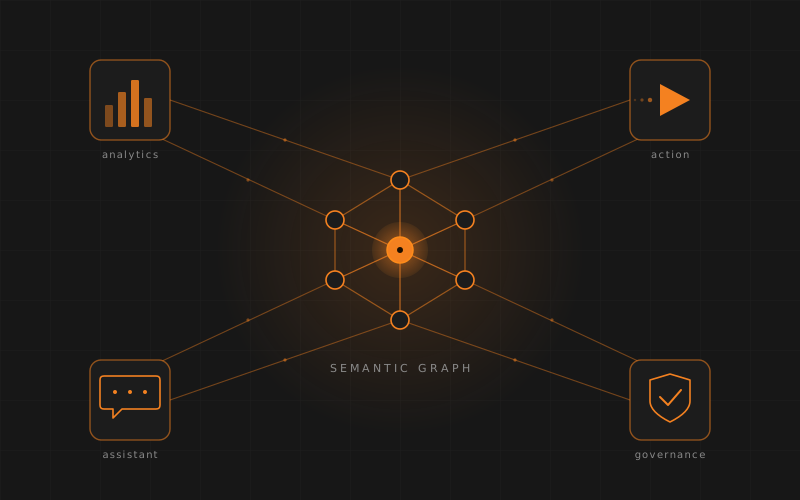
The enterprise therefore needs a centralised system capable of ingesting distributed organisational knowledge, constructing operational meaning, maintaining semantic consistency, and serving contextual understanding to AI systems in real time.
This is the role semantic platforms will play. Over time, they evolve into systems that continuously synthesise organisational context, maintain enterprise operational memory, align business definitions, coordinate reasoning across systems, and operationalise semantics for AI consumption. The architectural depth of this layer is explored in our deep dive on Building the Enterprise Memory Graph and its operating-system framing in The Emergence of the Semantic Operating System.
Over time, the semantic platform increasingly becomes the operational cognition layer of the enterprise. The industry is already converging on this conclusion. Gartner elevated the semantic layer to essential infrastructure in its 2025 Hype Cycle for Business Intelligence and Analytics, and reporting from the same period found that roughly 40 percent of enterprise leaders now see the absence of semantic context as a major blocker for operational AI.
Every Enterprise Application Becomes AI-Native
We believe every major category of enterprise software will embed AI capabilities over the next decade: BI platforms, CRMs, ERPs, underwriting systems, claims systems, electronic medical records, customer support systems, and industry-specific operational software. This is already underway. More than 60 percent of enterprise SaaS products carry embedded AI features today, and Gartner expects 40 percent of enterprise applications to integrate task-specific AI agents by the end of 2026, up from less than 5 percent in 2025.
Each application will attempt to develop its own localised semantic understanding. This creates an enterprise-scale problem.
Each application understands only a narrow operational slice of the organisation. As AI proliferates across enterprise systems, organisations face duplicated semantic modelling, inconsistent business definitions, fragmented operational memory, conflicting AI reasoning, semantic drift, and governance fragmentation.
The AI era introduces a harder challenge than data fragmentation. It introduces context fragmentation, and this is shaping up to be one of the defining operational problems of the AI-native enterprise. We covered the operational consequences of context fragmentation in The Accidental Complexity in Modern Data Stacks and the slow-burn version of the same problem in Knowledge Drift and Semantic Decay.
This is not hypothetical. Practitioners already treat metric inconsistency as a chronic condition. As AtScale has described it, enterprises spent the last decade treating conflicting definitions of revenue across Tableau and Power BI as a documentation problem, to be managed with quarterly reconciliation meetings. That approach worked while humans consumed the analytics, because humans could apply business context and spot obvious errors. Generative AI broke the model, because language models bring no business context of their own.
The Long-Term Consolidation of the Enterprise Stack
The modern enterprise stack is already operationally complex. Organisations maintain data pipelines, metrics definitions, governance rules, access policies, workflow logic, business mappings, semantic models, and AI prompts across dozens of disconnected platforms. The sprawl is measurable: the average enterprise now runs somewhere between 100 and 350 software applications, depending on how they are counted, and large enterprises sit at the upper end of that range. Every new AI-enabled system adds another store of fragmented context.
AI amplifies this dramatically. As many enterprise systems develop their own AI capabilities, organisations face an unsustainable expansion of fragmented context systems. Over time, maintaining distributed operational meaning across hundreds of AI-enabled systems becomes economically and operationally challenging.
This creates a strong consolidation force. Just as enterprises previously centralised identity, authentication, observability, cloud infrastructure, and data platforms, they are likely to centralise semantic understanding, operational context, organisational memory, and AI reasoning coordination. The pattern is already visible in adjacent tooling: Gartner expects more than 70 percent of organisations to centralise SaaS application management through dedicated platforms by 2028, up from less than 30 percent in 2025.
We believe this gives rise to a new enterprise control plane: the semantic coordination layer.
Why Semantic Platforms Become Strategically Central
Semantic platforms gain structural advantages over time because they sit at the intersection of enterprise data, operational workflows, AI reasoning, governance, and organisational knowledge.
Every connected system enriches enterprise understanding. Every workflow interaction improves contextual accuracy. Every AI execution strengthens operational reasoning models.
This produces compounding effects: semantic network effects, operational lock-in, reasoning centrality, and increasing switching costs. The dynamic mirrors data gravity itself. McCrory has described how cloud economics create an artificial data gravity, where the more data an organisation accumulates, the more expensive and impractical it becomes to move. Semantic state behaves the same way. The accumulated meaning of an enterprise, once encoded, is far harder to reproduce than the data it describes.
Importantly, this is not merely a metadata problem. Metadata systems describe assets. Semantic platforms operationalise understanding. The long-term opportunity is therefore larger than cataloguing or governance alone. It is the creation of a foundational reasoning infrastructure layer for AI-native enterprises. We argued the wider stake of this distinction in The Semantic Divide and The Decline of Metadata Tools.
The Colrows Thesis
At Colrows, we believe enterprise software is transitioning from application-centric architectures toward reasoning-centric architectures. As this transition accelerates:
- AI becomes the primary operational consumer of enterprise systems.
- Semantics become mission-critical infrastructure.
- Enterprises require centralised operational understanding.
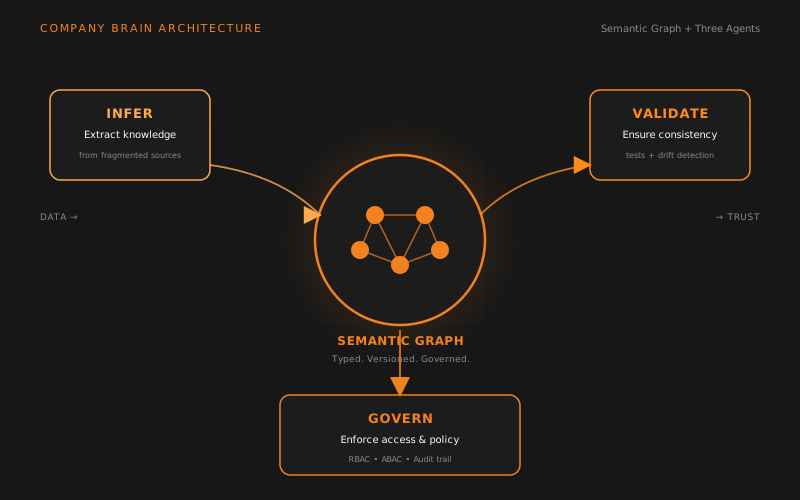
Colrows is being built as the semantic coordination platform for the AI-native enterprise: the company brain that grounds every AI system, copilot, and autonomous agent in shared, governed, and explainable meaning. Y Combinator has framed the same problem in its call for a company brain, a system that holds an organisation's collective knowledge and makes it usable by AI. We believe that problem is not solved by a better model or a larger context window. It is solved by infrastructure. We expanded on the precise definition - and on why a wiki, a vector index, or an MCP tool registry is not a company brain - in The Company Brain: Why Enterprise AI Agents Need a Shared Semantic Memory.
The model is not the bottleneck
The case for semantic infrastructure rests on a measurable fact: the bottleneck for enterprise AI is not model capability. It is context. The MIT NANDA initiative's 2025 study, State of AI in Business, found that 95 percent of enterprise generative AI pilots delivered no measurable impact on profit and loss, despite collective enterprise investment estimated at 30 to 40 billion dollars. The study attributed the failure not to model quality but to a learning and integration gap. Gartner reached a similar conclusion, predicting that more than 40 percent of agentic AI projects will be cancelled by the end of 2027 because of unclear business value and inadequate risk controls.
The technical evidence points the same way. On Spider 2.0, a benchmark built to reflect real enterprise text-to-SQL workflows, the strongest published systems answer only around half of questions correctly. Retrieval-augmented generation performs no better against structured enterprise data, because semantic similarity is not the same as semantic correctness. We unpacked this distinction in RAG vs Semantic Layer.
What Colrows is
Colrows is an autonomous semantic layer. In practice, this means it continuously learns enterprise definitions from existing systems, validates semantic consistency as those definitions evolve, and constrains AI execution paths before runtime so every output is governed and proven.
Mechanically, Colrows is a runtime compiler for enterprise intent. A request moves through a defined pipeline: parsing, abstract syntax tree construction, semantic binding, join path proof, constraint solving, logical planning, physical planning, and dialect specialisation. The output is not a plausible answer. It is an execution path shaped by semantics, constraints, and runtime guardrails, with correctness proven before anything runs. This is what separates Colrows from systems that store metadata, systems that retrieve context, and systems that generate SQL from prompts. The underlying argument for SQL as the compile target rather than the query language is in Why SQL Will Not Die.
How Colrows enters
Enterprises do not buy company brains. They buy immediate pain relief. Colrows enters at the most acute and measurable failures of enterprise AI: chat-based analytics that hallucinate against the data warehouse, AI copilots that return inconsistent numbers, and governance gaps that block AI deployment in regulated functions. The first installation typically targets a single high-value use case: conversational analytics for a finance team (see the BFSI case study), a recovery intelligence platform for a non-performing assets desk, or AI-assisted reporting for a clinical operations group (see the Cipla case study). From that beachhead, Colrows expands. Each new connected system, each governed metric, each policy node added strengthens the shared semantic layer that every subsequent AI system relies on. The destination is enterprise-wide semantic coordination. The path is one trusted use case at a time.
Autonomous, not hand-maintained
Traditional semantic layers are configuration projects. dbt, Cube, and AtScale all require business definitions to be authored and maintained by hand. That model does not survive contact with an enterprise where definitions change weekly and no single team owns them all.
Colrows builds and maintains the semantic layer itself. It crawls Confluence, databases, data catalogs, dbt models, and user interactions, and constructs the semantic graph without human authoring as the starting point. A coordinated set of autonomous agents keeps it current: discovery agents identify entities and relationships, architecture agents enforce structural correctness, learning agents refine definitions based on actual usage, and monitoring agents watch for drift and broken assumptions. The result is self-maintaining semantic infrastructure that preserves governance and trust without the curation burden that causes traditional semantic layers to decay. The architecture pattern is covered in The Rise of Autonomous Semantic Systems.
Drift and conflict resolved by structural proof
Meaning moves in every enterprise. A column changes distribution, a schema evolves, a definition shifts in one part of the business but not another. Traditional semantic layers drift silently until someone notices a wrong number, and they conflate similarly-named metrics that are in fact different.
Colrows treats drift and conflict as first-class signals. Drift is detected continuously across thousands of entities, using statistical fingerprinting of column distributions, structural diffing of dataset nodes, and a hybrid of vector and structural equivalence analysis. Conflicts are resolved by proof, not guesswork: two metrics are treated as equivalent only when their normalised expression trees and dependency sets match under canonical ordering. Vector similarity is used only to identify candidates; structural analysis determines the final answer. Low-confidence updates are rejected automatically, and ambiguous cases are flagged for human review.
Governance enforced at compile time
Most governance models are procedural: they mask or filter results after a query has run, meaning an incorrect or non-compliant plan can still be generated and must be caught downstream. Colrows makes governance structural. Policies are embedded into the semantic graph as policy nodes attached to metrics, dimensions, and datasets. When a request is compiled, the requester's persona scope is resolved into an allowed subgraph, and compilation happens only within it. If a metric depends on a node outside the permitted scope, resolution fails. An unauthorised query plan cannot be generated in the first place. For regulated buyers in banking, financial services, insurance, and pharmaceuticals, this is the difference between governance by convention and governance by construction. We argued this position at length in The Semantic Control Plane and Governance as Code → Governance as Semantics.
Versioned semantic state
Every node in the Colrows semantic graph is versioned. Changes create new semantic states rather than overwriting prior definitions, which makes it possible to re-execute a historical query and prove that it used the correct definitions at that exact point in time. The property cannot be retrofitted onto a system that was not designed for it from the start, and it is what makes Colrows defensible to an auditor.
The category Colrows defines
The semantic layer space is crowded with adjacent solutions, each addressing one slice of the problem:
- Traditional semantic layers - dbt, Cube, AtScale - standardise metric definitions but require manual authoring.
- Metadata catalogs - Atlan, Alation, Collibra - describe assets but do not operationalise meaning.
- AI copilots and chat interfaces sit on top of raw data and inherit its inconsistencies.
- RAG systems retrieve text by similarity but cannot guarantee semantic correctness.
- Knowledge graphs encode relationships but lack runtime execution.
- Text-to-SQL systems generate queries probabilistically without proof of correctness.
- Agent orchestration layers coordinate tools but bring no shared business understanding of their own. The MCP integration pattern is explored in MCP Meets the Semantic Layer.
Existing systems solve isolated pieces of the problem. Colrows unifies semantic understanding, governance, and deterministic operational reasoning into a single runtime coordination layer.
Why Colrows wins
The natural question is why a semantic coordination layer should be a separate platform at all, rather than a feature of Snowflake, Databricks, Microsoft, Salesforce, or ServiceNow. Each of those platforms is optimised for its own surface area: Snowflake and Databricks for storage and compute, Microsoft and Salesforce for application workflows, ServiceNow for orchestration within its own ecosystem. None is structured to be a neutral, cross-system coordination layer that operates across all of them. We covered the warehouse-native edge case specifically in Why Snowflake and Databricks Cannot Be Your Enterprise Semantic Layer. Colrows is purpose-built to operationalise enterprise semantics as a runtime coordination layer across every connected system, application, and agent.
Why this is hard to replace
Colrows is hard to replace because it accumulates enterprise-specific semantic state and uses that state to drive deterministic runtime resolution. Over time, it learns an enterprise's domain language, examples, semantic anchors, policy scope, join behaviour, and intent patterns. A generic retrieval system can imitate the interface but cannot easily replicate the learned state or the compilation logic underneath. This is the practical moat, and it deepens with every connected system and every executed query. It is semantic gravity, working in Colrows' favour.
The Long-Term View
The shift underway is larger than analytics, larger than metadata management, and larger than AI copilots. It is the emergence of semantics as a foundational enterprise gravity layer. We believe the enterprises that successfully operationalise semantics will define the next era of enterprise AI. Colrows is being built to power that transition.
Fix the context. Not the model.