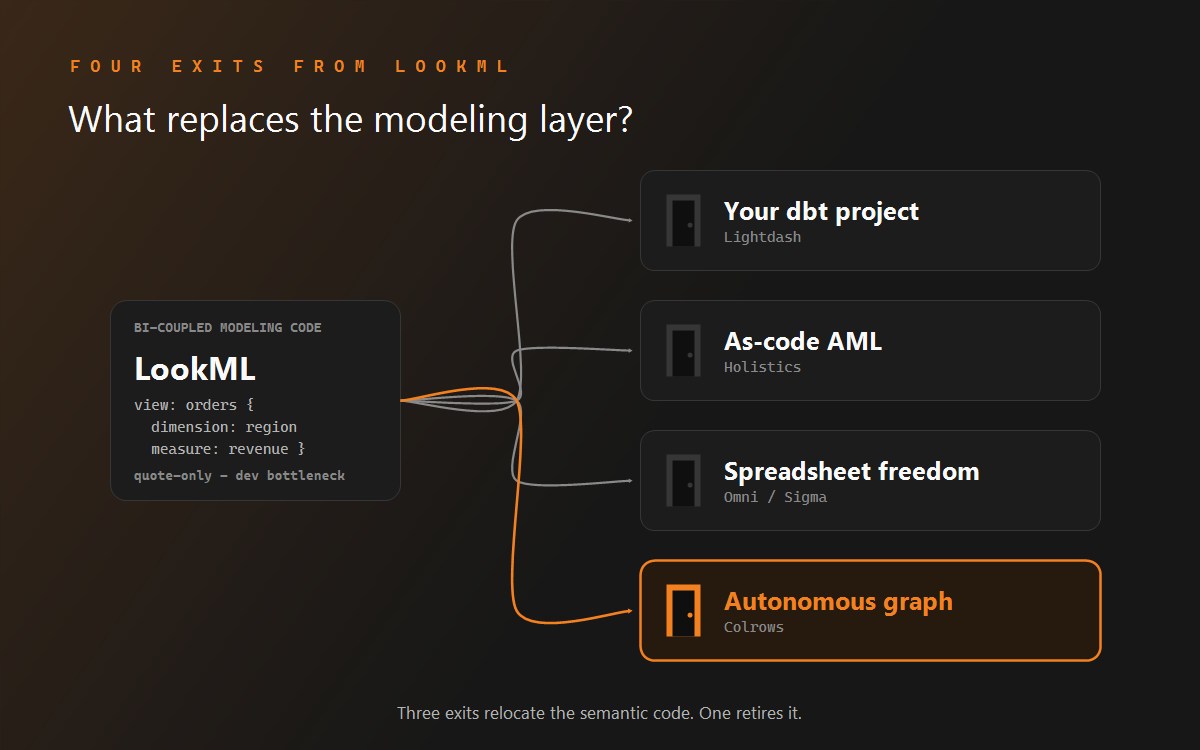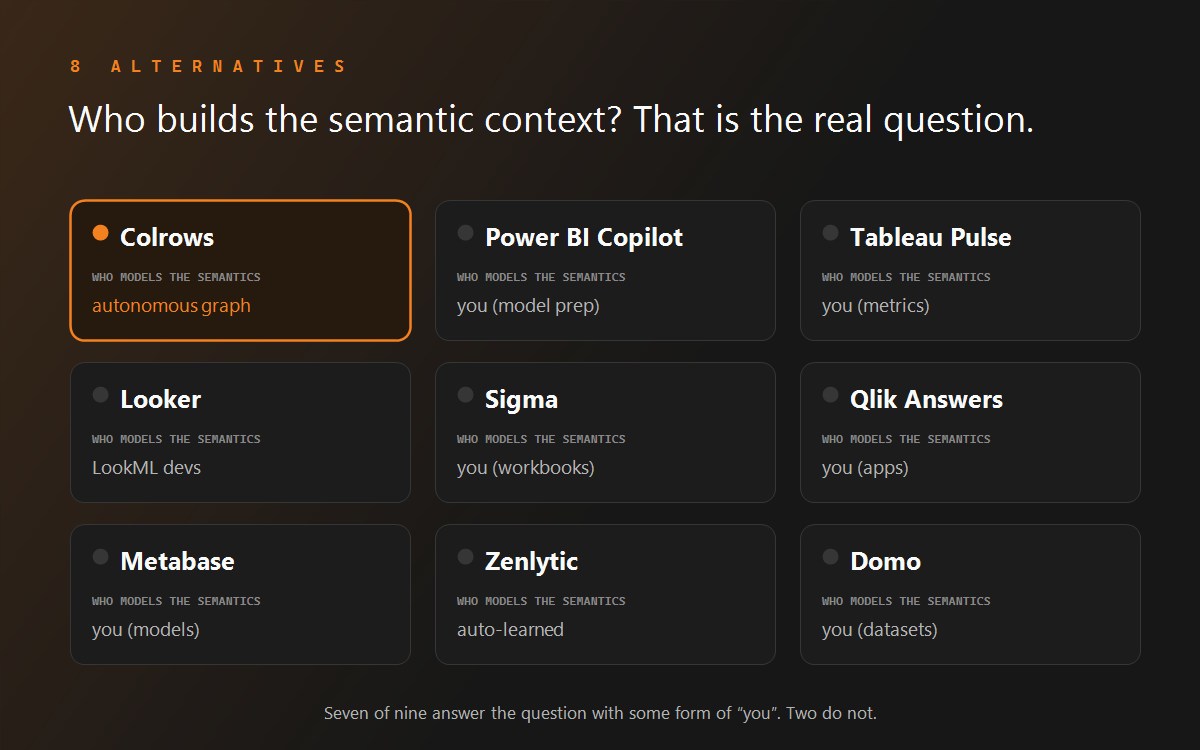
Short answer: The main Qlik Sense alternatives for teams putting AI agents into production are Snowflake Cortex Analyst, Databricks Genie, ThoughtSpot Spotter, Cube, the dbt Semantic Layer, WisdomAI and Colrows. Qlik remains strong for dashboards and embedded analytics, but its governance and logic live inside each app. Choose an alternative when agents need the same question to return the same governed answer across more than one warehouse, with compile-time access control and an audit trail.
Qlik's market position: strong in BI, not the agent layer
Qlik is a Gartner Magic Quadrant Leader in Analytics and Business Intelligence Platforms for the 15th consecutive year (Magic Quadrant published June 16, 2025) and a Leader for the 10th time in the 2025 Magic Quadrant for Data Integration Tools (published December 8, 2025). Per Qlik's official corporate boilerplate (2026): "The company serves more than 40,000 customers globally, including 75% of Fortune 500 organizations." Qlik is privately held; Thoma Bravo acquired it in 2016 and remains majority owner after a minority investment led by ADIA that closed in 2025 at a $10 billion valuation. This is not a declining vendor; it is a healthy BI incumbent whose center of gravity is dashboards, embedded analytics, and data integration.
Gartner's 2025 commentary credited Qlik with "renewed customer success," high customer satisfaction and retention, "associative model differentiation," and a cloud- and application-agnostic approach. Those are real strengths and should be stated plainly.
Why dashboard-first is a liability for agent-adopting teams
A dashboard is a pre-built answer to a question someone already anticipated. An AI agent's job is to answer questions nobody pre-built. When the agent's source of truth is a library of Qlik apps, three frictions appear:
- The app is the governance boundary. Section Access lives inside each app's load script and reduces data only after publish and reload. An autonomous agent that wants to compose a new cross-domain query cannot rely on a policy that was authored for one app and only takes effect after a manual reload-and-publish cycle.
- Logic is encoded per app, not as a shared, machine-reasonable graph. Qlik Answers prioritizes master measures and dimensions where they exist, which is good, but those definitions are scoped to the app. Colrows' thesis is that agents "require semantics that go far beyond metrics and dimensions: state, causality, constraints, event lifecycles, and organizational rules," modeled as a typed graph across the whole estate.
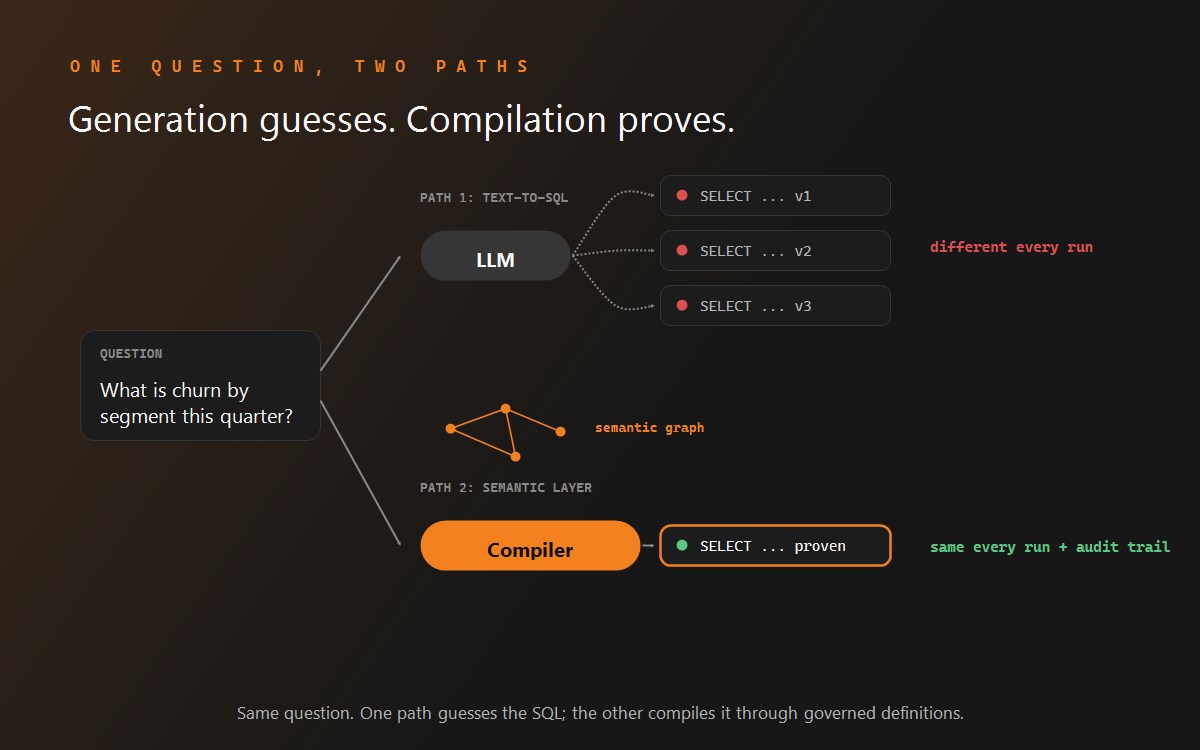
- Non-determinism in the interactive layer. Insight Advisor's documented behavior (English-first, no math on free-text questions, degraded NL responses past two filters or three measures) is acceptable for a human who can rephrase, but an agent needs the same question to compile to the same governed SQL every time.
Qlik made its agentic experience generally available on February 10, 2026, delivered through Qlik Answers as a unified conversational interface, alongside a Model Context Protocol (MCP) server that lets third-party assistants such as Anthropic Claude and ChatGPT query governed Qlik data. CEO Mike Capone framed the 2026 bar for enterprise AI as "auditable, governed, and able to act inside real workflows." This is genuine progress. But Qlik's own FAQ confirms Qlik Answers "works on top of existing Qlik Sense applications and uses the same data, logic, and security model" and that apps "should be prepared beforehand." The agent sits on top of the app; the app is still the unit of governance and logic.
The deterministic-compilation evidence
The strongest neutral evidence for compile-time semantics over text-to-SQL is the dbt Labs 2026 benchmark on the data.world ACME Insurance dataset (11 questions, each run 20 times). dbt's finding: because MetricFlow generates SQL deterministically, "the LLM can't produce an incorrect join or a bad aggregation," and critically "it can't produce correct-looking numbers that are subtly different across runs: the logic is codified and deterministic." Separately, per Sequeda, Allemang & Jacob, data.world (arXiv:2311.07509): GPT-4 zero-shot "over Enterprise SQL databases achieved 16.7% while ... over a Knowledge Graph representation of the enterprise SQL database achieved 54.2% accuracy" - across 43 insurance-domain questions. On the vendor side, per Snowflake's engineering blog, Cortex Analyst delivers "an extraordinary SQL accuracy of over 90%" and is "close to 2x more accurate than single-shot SQL generation using a state of the art LLM, like GPT-4o" (which scored 51% on the internal set). The common thread: the governed semantic layer, not the LLM, is what makes agent answers trustworthy. Read more on deterministic vs probabilistic text-to-SQL.
Colrows vs Qlik Sense, head to head
- Governance: Colrows compile-time (RBAC/ABAC/row/column injected before SQL emits; unauthorized intent fails compilation) vs Qlik runtime Section Access (data reduction after publish/reload, inside the app).
- Determinism and reproducibility: Colrows deterministic path with point-in-time-reproducible audit records vs Qlik interactive associative exploration (designed for human click-paths, not identical-query reproducibility).
- Multi-warehouse: Colrows emits dialect-perfect SQL for 16+ engines (Snowflake, Databricks, BigQuery, Redshift, Postgres, MySQL, ClickHouse, Trino and more) and reads from your warehouse without moving data; Qlik historically loads data into its in-memory associative engine, though Qlik Talend Cloud and Open Lakehouse (Apache Iceberg) broaden its data foundation.
- Semantic maintenance: Colrows autonomously builds and maintains the typed graph with drift, conflict, and schema-evolution detection; Qlik apps and data models are maintained manually (QVF/load-script edits, reload, republish).
- Architecture orientation: Colrows is agent-first (any agent over HTTP or JDBC passes intent, gets governed SQL or results); Qlik is dashboard-first with an agentic experience layered on top.
- Cost model: Colrows Free + metered compute + custom Enterprise vs Qlik capacity-based (Data for Analysis) or legacy per-seat.
Competitive positioning matrix
| Criterion | Qlik Sense | Colrows | Cortex Analyst | Genie | ThoughtSpot | Cube | dbt SL | WisdomAI |
|---|---|---|---|---|---|---|---|---|
| Primary orientation | Dashboard-first BI | Agent-first execution layer | Warehouse-native NL-to-SQL | Warehouse-native NL-to-SQL | Search-first agentic BI | Universal semantic layer | Code-first metric layer | Agentic AI Data Analyst |
| Governance timing | Runtime (in-app) | Compile-time (pre-SQL) | Query-time on Snowflake | Query-time via Unity Catalog | Model-time + runtime | Pre-SQL at semantic layer | Query compile in MetricFlow | Query-time, governed context |
| Determinism | Interactive, not reproducibility-designed | Deterministic + audit trail | Verified-query repository helps | Verified functions help | NL search, model-dependent | Deterministic via model | Deterministic SQL gen | LLM writes query only |
| Multi-warehouse | In-memory engine | 16+ engines | Snowflake-bound | Databricks-bound | Cloud-agnostic | All SQL sources | 4+ engines | Multi-source |
| Cost model | Capacity or per-seat | Free + custom Enterprise | Snowflake consumption | Databricks consumption | Per-seat/quote | Tiered/usage | dbt Cloud tiers | Enterprise quote |
Where Qlik genuinely wins, and Colrows does not compete: interactive dashboards and data visualization, mature embedded analytics, business-user self-service through a polished UI, narrative/reporting (NPrinting and the reporting service), a 40,000-customer base with deep partner ecosystem and brand trust, and a 15-year Gartner Leader track record. Colrows does not ship dashboards or a self-service BI front end; it is infrastructure beneath agents and applications. A team that primarily needs people to look at charts should not buy a semantic execution layer expecting a BI tool.
The competitor field for agentic teams
- Snowflake Cortex Analyst - warehouse-native, YAML semantic model, 90%+ accuracy claim; best for Snowflake-centric shops. See Cortex Analyst alternatives.
- Databricks Genie - Databricks-native NL-to-SQL grounded in Unity Catalog governance; only queries data in Databricks.
- ThoughtSpot Spotter - search-first agentic analytics, cloud-agnostic (Snowflake, Databricks, BigQuery, Redshift); accelerates building analytics rather than autonomously investigating.
- Cube (Cube D3 / Cube Core) - universal, MCP-native semantic layer used by Brex and Webflow; metrics defined once in code (YAML/JS), governance enforced before SQL emits.
- dbt Semantic Layer / MetricFlow - vendor-neutral, code-first, deterministic SQL generation; open-sourced under Apache 2.0 and the reference implementation for the Open Semantic Interchange.
- WisdomAI - agentic "AI Data Analyst" that uses the LLM only to write queries, not answers; $73M total funding, customers including Cisco, ConocoPhillips, Patreon.
The standards signal: Open Semantic Interchange
The industry is converging on a vendor-neutral semantic standard. The Open Semantic Interchange (OSI), led by Snowflake with Salesforce (Tableau), dbt Labs, BlackRock, and RelationalAI, launched September 23, 2025, with the specification going live on GitHub under Apache 2.0 on January 27, 2026. Qlik joined OSI on January 27, 2026. Salesforce/Tableau's Southard Jones called a common semantic framework "the Rosetta Stone for business data." The strategic read: every major vendor now agrees that shared, machine-readable business meaning, not dashboards, is the foundation for AI. That validates the semantic-execution-layer category Colrows occupies, and it means a Colrows graph that ingests dbt or OSI definitions is positioned with the standard, not against it.
When an agent returns inconsistent numbers for the same metric against Qlik, the fix is not a smarter model but a compile-time semantic layer that hands every agent the same governed answer with a reproducible audit trail. Fix the Context, Not the Model.
Staged buyer guidance
- Stay on Qlik (do nothing) when: your primary need is interactive dashboards, embedded analytics, and business-user self-service; your data already lives well in Qlik's associative engine; agent use is exploratory.
- Add Colrows alongside Qlik when: you are putting agents into production against governed data, you need the same question to return the same governed answer every time, you span more than one warehouse, or you need compile-time RBAC/ABAC with a reproducible audit trail. Threshold trigger: the first time an agent returns inconsistent numbers for the same metric, or the first compliance review that asks "prove this agent could never read unauthorized rows."
- Lead with Colrows (agent-first build) when: you adopted agents before standardizing BI, you have no large installed dashboard estate to protect, and you want the semantic layer to be the foundation rather than a feature.
Benchmarks that would change the recommendation: if Qlik ships compile-time, app-independent governance with a reproducible audit trail and a published agent-query accuracy benchmark, the architectural gap narrows and the "stay on Qlik for agents too" case strengthens. Track the Q2 2026 Predict Agent rollout and any GA of the Automate/Analytics/Data Product agents.
Frequently asked questions
When did Qlik's agentic experience launch?
February 10, 2026, via Qlik Answers, with an MCP server for Claude and ChatGPT. Qlik joined the Snowflake-led Open Semantic Interchange on January 27, 2026.
What languages does Qlik Insight Advisor support?
On Windows, English only - unless a Qlik Cloud tenant is added (then English, French, Russian, Spanish). Per Qlik's November 2025 docs, NL responses are not available for questions with multiple dimensions or three or more measures.
When does Qlik Section Access apply?
At runtime, inside a published app. Section Access requires uppercase field matching and the app must be published and reloaded before changes take effect. It is data reduction tied to a specific app, not compile-time governance.
Is Qlik a Gartner Leader?
Yes - 15 consecutive years in Analytics and BI (Magic Quadrant published June 16, 2025) and 10 consecutive years in Data Integration Tools.
Caveats
Vendor self-claims are labeled as such. Snowflake's 90%+ Cortex accuracy, WisdomAI's hallucination-avoidance, and Colrows' determinism claims are vendor statements; the dbt and data.world benchmarks are the most independent evidence and still come from interested parties. Compliance language is deliberate: Colrows provides controls that can assist with governance and auditability; no tool "ensures compliance." Qlik is actively closing the agent gap (MCP server, OSI membership, Open Lakehouse, agent roadmap). Independent analysis flags some 2026 agents as still maturing; treat roadmap items as roadmap, not shipped capability.